An 8K player is a video source device that decodes 7680×4320 and carries HDMI 2.1. It sits upstream of the AV receiver, in living rooms where the library is mostly disc rips and a NAS. A ceiling-mounted 5.1 wireless cinema starts at the entry tier, which is the full CW90 package.
Whether a 4K TV needs one comes down to three things: how many 8K sources you own, which HDMI generation the TV has, and whether the AV receiver accepts a bitstream. Miss one of the three and the extra money buys a single line on a specification sheet.
Key points
- 8K is 7680×4320, about 33.18 million pixels, four times 4K. Uncompressed 8K60 runs around 30Gbps, and HDMI 2.0's 18Gbps is only enough for 8K30.
- On a 4K TV the job of an 8K player is supersampling and decoding headroom. It does not turn the TV into an 8K display.
- The player's real work is bitstream passthrough. Decode to PCM first and the player decides how the height channels get mapped.
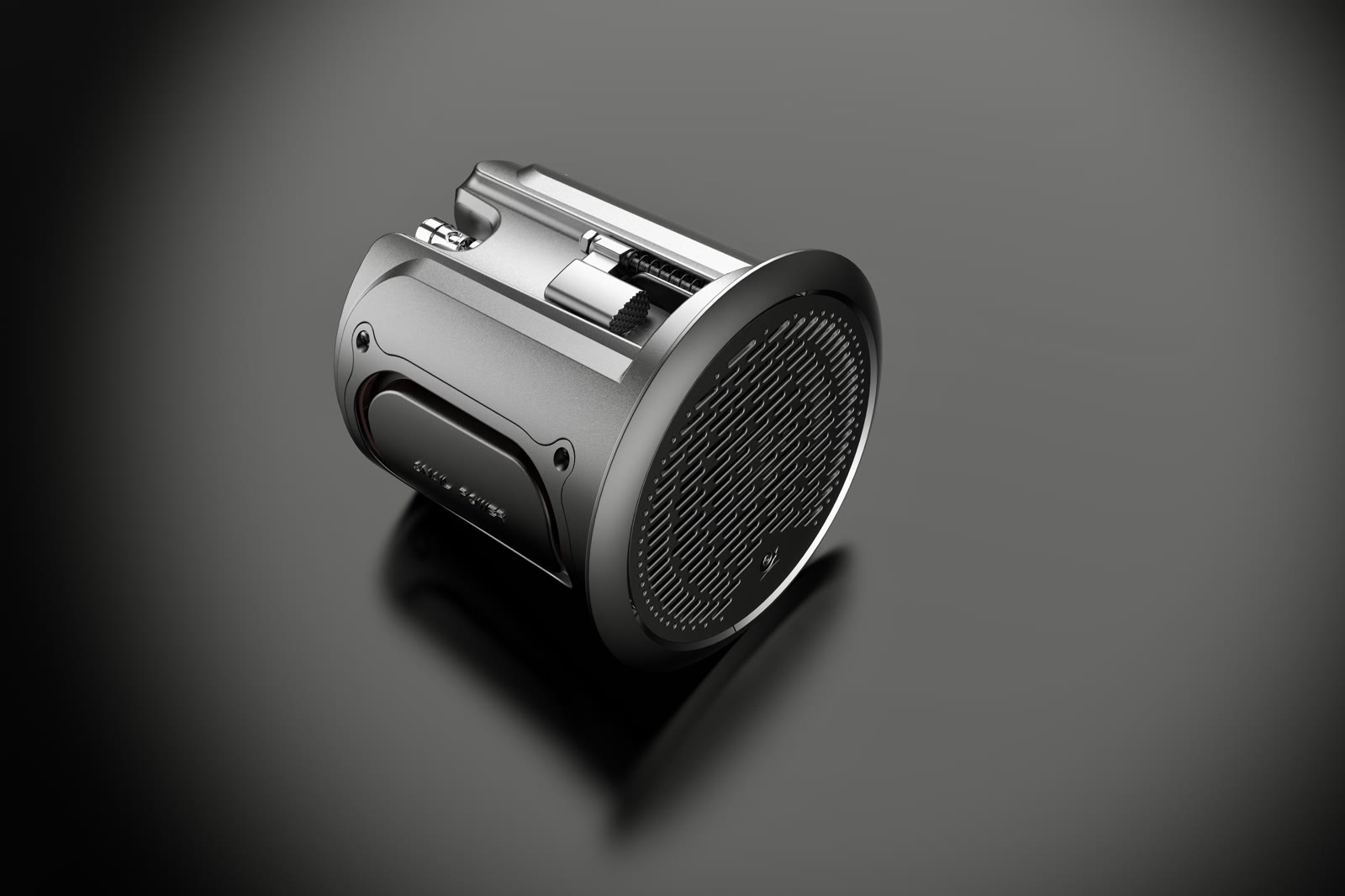
- The last link in the chain is still a Ø90mm hole in the ceiling: the CW90 is 90W per unit, 111dB, a 2.75-inch full-range driver plus a passive radiator, with the low end handed to the W10 subwoofer.
- If the source, the display or the AV receiver falls behind, the 8K premium never comes back.
1. Decode, Scale, Send: What an 8K Player Actually Does
Decode is codec support and the bitrate ceiling. 4K discs are mostly H.265, AV1 titles are becoming more common, and the machine has to accept disc formats such as BDMV folders and ISO images. Ask plainly whether Dolby Vision is single-layer or dual-layer.
Scale is supersampling. 7680×4320 down to 3840×2160 is 2×2 downsampling: four pixels averaged into one, so noise and jaggies get averaged out and edges come out cleaner. That is a real gain on a 4K TV, on one condition — the material itself has to be 8K.
Send is output. Picture over HDMI, sound as bitstream passthrough, with the Atmos and DTS:X streams handed to the AV receiver untouched. Once a player decodes to PCM first, the height-channel position information is fixed at that link.
Beyond that is the source path: gigabit Ethernet for a NAS, USB 3.0 for a hard drive. In the SNAIL POWER ecosystem, Yingniuniu, 4K Blu-ray, the Yinchuang song library and QQ Music run down one chain, and Mijia / Xiao Ai plus TCP/IP or serial control connect too.
The trade-off: decode and send are software and interface work with little to do with 8K. A 4K player that does both of them solidly is enough for most living rooms. What the extra 8K budget buys is headroom you will not have to replace later.
2. A 4K TV on an 8K Player: What You Get and What You Do Not
The table below is the 8K-versus-4K arithmetic, taken throughout at 60Hz, 4:2:0 and 10-bit.
| Item | 4K 3840×2160 | 8K 7680×4320 |
|---|---|---|
| Pixel count | About 8.29 million | About 33.18 million |
| Uncompressed bitrate | About 7.5Gbps | About 30Gbps |
| Carried by HDMI 2.0 (18Gbps) | 4K60 yes | 8K30 only |
| Carried by HDMI 2.1 (48Gbps) | 4K120 yes | 8K60 yes |
| Sources today | Mostly streaming and Blu-ray | Demo clips and a few on-demand titles |
Read the first three rows together: pixels go up four times and the uncompressed bitrate follows to around 30Gbps. HDMI 2.0's 18Gbps will not fit 8K60 and drops back to 8K30; for 8K60, both TV and player have to be on HDMI 2.1 at 48Gbps.
A 4K TV on an 8K player therefore lands on one of two paths: 8K30 output, or the player downscales internally and feeds 4K60. The second is the more common, and what you are looking at when it happens is the supersampling.
Three things you do get: cleaner edges after downsampling, decoding headroom so high-bitrate titles do not stutter, and a fuller set of interfaces and HDR formats. Three you do not get: resolution, panel brightness and colour gamut, and the number of titles available. The player changes none of them.
The trade-off: 8K material is not widely available here, and everyday viewing is still mostly 4K compressed streams. Without 8K material the supersampling gain has nothing to work on; the money pays for interfaces and decoding headroom, not for a picture-quality tier.
3. The Player Cannot Decide the Sound, but It Decides Whether the Sound Survives
The chain in a home cinema is fixed: player, HDMI, AV receiver, then five cabinets and one subwoofer in the ceiling. The player has exactly one task — do not lose what is already there.
With bitstream passthrough the receiver decodes the Atmos and DTS:X metadata; without it the sound is folded down to PCM and the height-channel information is fixed at the player. So "does it output bitstream" is the question to ask before "does it support 8K". At the receiver end, Dolby Atmos and DTS:X certification in progress; until the approval letter arrives, do not make the certification a reason to buy.
Further down is the end of the chain. The CW90 is a 2.75-inch full-range driver with a passive radiator: Ø90mm cut-out, Ø105mm faceplate, 100mm body height, 90W per unit and a maximum SPL of 111dB. A 2.75-inch full-range driver will not reach very low, so the low end goes to that W10 subwoofer — which is what lets the full-range unit stay thin enough to hide in a 100mm ceiling.
Changing the player does not change the cut-out. Those five Ø90mm holes in the ceiling were fixed at the renovation stage.
The trade-off: a player cannot close a gap in cut-out size or make up for a missing subwoofer. The reverse holds too: if the bitstream output is incomplete, the money spent further down is wasted just the same. Tuning the low end by swapping the player is fixing the wrong link.

4. Walls Already Closed: Wireless Saves Cable, Not Holes
The CW90 line runs on a dedicated 5.8G channel. The MS-1 sends the signal to the five ceiling cabinets and the W10 subwoofer with no cabling in between. Renovation progress no longer decides whether a cinema can happen: a newlywed flat where nobody wants chases cut into the walls, an old flat where nobody wants to break ground — either can be done this way.
Concealed cinema speakers land in the ceiling. Once the cabinets are in, all that remains visible is a Ø105mm faceplate, and the living room does not look like it has five speakers in it. What most people want is not really "a cinema"; it is "no one can tell there is a cinema". This is physical separation too: not making the cabinet smaller, but moving it out of the room's own layer.
Cinema and karaoke share those five ceiling cabinets and the one subwoofer, so the living room does not need a second KTV set, and there is one less box on the console.
The trade-off: wireless saves the cable, not the holes. The five cabinets still need Ø90mm cut-outs and the ceiling void 100mm of clear depth, and the air-conditioning outlets, downlights and access panels all have to move aside first. Wireless also hands the choice of amplifier back to the factory: you cannot swap in a different receiver to drive it. If you are worried about the flat below, physics will not make it completely silent down there; if the neighbour is sensitive, a floating floor does more good than changing the player or the speakers.
5. Where the Money Goes First: One Price List Beats Ten Pages of Specs
Everything sold as 5.1 runs across a wide band as a living room package, and the difference lands mainly on the subwoofer and the AV receiver, not on those five cabinets. The same judgment holds for a player: the difference is in decoding and interfaces, not in the two words "8K capable".
The order to spend in is this: ceiling and cut-outs, then subwoofer, then AV receiver, then player. The player comes last: it is the one item that can be added afterwards, and cut-outs and cabling cannot. The three things to settle at the design stage are all in the walls and the ceiling: cut-out positions, 100mm of ceiling void, and power and network cabling in the cabinet.
Package prices for a ceiling-mounted 5.1 system, delivered, from the official price list of November 2026:
| Tier | Configuration | Price |
|---|---|---|
| CW90 5.1 wireless cinema and karaoke | CW90×5 + W10 subwoofer + MS-1 | Price on request |
| U3 5.1 cinema and karaoke | U3×5 + B28 subwoofer + AV-700III + MU-1 | Price on request |
| Mini 5.1 cinema and karaoke | Mini×5 + B28 subwoofer + AV-700III + MU-1 | Price on request |
| IW3max 5.1 cinema and karaoke | IW3max×5 + B28 subwoofer + AV-700III + MU-1 | Price on request |
Two cut-out figures in that table need keeping apart: the CW90 is Ø90mm, while the Mini and the IW series differ by model. A 1mm difference means nothing to the sound; to a hole saw it means two different tools.
The trade-off: those are delivered package prices, excluding making good after the cut-outs, acoustic treatment and electrical work. Move the player's budget onto the subwoofer and it is audible in a 20 to 25 m² living room; move it onto the player and, unless both the sources and the display keep up, it can neither be heard nor seen.
6. Who Should Not Buy an 8K Player, and One Sentence of Judgment
Who should not buy: a TV whose HDMI ports are still 2.0, with viewing limited to streaming subscriptions; a projector that stops at 1080p, or a 4K projector fed entirely by compressed streams; a budget that stops at the entry package while the subwoofer position and the ceiling cut-outs are still undecided. For these three, an 8K player now buys no difference on screen.
Nor should a player be expected to fix the room: the peaks and dips in the low end are calculated from the dimensions of the room and answered with subwoofer position, crossover point and placement. The player has no say.
The trade-off: an 8K player occupies one shelf in the cabinet, one power socket and one line of budget, and the headroom it buys is invisible in the short term. While the room has no low-frequency treatment and the ceiling is not settled, that money goes further on the subwoofer and the install.
In one sentence: the value of an 8K player is not in the two numbers, it is in three hard jobs — interfaces, decoding and bitstream passthrough. With a 4K TV it only holds when the source, the display and the receiver all keep up; miss one and the money went on a specification.
Exit condition: the TV is HDMI 2.0 only, the library is mostly streaming, the cabinet has no network run — any one of the three, and a player that does 4K and bitstream properly is enough; none of the three, and only then is it worth talking about 8K headroom.
Related articles
- Cinema and Karaoke From One System: Where the Boundary Actually Sits
- Why 40Hz Picks Your Sofa: Standing Waves in a 4.3m Living Room
- 5.1.2 in a Living Room: What the Overhead Pair Actually Buys
END
#8KPlayer #4KTV #HDMI21 #HomeCinemaAudio #LivingRoomCinema #ConcealedCinemaSpeakers #CW90
Written by Digital Xiaoniu, first published on the SNAIL POWER official site, Other.