Low-frequency standing waves are the fixed pressure pattern that builds up in a rectangular room when sound at one frequency reflects back and forth between two parallel walls: in a living room 4.3 metres deep the first axial mode lands at 39.9Hz, and the 40Hz bass stacks up over the sofa. Once the dimensions are fixed it is there — the price tier of the speakers has little to do with it, and the CW90 (SNAIL POWER's 5.1 wireless cinema, quoted on request) does not cure it either.
Key points
- In a living room 4.3 metres deep, 40Hz meets the first axial mode, and a sofa against the rear wall sits on the peak.
- At 40Hz, moving the sofa 1.1 metres buys about 3dB; 10 centimetres buys 0.2dB.
- PEQ only cuts, never boosts: the peak comes down, the decay of the mode does not.
- A small in-ceiling cabinet that cannot reach 40Hz is a division of labour, not a defect: everything below 80Hz belongs to the subwoofer.
- If the downstairs neighbour is sensitive, a floating floor is more practical than changing the speakers.
1. How 40Hz Picks Out Your Sofa
Treat the living room as a rigid box: sound reflects back and forth between two parallel walls, and when the wall spacing equals half a wavelength the reflected wave adds in phase with the original, forming a fixed pressure distribution — peaks at the walls and in the corners, a null near the centre line. The arithmetic is 343 ÷ (2 × wall distance).
Put 4.3 metres in and it reads 343 ÷ 8.6 = 39.9Hz. As long as the distance from the sofa to the TV wall is around 4.3 metres, the 40Hz band belongs to the room, not to the speakers. Further up sit 79.8Hz and 119.6Hz, and both land on the same frequency response curve.
The wavelength of 40Hz is 8.58 metres, longer than any side of most living rooms, so no position escapes it; the only choice is a peak or a null. Set the sofa 0.3 metres from the rear wall and it sits on the peak — that is where most "boomy bass" in ordinary flats comes from, and it is not the size of the subwoofer.
The trade-off: this all rests on the dimensions being measured accurately. Measure the clear distance, finished surface to finished surface; for a stepped ceiling take the finished ceiling surface, not the underside of the structural slab. Being 20 centimetres out moves the modal frequency off target. It is the step that usually gets skipped, because it produces nothing you can see.
2. Do the Arithmetic First: a 4.3 × 5.2 × 2.8 Living Room
Take a common two-bedroom living room: 4.3 metres deep, 5.2 metres wide, 2.8 metres clear height — three axial modes in each of the three directions.
| Item | Value (with unit) |
|---|---|
| Depth, first / second / third mode | 39.9/79.8/119.6 Hz |
| Width, first / second / third mode | 33.0/66.0/99.0 Hz |
| Clear height, first / second / third mode | 61.3/122.5/183.8 Hz |
| Room volume | 62.6 m³ |
| Upper limit of the modal region (RT60 assumed at 0.5 s) | about 179 Hz |
39.9Hz (depth) and 33.0Hz (width) are 6.9Hz apart and do not collide; 61.3Hz (height) and 66.0Hz are only 4.7Hz apart, close enough that the band tends to stack into a sharper peak.
With 62.6 cubic metres and RT60 assumed at 0.5 seconds, the empirical formula puts the upper limit of the modal region at about 179Hz. Below 179Hz this model means something; above it the modes are dense enough to merge into a statistical field.
The trade-off: the numbers come from a rigid-wall model. A real room has door gaps, curtains and low-frequency leakage, and the measured peak is often 3 to 6dB lower than the model. The table sets a direction; it is not something to sign off at ±1dB.
3. Moving the Sofa: 1.1 m Buys 3dB
The pressure of the first mode follows a cosine along the depth of the room: the theoretical null is on the centre line (2.15 metres from the TV wall here), the peaks are on the two walls. Convert the sofa position into a cosine value, then into decibels.
| Sofa distance from the rear wall | 40Hz relative to the wall peak | What it costs at the same time |
|---|---|---|
| 0.3 m | −0.2 dB | Against the wall, essentially on the peak |
| 0.7 m | −1.2 dB | A 0.7-metre walkway, barely passable |
| 1.1 m | −3.2 dB | 0.8 m less clear depth in the living room |
| 1.5 m | −6.7 dB | Sofa floating in the middle, circulation hard to plan |
This explains something counter-intuitive: at 40Hz, moving the sofa 10 centimetres is worth 0.2dB, and 1.1 metres is worth 3.2dB. The wavelength is too long to care about a short displacement — at 200Hz you would hear 10 centimetres; at 40Hz you will not.
So would a bigger subwoofer help? A bigger subwoofer in the same position only pushes 40Hz higher and makes the peak sharper. The peak is gain given by the room, not by the equipment.
The trade-off: move the sofa forward 1.1 metres and the living room loses 1.1 metres of clear depth; most people will not hand over a walkway for 3dB.
4. PEQ Cuts the Peak; It Cannot Cut the Tail
PEQ is the parametric equaliser built into an AV receiver or a DSP. It has four disciplines on a standing wave, and breaking any one leaves the result worse than before.
Cut only, never boost. A null is a pressure node with no energy there to begin with. Boosting only spends amplifier headroom for nothing, and a different seat moves the null anyway. Every gain should be negative.
Q can only come from bandwidth. Q = centre frequency ÷ −3dB bandwidth. Cut 40Hz by 6dB with a bandwidth of about 5.7Hz and Q comes out around 7. Pick Q=15 because it "sounds narrow" and the notch is narrower than the peak you meant to remove.
Cap the number of bands. One subwoofer, five bands at most, adjacent peaks merged into one. Too many bands and the filters interfere with each other, and not one of them is accurate. Report the headroom: Σ|G| is what you have to give back — a 6dB cut takes the whole low-frequency gain down 6dB.
The trade-off: what PEQ cuts is the peak, not the decay time of the mode. Flatten the peak and the drum hit still rings as long as it did — the boom is pushed down, the mud is still there. The curve also only holds at the microphone position; move one seat along the sofa and the peak comes back a little.
5. What Each of the Four Fixes Costs
Every method you can act on has to be priced.
| Method | What it improves | What it costs |
|---|---|---|
| Sofa forward 1.1 m | about −3 dB at 40Hz | 1.1 m less clear depth in the living room |
| Two subwoofers + phase calibration | takes down the peak of the first axial mode | two subwoofer positions, two signal runs, one more calibration |
| PEQ peak cut (≤5 bands) | peak comes down; the nulls do not move | eats headroom, decay unchanged |
| Floating floor + acoustic construction | the part of the low end the downstairs neighbour hears | large works, high cost |
What was not done at the renovation stage usually costs double later: pre-wiring one power run is a small cost; adding it after the ceiling is closed means cutting out a sheet of plasterboard. The concealed cinema speaker line solves "you cannot see that a cinema was installed" — it does not flatten the 40Hz peak. Keep the two apart and the budget lines up.
The trade-off: there is nothing cheap in that table. Two subwoofers and a floating floor both start at four figures, and PEQ, which looks free, is bought with headroom plus a measurement session.
6. On the Equipment Side, Only the Division of Labor
Standing waves are the room's business; no speaker cancels them. Change the whole living-room cinema set and the 40Hz peak stays where it was. What the equipment side can do is split the bands so each driver does only the job it is good at.
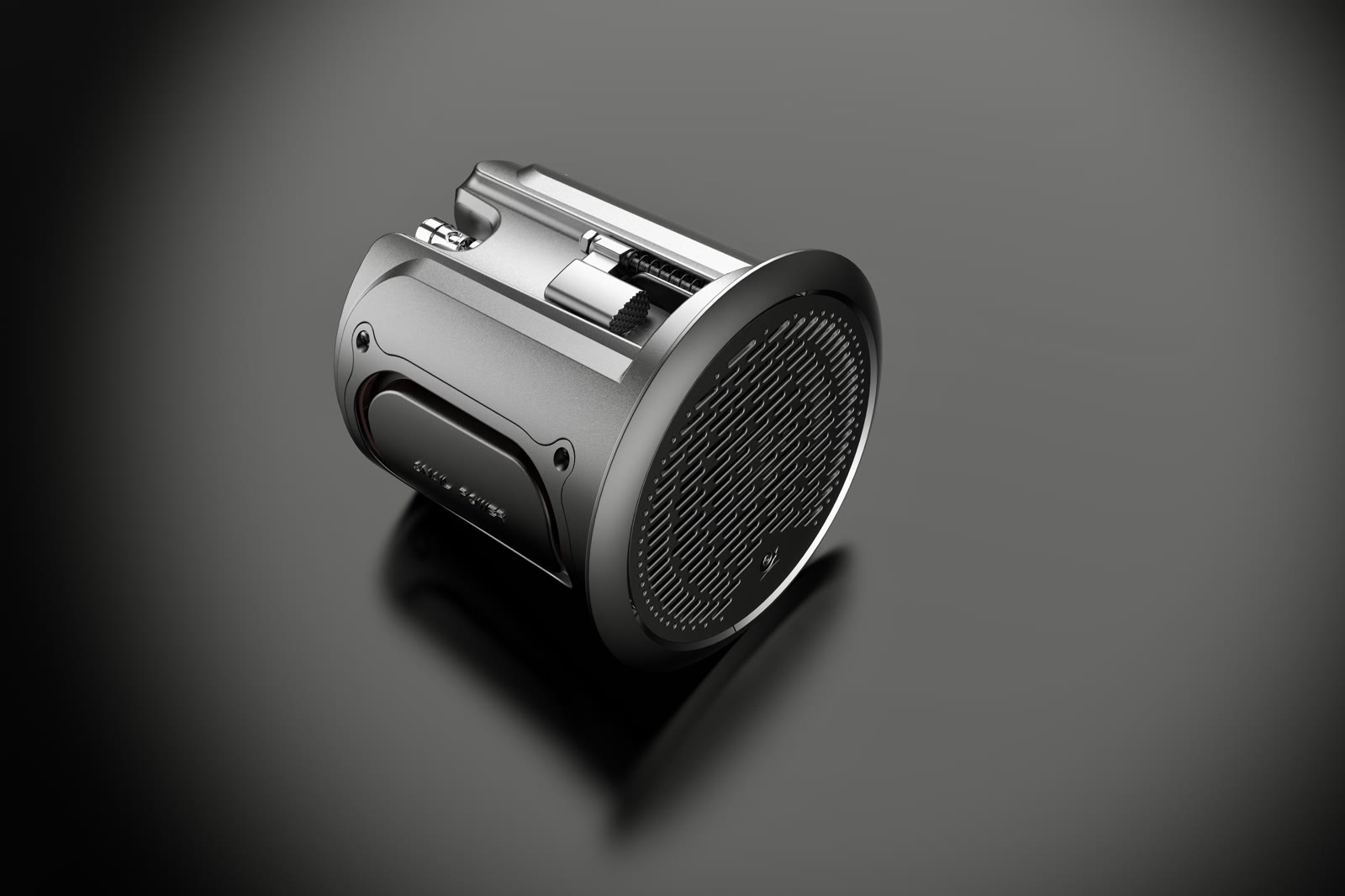
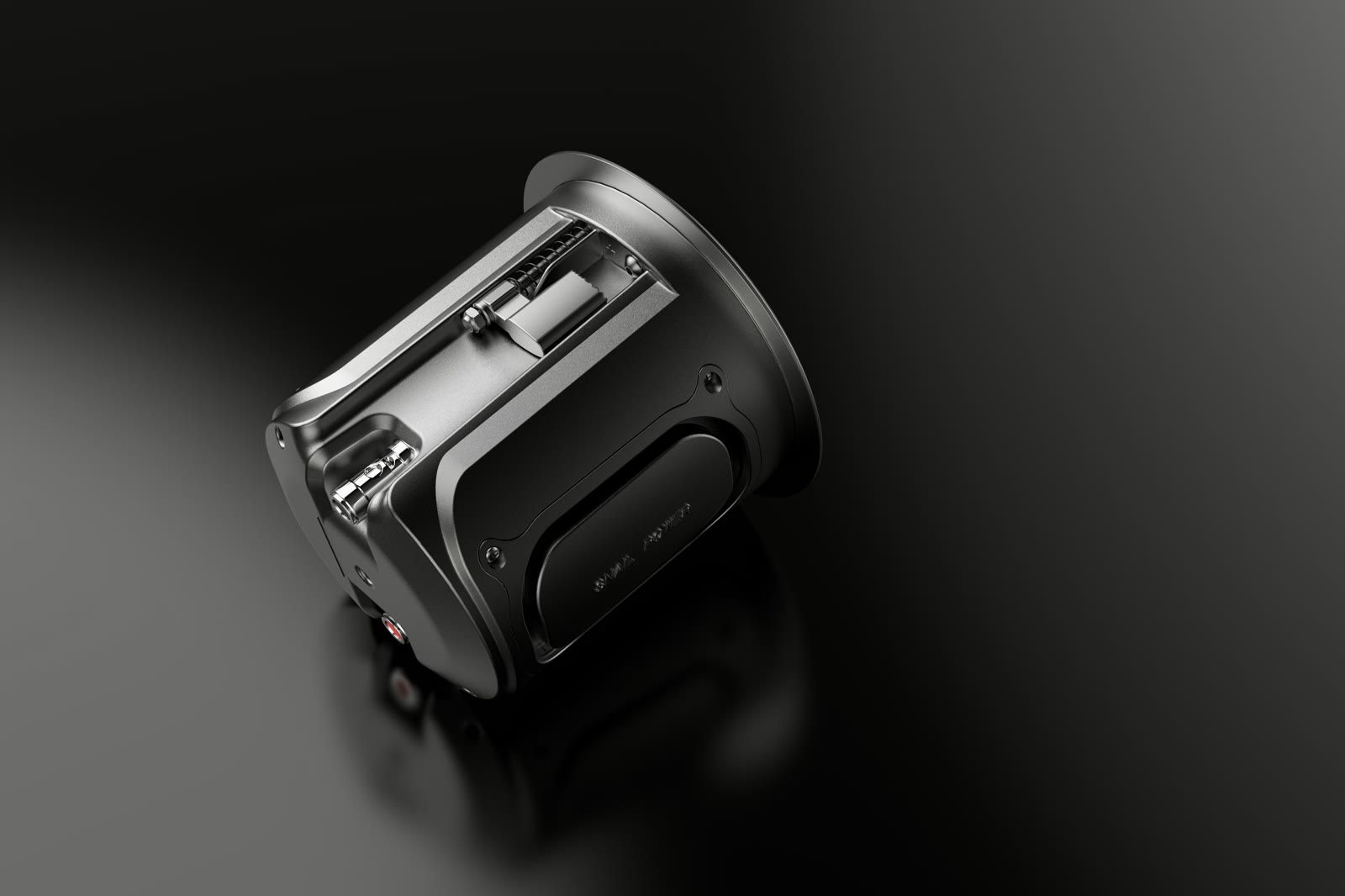
The CW90 is a 2.75-inch full-range driver plus a passive radiator in an in-ceiling cabinet. The lower limit of a 2.75-inch full-range does not reach 40Hz — a physical fact of diameter, not a design defect. Everything below 80Hz goes to the W10 subwoofer. Ø90mm cut-out, Ø105mm faceplate, 100mm height, 90W per unit, 111dB maximum SPL — 111dB through a 90-millimetre hole is why this line can carry a 5.1 wireless cinema in a living room of twenty-odd square metres.
Transmission runs on a dedicated 5.8G channel: it does not take the band your home Wi-Fi uses, and needs no chasing into the wall. In home theater wiring, the two runs behind the sofa are much harder to add later than the two to the main speakers, and wireless rear surrounds step around that.
Its role in home theater design is to hide: a 90-millimetre cut-out, about a medium downlight, and once the ceiling is done you basically cannot see it. Dolby Atmos and DTS:X certification in progress. The complete 5.1 wireless cinema (CW90×5 + W10 subwoofer + MS-1) is quoted on request at the entry tier.
The trade-off: wireless saves the cable, not the power. Power has to be left at the ceiling positions; if it was not left at first fix, adding one run later costs far more than pre-wiring. In a room close to square (4.2 metres a side, say) the first mode in both directions lands at 40.8Hz, stacked into one peak, and any PEQ move cuts both axes at once. And one thing has to be said plainly: there is no physical way to make the flat below completely unable to hear it; if they are especially sensitive, do the floating floor first — it is more effective than changing speakers.
Who should not buy it: people who only want "more bass" — the value here is being hidden and the division of labour, not 40Hz gain; people who will not measure the room or run a measurement — standing waves are a position problem, and with nothing measured after installation you will never know where the money went; people with a sensitive downstairs neighbour who cannot do soundproofing — fix the structure first, the speakers come after.
In one sentence: the room decides 40Hz first; the equipment only handles what lies outside it. If the depth is around 4.3 metres, the sofa can only sit against the rear wall, and no renovation is planned, accept the peak and put the budget into division of labour and adjustability — do not expect a more expensive set of cabinets to flatten it.
Related articles
- 5.1.2 in a Living Room: What the Overhead Pair Actually Buys
- From a Downlight: How SNAIL POWER Is Reshaping the Living-Room Cinema
- Why a 5.1 Subwoofer Has to Be Powered
END
#RoomModes #StandingWaves #HomeTheaterDesign #SubwooferPlacement #PEQ #CW90 #SnailPower #LivingRoomCinema
Written by Digital Xiaoniu, first published on the SNAIL POWER official site, Other.