Home / News / Product News / Sharing Speakers Between Cinema and Background Music: What It Costs
Sharing Speakers Between Cinema and Background Music: What It Costs
2026-11-19 12:05 · Product News
One set of speakers for both background music and cinema is doable, but you pay for it: the CW90 5.1 wireless cinema takes a Ø90mm cut-out, runs 90W per unit and lists at ¥17,200 (from ¥17,000); it can carry living room viewing and whole-house background music at once, provided zones and channels are separate.
Key points
- Background music wants hours of low-level, even coverage across several zones. A cinema wants short bursts of sound pressure and firm imaging. The two ask different things of one cabinet.
- Three ways to share: one zone shared, two zones independent, or a separate background music host alongside the cinema. Experience improves in that order, and so does the price.
- CW90: Ø90mm cut-out, Ø105mm faceplate, 100mm height. A small hole is what lets it hide; a 2.75-inch full-range driver has a limited low-frequency floor, so the low band goes to the W10 subwoofer.
- 90W per unit and 111dB are headroom reserved for cinema transients. Background music never uses it, and idle headroom does not make the sound worse.
- The 5.8G dedicated channel solves "no cable after the renovation". It does not solve walls; measure the link distance on the drawings.
1. Two Jobs First: Background Music and Cinema Do Not Want the Same Sound
Background music runs while you cook, clean or talk — two or three hours at a stretch, usually around 60dB, nobody in a fixed seat, every corner of the house at roughly the same level. A cinema is the reverse. Most of a feature film sits at moderate volume too, but the explosion and the impact have to hold up for those few seconds, the listener is fixed on the sofa, and a bullet has to be audible crossing left to right.
The conflict shows up twice. On headroom, background music does not need it and a cinema cannot do without it. On coverage, one wants evenness, the other wants directivity. On zoning, background music often wants the kitchen and the study on their own runs, while a cinema is a single zone.
Only a system whose zones and channels can both be separated can do the two jobs at once.
The trade-off: it lands on floor area. Below 20 m² the 5.1 set already wraps the sofa, and splitting off a kitchen zone and a balcony zone means every cabinet works at a level it is not good at. In home cinema design, zoning is arithmetic — how many independent channels can be lent to background music — not how many more cabinets to buy.
2. Three Ways to Share, Three Different Costs
Three ways to share one set of cabinets, and the difference is not in the cabinets. It is in the amplifier and the zoning.
| Way to share | How it is wired | Zones covered | Cost |
|---|---|---|---|
| A. One shared zone | The cinema amplifier's Zone 2 output drives two in-ceiling cabinets in the living room | 1 zone, cinema or music | No sound in the kitchen during a film; the film stops while you cook |
| B. Two independent zones | The five 5.1 cabinets run off the cinema amplifier; background music gets its own amplifier | 2 zones, playing together | One more amplifier and one more cable run; the rack needs a slot and cooling |
| C. Separate host | The cinema is left alone; a background music host drives 2-4 small cabinets | 2-4 zones, no interference | Budget counted separately; more holes in the ceiling |
My advice is B or C. A is not impossible, but the gap shows within a month — the kitchen goes silent when the film starts, the film gets paused when you cook. The point of sharing one set is that neither side compromises; A is compromising from day one.
The trade-off: B needs one more amplifier and one rack position. Most homes have no room for that under the TV cabinet, so the power socket and the cooling have to be allowed for at the wiring stage. C needs more holes, and for a rental, or a move within three to five years, it is not worth considering.
3. A Ø90mm Cut-Out: A Small Hole Hides, and the Low Band Goes to the Sub
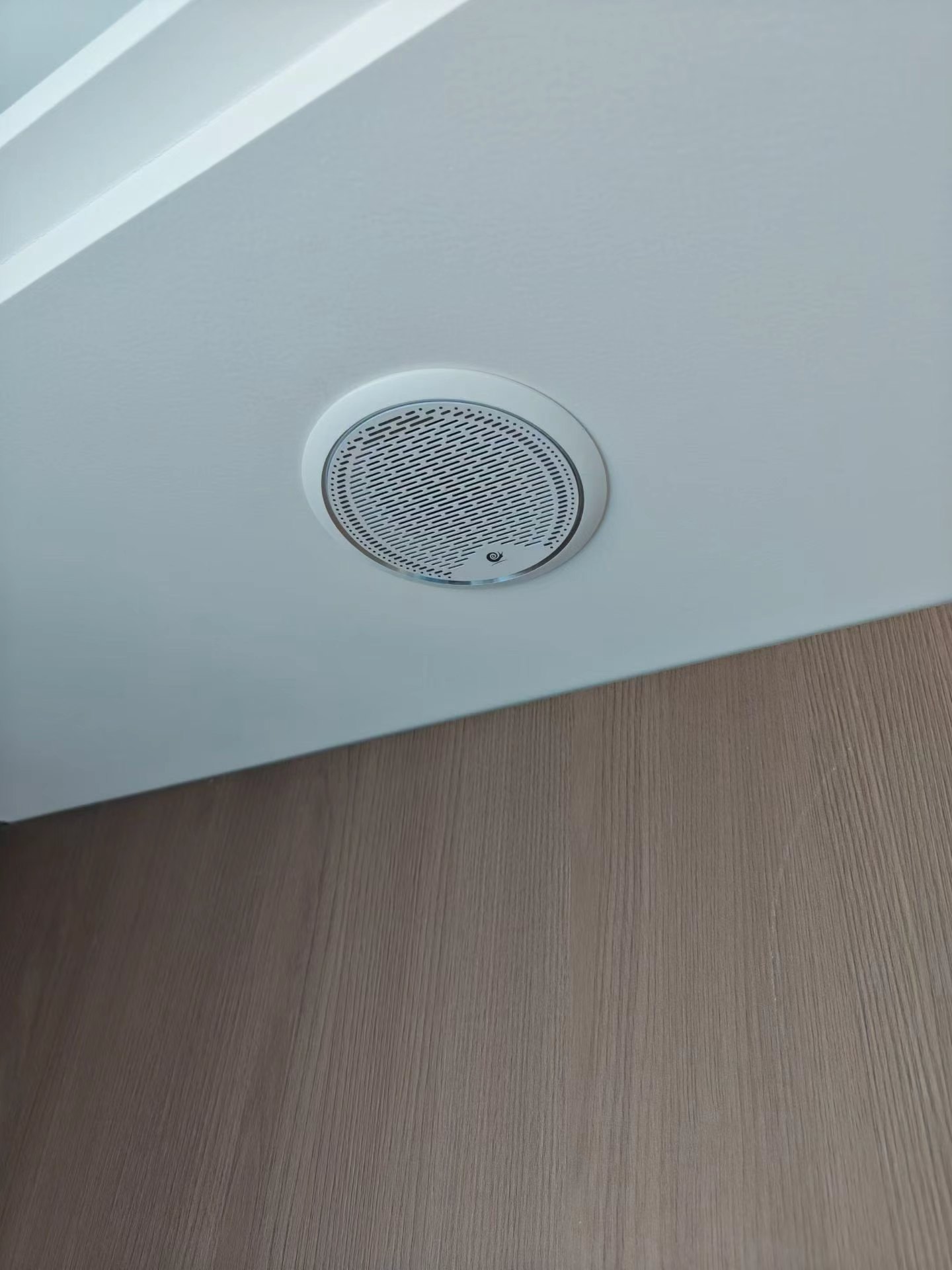
The premise for sharing one set is that it does not fight for the sightline in the living room — otherwise the moment background music starts, the eye is caught by five discs in the ceiling. The CW90 takes a Ø90mm cut-out behind a Ø105mm faceplate, with a 100mm cabinet height. In a suspended ceiling that is one layer of plasterboard plus a few centimetres of joist space, so a downlight position can be reworked to take it. The Mini and the IW series in the same family each take their own cut-out, 1mm apart; do not mark them interchangeably on the construction drawings.
The threshold for concealed cinema speakers was never how loud they play; it is how small the hole is. Once five cabinets are in the ceiling, placement for living room cinema speakers can be discussed at all — a cabinet first has to land in the right position.
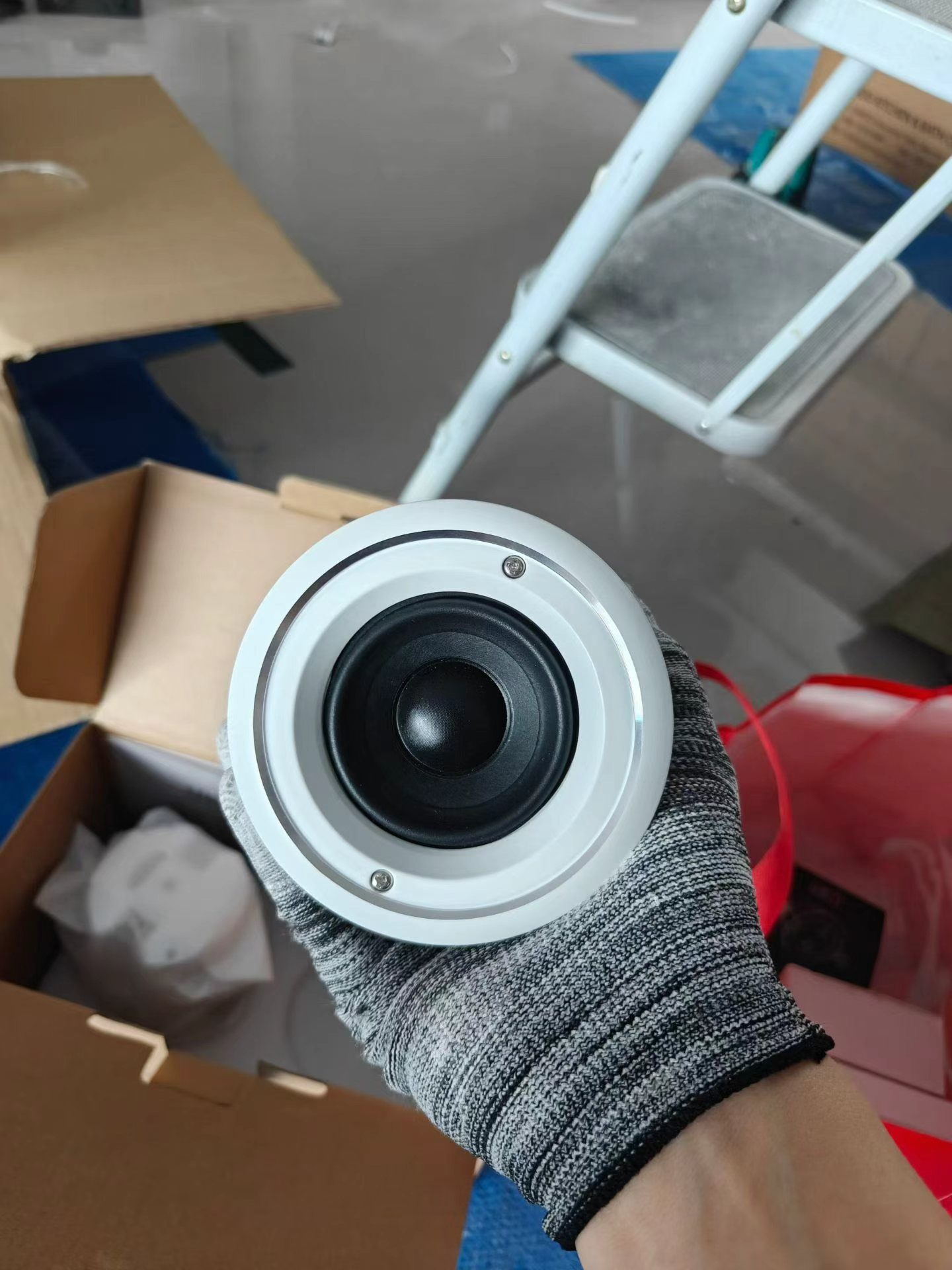
The cost of the small hole lands on the driver. One 2.75-inch full-range driver plus one passive radiator; full-range drops the crossover and the midrange joins cleanly, but the diaphragm area is what it is, and the low-frequency floor cannot go very low. That is not tuning, it is physics. So in this CW90 system everything below 80Hz has to be caught by the W10 subwoofer, and the five in-ceiling cabinets only work above 80Hz.
That brings a benefit. Background music carries almost no low-frequency content, so five full-range cabinets running for hours above 80Hz are easier on themselves than large cabinets would be. The cost: subwoofer off, background music alone, and the sound is thin — vocals and guitar are fine, drums and bass are simply gone.
The trade-off: in-ceiling cabinets plus a subwoofer cannot, physically, stop the floor below from hearing anything. If the downstairs neighbour is sensitive, a floating floor does more than new speakers.
4. 90W per Unit and 111dB: Where the Headroom Is Spent
The CW90 is rated at 90W per unit with a maximum SPL of 111dB. Both figures are there for the few seconds of cinema transient: five cabinets past 100dB together, the amplifier has to keep up, the driver must not bottom out.
For background music that headroom is waste. 60-70dB is enough, and a 90W cabinet runs at around 1W. Waste costs nothing: the cabinet does not get worse because you never used it fully. What you should listen to at low volume is the amplifier's idle noise floor, and that cannot be judged in a showroom.
The trade-off: low-volume behaviour cannot be heard in a shop. Background music is hours at low level, and sensitivity and noise floor decide whether you hear that hiss. Before signing, ask for half an hour at home at the volume you actually use; that is worth more than a loud demo passage in a showroom.
| Parameter | Figure | What it means when shared |
|---|---|---|
| Cut-out | Ø90mm | Interchangeable with a downlight; little change to the ceiling |
| Faceplate | Ø105mm | Exposed area close to a small downlight |
| Cabinet height | 100mm | Leave 100mm or more of clear space above |
| Driver | 2.75-inch full-range + passive radiator | Clean midrange; the low end needs the sub |
| Rated power | 90W per unit | Used by cinema transients, never by background music |
| Maximum SPL | 111dB | Enough for a 20-35 m² living room |
| Transmission | 5.8G dedicated channel | No speaker cable after the renovation |
| Package price | ¥17,200 | CW90×5 + W10 subwoofer + MS-1 |
5. The 5.8G Dedicated Channel: No Cable, But Accept the Distance
Sharing runs into one unavoidable question: whether it can still be added after the decoration is finished. The CW90 runs a 5.8G dedicated channel, so no speaker cable is pulled between the five in-ceiling cabinets and the power amplifier — power in the ceiling is all it needs. For an old house being renovated, or a flat in its second round of work, that matters more than any row in the spec table: no chasing walls, no repainting.
The 5.8G channel does not fight the home router, so streaming video and gaming do not drag against background music. The cost: it does not solve walls. A load-bearing wall, a metal ceiling, or more than the rated distance between host and cabinets, and the link drops. In home cinema design this is measured on the floor plan, not tried on site.
On zone control, the system can connect to Mijia / Xiao Ai, and it takes TCP/IP and serial into a control system. The value of a smart cinema system is not switching things on from a phone; it is that background music and cinema each have their own scene — coming home starts background music, one key press switches to cinema, and the amplifier input, the screen and the lighting move together.
The trade-off: third-party control has to be commissioned, and that time is usually a separate line in the quotation. Without whole-house smart on the plan, those interfaces sit idle and there is no reason to pay for them.
6. Who Should Not Buy It, and the One-Sentence Verdict
Start with the cases where the answer is no.
- One or two people live there, the living room is mainly for television, and background music would never be switched on. A 5.1 set is enough; the extra zones pay for idle equipment.
- The flat is rented, or you will move within three years. Holes in a ceiling are irreversible and do not move house with you.
- Ceiling height under 2.6 m with no suspended ceiling. The cabinet needs 100mm of clear space, and a faceplate on show makes the ceiling feel lower.
- You only want background music and do not watch films. One background music host and two small cabinets will do; no need for a whole cinema set.
One more exit condition: a living room under 15 m² with the sofa against the wall. The five in-ceiling cabinets bunch their imaging together and there is nowhere for the rear surrounds. Build 3.1 and put the budget into the subwoofer and the amplifier rather than forcing 5.1. 5.1 is not standard equipment; it only holds if the room can take it.
On certification, one plain statement: SNAIL POWER's current position is "Dolby Atmos and DTS:X certification in progress". If you want the ceiling channels laid out to the full Atmos specification now, either wait until this round is finished, or install 5.1 first and leave the ceiling positions and power in place.
The verdict in one sentence: sharing one set is worth doing, but the precondition is that zoning is separated from the design stage. If it cannot be separated, install a 5.1 wireless cinema first (CW90 package ¥17,200, from ¥17,000), get the film side right, and add background music later with a single host. That costs less than forcing it in now.
Related articles
- ST2 Multi-Zone System Launched: One House, Every Room Its Own Music (Video)
- Cinema and Karaoke in One System: Where ¥17,200 Starts
- CW90 Speaker Power: What 90W per Unit and 111dB Actually Mean
END
#HomeCinemaSpeakers #ConcealedCinemaSpeakers #LivingRoomCinema #BackgroundMusicSystem #SmartCinemaSystem #HomeCinemaWiring
Written by Digital Xiaoniu, first published on the SNAIL POWER official site, Product News.