Embedded cinema means recessing speakers into finished wall and ceiling surfaces, leaving only a grille ring visible. In a dedicated room, an embedded custom cinema is settled by three surfaces before any model number: Ø85–191mm cutouts, 7–13cm mounting depths, in-ceiling 5.1 packages from ¥23,600. Those numbers decide how many channels the room can hold.
Key points
- The wall decides whether front and centre can be recessed, the ceiling whether height channels exist, the seating whether back surrounds fit.
- Cutout is not faceplate: the IW3max has a Ø85mm cutout and a Ø100mm faceplate, and the 15mm between them is the overlap.
- The IW3max is about 7cm deep, so leave 8cm clear; the extra 1cm covers cable and framing tolerance.
- In-ceiling 5.1 starts at ¥23,600, large-room 7.1 at ¥55,800; the gap is channels, subwoofer and amplifier.
- Under 2.6m of height, a sofa against the rear wall, or no false wall: two of three and this approach is wrong.
1. Walls: fix the LCR positions before the wall goes up
In-wall and in-ceiling share the same round box; only the mounting surface changes. The faceplate clamps to the finished surface, the box sinks into the cavity. The front wall answers three questions first: cutout size, box depth, height above the floor.
The IW3max — Ø85mm cutout, Ø100mm faceplate, about 7cm deep — covers front, centre and surrounds. More dynamic range means the IW4pro (Ø105mm cutout, Ø120mm faceplate, over 100mm deep); a room over 7m deep or double-height needs the IW6 WIDE (186–191mm cutout, Ø202mm faceplate, 125mm deep).
Align to seated ear height: tweeters level with the ears, at most 10cm above; centre at the same height, within 30cm of the screen centre line. A centre squeezed into a cabinet shelf is the most common rebuild: the shelf blocks dialogue. Mark the cutout before the cabinet is built.
A steel-stud partition gives a 75–100mm cavity, just enough for 7cm. Brick and concrete need a false wall, which eats 8–15cm. Load-bearing walls do not get large holes.
The cost: a false wall takes about 10cm off the clear width and changes the symmetry of the front pair. Once the wall closes the cutouts are fixed; moving up to the IW6 WIDE's 186–191mm cutout means tearing the boards off.
2. Ceiling: leave 8cm of clear depth, not 7cm
Usable depth is finished surface to original slab, minus framing and plasterboard. The IW3max is about 7cm deep, so plan 8cm clear; the extra 1cm pays for cable, a junction box and tolerance. The usual failure: plan a 7cm drop and two board layers plus furring take 3–4cm, leaving barely 3cm.
Look cutouts up by model, never from a nominal size: IW3max Ø85mm, CW90 Ø90mm, IW4pro Ø105mm, IW6 WIDE 186–191mm; faceplates run about 15mm larger. Cutout is the hole, faceplate the lid — swap them and the speaker drops through.
Plan framing with the cutouts: main channels at 400mm centres, cutouts between two furring channels, a cross-brace at the edge. Under 30mm of clearance the board cracks along the opening. Height speakers also compete with downlights and vents, so finish the ceiling drawing before framing starts.
The cost: a 10–15cm drop is normal, so a 2.7m room finishes at 2.55–2.6m, and four height speakers under 2.6m put the image on your head. Closed ceiling, fixed cutouts: one extra speaker rebuilds a panel.
3. Seating: back surrounds are paid for by the sofa
The sofa back needs 0.8–1.2m from the rear wall before back surrounds fit and 7.1 becomes real. Against the wall they sit at your sides — sound beside you, not behind — and the position adds 6–10dB of low frequency, so 40–80Hz booms in a way no amplifier swap fixes.
Put the listening position at 60%–70% of room length, front pair 30° either side of centre. For two rows, raise the rear row 15–20cm and set the screen's bottom edge from its eye height.
Geometry beats channel count. Four height speakers at ±45° azimuth and 45° elevation, on a 2.9m ceiling with 1.2m ear height, land about 1.6m ahead of and behind the seat. Under 5.5m of depth they crowd the fronts and back surrounds and the image collapses into one layer; 5.1.2 is the honest answer.
The cost: moving the sofa 1m forward removes a row. A 15–20cm riser takes more height, and the void beneath becomes a bass cavity that must be filled or treated.
4. The numbers: cutouts first, prices second
All four models below are in production, cutout and faceplate listed separately. Fit is decided by cutout and depth, so check that column, not a size name.
| Model | Cutout | Faceplate (outer) | Mounting depth | Max SPL |
|---|---|---|---|---|
| IW3max | Ø85mm | Ø100mm | about 7cm (leave 8cm clear) | 110dB |
| IW4pro | Ø105mm | Ø120mm | more than 100mm | 110dB |
| IW6 WIDE | 186–191mm | Ø202mm | 125mm | 109dB |
| CW90 | Ø90mm | Ø105mm | more than 100mm | 111dB |
Prices are always "from", because two systems called 5.1 can differ by half: ¥17,200 buys the wireless CW90 with built-in amplification, ¥23,600 the in-ceiling C110 with an AV-700 III. The gap is subwoofer and amplifier.
| Tier | Configuration | Channels | Subwoofer | Price |
|---|---|---|---|---|
| In-ceiling 5.1 | IW3max ×5 + AV-700 III | 5.1 | C110 | from ¥23,600 |
| High-dynamic 5.1 | IW4pro | 5.1 | as configured | from ¥33,200 |
| Large-room 7.1 | IW6 WIDE + X135 | 7.1 | X135 | from ¥55,800 |
| Wireless 5.1 | CW90 + W10 | 5.1 | W10 | from ¥17,200 |
| Custom 5.1.2 | X Series | 5.1.2 | as configured | from ¥79,900 |
The cost: identical package names with different contents are common, so check a quote in three parts — channels, subwoofer, amplifier. A single-speaker price is not a 5.1 price, and mixing them can hide a subwoofer.
5. Amplifiers and certifications: name the model
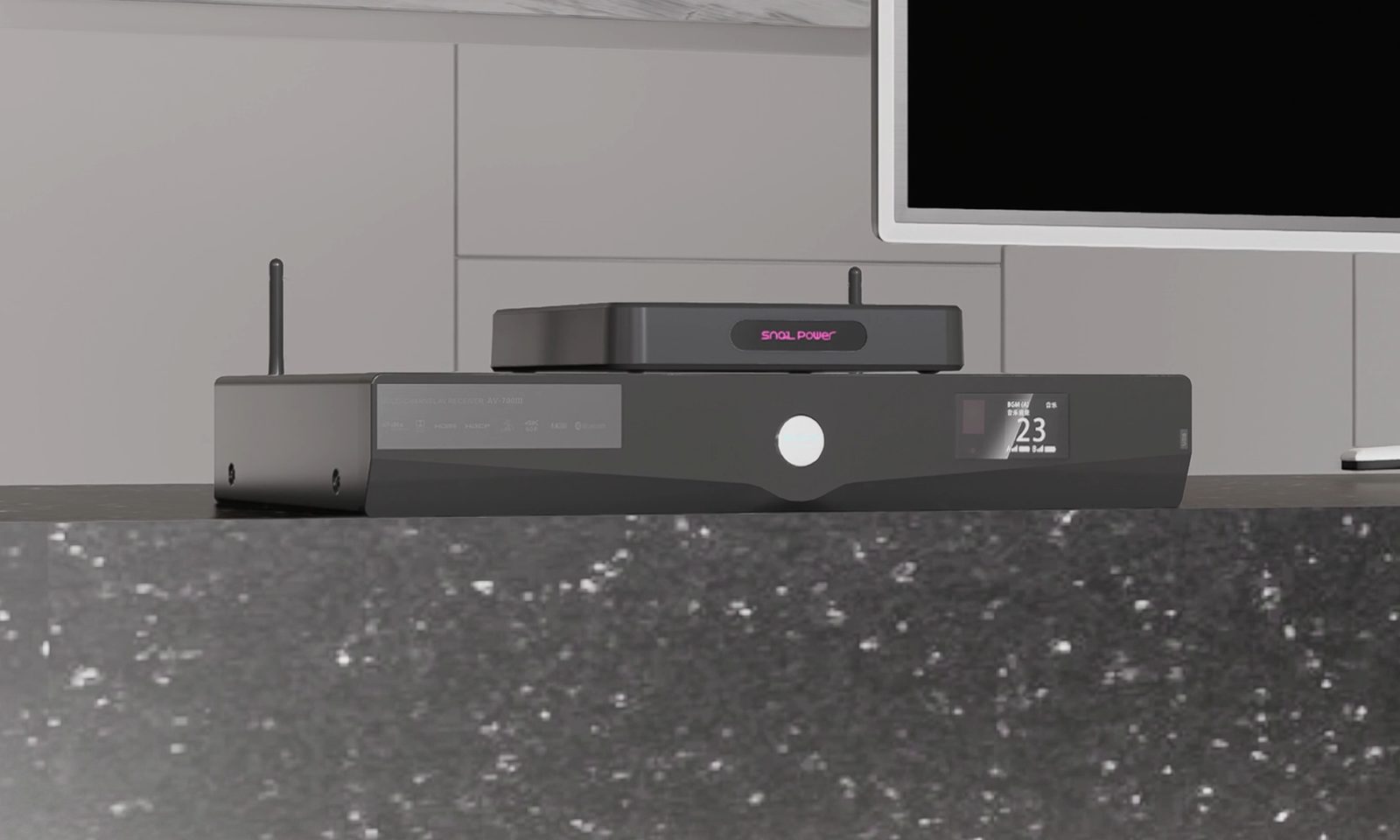
The AV-700 III is 7+2 channels, 7×100W, with Dolby and DTS certification; the AV-900 II is a cinema-and-karaoke unit with Dolby certification. Certification differs by model, so "Dolby compatible" on a quote says nothing.
Channel count is fixed the day you buy the amplifier: six runs for 5.1, eight for 7.1, two more for 5.1.2. Pull them before the boards go up; afterwards only surface trunking is left. Recessing hides the cable with the speakers, and cable costs more to replace than a speaker.
SNAIL POWER , founded in Milan in 1995 by audio designer Steven, sells in China through Shenzhen Newzeyu Audio Technology Co., Ltd.
The cost: a 7+2 channel amplifier is often over 400mm deep, so the cabinet needs 450mm plus airflow. Bury it in a TV cabinet and summer heat takes capacitor life with it.
6. Who should not build an embedded custom cinema
- Rooms under 2.6m of height. After a 10–15cm drop the height speakers sit too close; 5.1 or 5.1.2 is realistic, and the money belongs in the subwoofer and corners.
- Closed ceilings and painted walls. No pre-wiring: the CW90 needs a Ø90mm cutout, over 100mm clear and a 5.8GHz link — no new cable, but still a hole.
- Walls that cannot take a false wall. Brick-and-concrete, load-bearing and insulated external walls are out; surface mounting or wireless is left.
- Rooms under 2.9m clear width. Fronts under 0.4m from the side walls give asymmetric reflections and leave 7.1 surrounds nowhere; 5.1 with two subwoofers sounds better.
- Budgets that cover gear but not acoustics. ¥30,000 of equipment with no treatment usually loses to ¥20,000 of equipment and ¥10,000 of treatment; recessing hides speakers, not standing waves.
Of those five, "the ceiling is already closed" is the one people miss: wireless does not mean no cutout. The CW90 still needs a Ø90mm hole and over 100mm of clear depth, and no cable to the rack.
7. FAQ
Q: How far apart are cutout and faceplate?
About 15mm: IW3max Ø85mm against Ø100mm, CW90 Ø90mm against Ø105mm, IW4pro Ø105mm against Ø120mm, IW6 WIDE 186–191mm against Ø202mm.
Q: The ceiling has 6cm of clear depth — will an IW3max fit?
No. The box is about 7cm deep and needs 8cm clear. If the depth is not there, surface-mount it or move it clear of the framing.
Q: Can embedded speakers be added after the ceiling is closed?
If a hole can still be cut, yes: the CW90 needs a Ø90mm cutout, over 100mm clear and a 5.8GHz link, so no re-wiring. If not, surface-mount it.
Q: Will recessed bass disturb the neighbours?
Recessing changes where the box sits, not how the slab isolates sound. Low frequency is stopped by mass: in a sensitive building, build a floating floor and isolate the hangers before discussing speakers.
One-sentence verdict
The ceiling of an embedded custom cinema is set by the wall, the ceiling and the seating; the equipment is chosen inside that frame. Order of work: measure clear height and width, fix the front and centre cutouts, lay out height and back surround positions, then choose models by cutout size. Under 2.6m of height, a sofa that must touch the rear wall, or no false wall — two of three, and drop this for a wireless 5.1.
Related: IW3max, IW4pro, IW6 WIDE, CW90, AV-700 III.
Related articles
- In-Wall vs In-Ceiling: Built-In Cinema
- CW90 Speaker Power: What 90W per Unit and 111dB Actually Mean
- IW3mini + B28, Long Cut: A Full 5.1 Handover in 46 Seconds (Video)
END
#EmbeddedCinema #CustomCinema #InWallSpeakers #IW3max #HomeCinema #SnailPower
Written by Digital Xiaoniu for SNAIL POWER.