Home / News / Product News / What a Passive Radiator Is, and Why a 100mm Cabinet Needs One
What a Passive Radiator Is, and Why a 100mm Cabinet Needs One
2026-11-17 12:05 · Product News
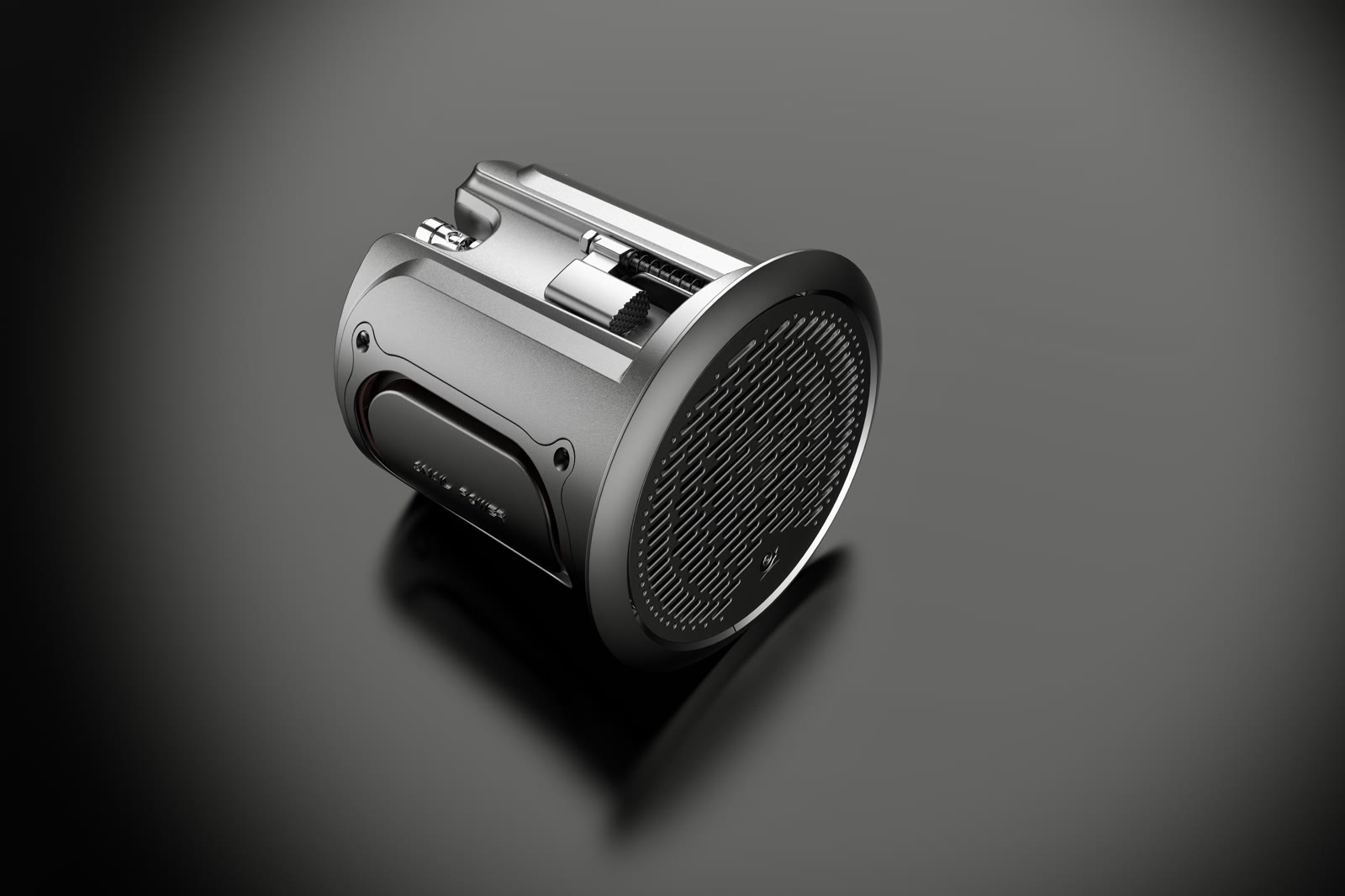
A passive radiator is a diaphragm with no voice coil and no magnet: it vibrates on pressure inside the cabinet and makes up low end for a small box. The CW90 pairs one with a 2.75-inch full-range driver: Ø90mm cut-out, 100mm height, 90W per unit, 111dB maximum SPL, and ¥17,200 for the whole 5.1 wireless cinema package — the 17,000 entry point. It is SNAIL POWER's 5.1 wireless cinema, for homes that do not want to see a speaker in the living room.
The problem is specific. A ceiling void gives the cabinet 100mm of height and a port has nowhere to extend; the 2.75-inch full-range has its own lower limit; a subwoofer cannot hang from the ceiling. The passive radiator fills in low end inside that gap. This article takes apart its structure, arithmetic and trade-offs, and says plainly where it cannot help.
Key points
- A passive radiator has no voice coil and no magnet: a weighted diaphragm that, with the air in the cabinet, forms a resonator.
- It does the port's work: no tube length to reserve, so tuning can be pushed down inside a 100mm-tall cabinet.
- Around the tuning point it takes load off the driver; below it the driver loses that restraint and excursion climbs instead of falling.
- What it adds is extension, not energy. Below 80Hz a subwoofer still has to catch the rest.
- The trade-off is one more surround that will age, sensitivity to air leaks and added weight, and one more setup step than a sealed box.
1. It Is a Diaphragm With No Voice Coil
Take a driver apart: cone, surround, spider, voice coil, magnet. The passive radiator keeps the first three and adds a weight. No voice coil, so no electromagnetic force; no magnet, so no drive of its own. It moves because the air in the cabinet moves.
The full-range driver pushes forward, the air behind it is compressed into the cabinet, and the pressure pushes the radiator's diaphragm out; when the driver travels back, the negative pressure pulls it in. The weight and the elasticity of the air in the cabinet make a resonator; at the set frequency the radiator's amplitude peaks while the driver's displacement drops, and that band is radiated by the radiator in the driver's place.
It does the port's job: extra output around tuning and less driver displacement at once. What vibrates differs — a column of air in a tube, or a whole diaphragm. The air column's mass comes from tube length and diameter; the diaphragm's, from the weight.
The trade-off: one more diaphragm means one more surround and spider that will age. The spec sheet says nothing about service life, but after years at high volume in a damp, dusty ceiling the surround compliance changes and the tuning point drifts. It is not a consumable; once the cabinet is sealed, a problem means opening it up.
2. In a Small Cabinet, the Arithmetic You Cannot Avoid Is Port Length
A ported box is tuned by cabinet volume, port cross-section and port length. The smaller the volume and the lower the tuning point, the longer the tube. The CW90 cabinet is 100mm tall, tight in depth and volume, with nowhere for that length; a thinner tube gets around it, but the air volume moved at a given low frequency does not change, so the narrower the port the higher the velocity at its mouth. In practice port velocity is held under 20m/s; above that, wind noise and compression arrive.
The passive radiator replaces the question. There is no port length to find: tuning comes from the weight and surround compliance, the diaphragm can be larger than a port mouth, and the same air volume moves at lower velocity with less wind noise. The cabinet needs only two openings, one for the driver and one for the radiator, both sealed by surrounds.
This is also a rule underneath concealed cinema speakers: you do not make the box smaller, you move it out of the room layer and into the ceiling. A small box loses the space low end needs, and a passive diaphragm is what you trade for it. What you get back is extension, not energy.
The trade-off: efficiency. A radiator generates no power; it takes the energy off the back of the driver and releases it at a different phase and a different time. There is gain around tuning, and below it the response rolls off at 24dB per octave, the same order as a ported box — and a 2.75-inch full-range still cannot reach what it cannot reach. It does not turn a 100mm cabinet into a large one; it buys the 80–100Hz band one more breath.
3. The CW90 Numbers, and What Sits Outside Them
| CW90 item | Figure |
|---|---|
| Driver complement | 2.75-inch full-range + passive radiator |
| Cut-out diameter | Ø90mm |
| Faceplate diameter | Ø105mm |
| Cabinet height | 100mm |
| Rated power | 90W per unit |
| Maximum SPL | 111dB |
| Wireless transmission | 5.8GHz dedicated channel |
| Package | 5.1 wireless cinema and karaoke: CW90×5 + W10 subwoofer + MS-1 |
| Package price | ¥17,200 (from 17,000 up) |
| Certification status | Dolby Atmos and DTS:X certification in progress |
The cut-out is the one item a renovation cannot change: Ø90mm is about a downlight's size, and one ring of patching plaster puts the ceiling back. On the Mini and the IW series the cut-out differs by model, and a 1mm difference means the holes cannot be mixed. Port and radiator are not a ranking either; each has its own bill.
The table carries no tuning frequency, no low-frequency limit, no group delay. Those three decide how it sounds, and they depend on cabinet design and on setup. A spec sheet cannot prove the low end is clean.
The trade-off: these figures cannot make the judgement for you. Ø90mm, 100mm and 111dB are hard numbers, but whether the low end is enough has to be heard on site; reading the table alone, it is easy to take a radiator that adds extension for a woofer.
4. It Adds Extension, Not Energy
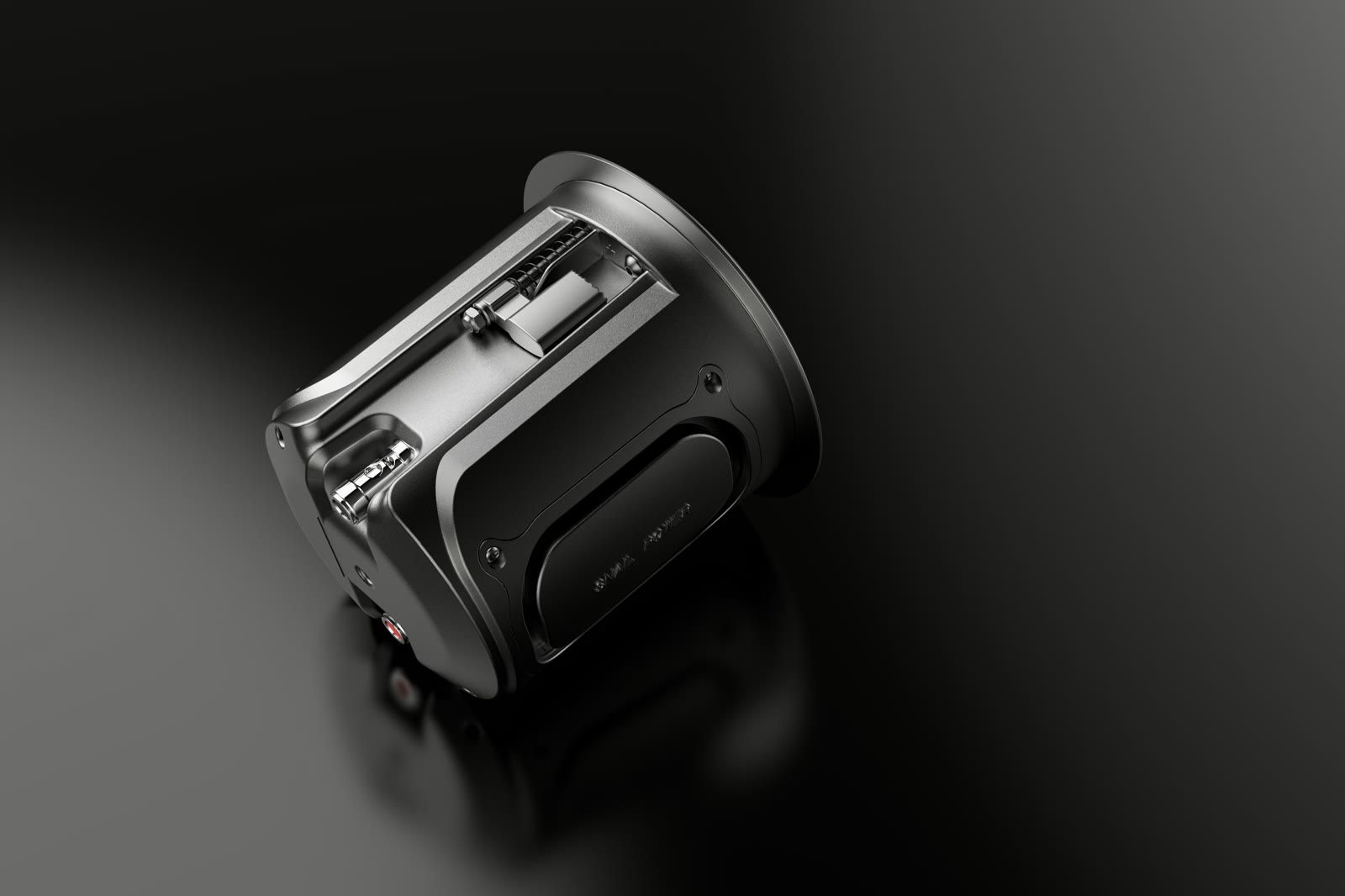
Taking the passive radiator for "one more woofer" is a misunderstanding. It has no voice coil and cannot turn a signal into force; it only radiates pressure already in the cabinet, more efficiently in one band. Conservation of energy does not bend for it.
Three boundaries cannot be avoided. Below the tuning point the radiator no longer helps and the driver loses the air spring, so its excursion rises fast; a 2.75-inch driver has a few millimetres of linear travel, and an explosion can put it on the stops. The radiator has mass, so low end decays more slowly than in a sealed box, group delay rises, and music can feel behind the beat. Its output is directional too: change the position or the aim and the low-frequency coupling changes with it.
That is why the CW90 hands everything below 80Hz to the W10 subwoofer. The logic of dividing the low end is direct: the 2.75-inch full-range does not take on work it cannot do — the driver covers mid and high, the radiator covers the 80–100Hz handover, the subwoofer the band below. Crossover points, phase and distance have to line up; when they do not, one band is too much and another too little.
The trade-off: system complexity. One more subwoofer, one more crossover, one more setup; with the subwoofer badly placed, 40–80Hz booms at the sofa and covers the dialogue. In a living room the low end depends heavily on where the subwoofer sits, and one more radiator does not solve that.
5. Once It Goes Into the Ceiling, Three Things Decide Whether It Was Worth It
Clearance first. The cabinet is 100mm high, and with furring channels, isolation pads and wiring space, 120mm or more has to be reserved in the void. Where the ceiling is a shallow perimeter drop only, the cabinet runs into the slab and the install is wasted.
Sealing next. The passive radiator uses the air in the cabinet as its spring; leak a little air and the spring softens, the tuning point moves down, and the low end shrinks and turns muddy. Cut-out edges, faceplate clamps and cable entries all have to be sealed. What goes inside the cabinet is set by the factory — do not add wadding yourself, it changes the effective volume.
Then crossover and placement. Start the crossover at 80Hz and adjust the subwoofer's phase and distance to match; the five CW90s run on a 5.8GHz dedicated channel, so no speaker cable goes into the ceiling, but every cabinet needs a power outlet beside it, not on the LED driver circuit.
The trade-off: low tolerance for error. A ported box that leaks a little still plays; a radiator box that leaks loses low end straight off the spec sheet. Reopening a finished ceiling to redo the sealing costs far more than doing it right first time.
6. Who Should Not Buy It, and One Sentence to Decide
In these cases I would talk you out of it:
- You want 30–40Hz you can feel from five ceiling speakers and will not add a subwoofer. The radiator adds extension, not depth.
- The void cannot give 120mm, or the ceiling cannot be cut. Renting, a finished flat you do not want to repaint, a beam in the way all count; the surface-mounted U series is the other route.
- You mainly listen to two-channel music and chase low-frequency speed and texture. This system is tuned for film and karaoke; its group delay and tuning are not made for two channels.
- The living room is over 35 m², or you want 7.1.4. Five CW90s and one subwoofer will be tight on headroom; look at the IW series or the X series.
- The budget is clearly below the 17,000 entry point. ¥17,200 is the delivered package, with five CW90s, one W10 subwoofer and the MS-1; there is no lower configuration.
- You have already run speaker cable and trust wired only. There is no reason to switch for wireless; changing over trades certainty for uncertainty.
The trade-off: half the low end goes to the subwoofer and half the stability goes to the install. The speakers are one link; installed and set up right, the 100mm cabinet delivers the figures it claims.
In one sentence: a passive radiator does not turn a 2.75-inch driver into a large cabinet. It catches the 80–100Hz band inside a 100mm-tall cabinet, and whatever it cannot catch goes to the subwoofer.
On a living-room ceiling the order should be: measure the void, then fix the subwoofer position, then choose the speakers. Done the other way round, it is easy to find out only after the holes are cut that the cabinet does not fit.
The exit conditions are just as clear: no 120mm to spare, no Ø90mm hole to cut, no corner to give up for a subwoofer — any one of those and this package is not the answer. Fix the structure and the placement first; do not ask the speakers to make up for them.
Related articles
- CW90: How a Ø90mm Hole Produces 111dB, and What It Costs
- IW3mini + B28: The Smallest 5.1 Package for a Small Living Room (Video)
- Why Sealed Cabinets Beat Ported Ones in Ceilings
END
#PassiveRadiator #CW90 #SnailPower #ConcealedCinemaSpeakers #HomeTheaterDesign #LivingRoomCinema #Wireless51Cinema
Written by Digital Xiaoniu, first published on the SNAIL POWER official site, Product News.