Home / News / Product News / IW3mini + B28: The Smallest 5.1 Package for a Small Living Room (Video)
IW3mini + B28: The Smallest 5.1 Package for a Small Living Room (Video)
2026-11-17 09:05 · Product News
The IW3mini and the B28 are a 5.1 concealed cinema package for a small living room: five IW3mini cabinets hide in the ceiling and the walls on a Ø80~85mm cut-out, the B28 subwoofer takes the low end, and the threshold sits on the ¥17,200 line. What that solves is not "the cabinet is not good enough"; it is the fact that in a 15-25 m² living room there is no position left beside or behind the sofa to begin with.
Key points
- Cut-out: Ø80~85mm. The cabinet goes into the ceiling or the wall, so it costs no floor space and no furniture position.
- Small drivers have a limited low end. The five cabinets handle the mids and highs; the B28 carries the bottom.
- On this SNAIL POWER line the entry step is the CW90 package at ¥17,200.
- The IW3mini package price must be confirmed against the actual configuration. One speaker's price is not a package price.
- No ceiling, no permission to cut holes, or a move within two or three years: this package is not the answer.
1. The Real Limit in a Small Living Room Is Not the Budget, It Is the Wall
The standard shape of a living room cinema is surface-mounted cabinets: floorstanders, bookshelf speakers, wall-mounted surrounds, each one occupying a position. In a large house that is fine; in a 15-25 m² living room it is not. The TV wall is eaten by the media console, one side is the balcony door, the other the walkway, and behind the sofa there still has to be room to walk through. Measure the room once and the only places left for a cabinet are two corners, while 5.1 needs five positions plus a subwoofer.
Concealed cinema goes a different way: the cabinet leaves the room layer altogether, into the ceiling, into the wall; all that remains in the room is a Ø80~85mm hole and a grille. Furniture layout and walking width do not move. What a client usually wants is not a cinema; it is a cinema you cannot see. Screen down and lights low, it is a cinema; the rest of the time it is just a living room.
The trade-off: this route is limited by the building, not by the budget. A cut-out needs a cavity behind it and a substrate that can be worked: plasterboard ceilings and lightweight walls are fine, the underside of a concrete beam, steel structure or an old ceiling packed with pipework is not. The holes mean patching paint and fitting grilles, so a finished flat gets dust and a repair period, and a low ceiling with dense downlights must be negotiated with the lighting plan. Have someone look at a ceiling section before this package is discussed at all.
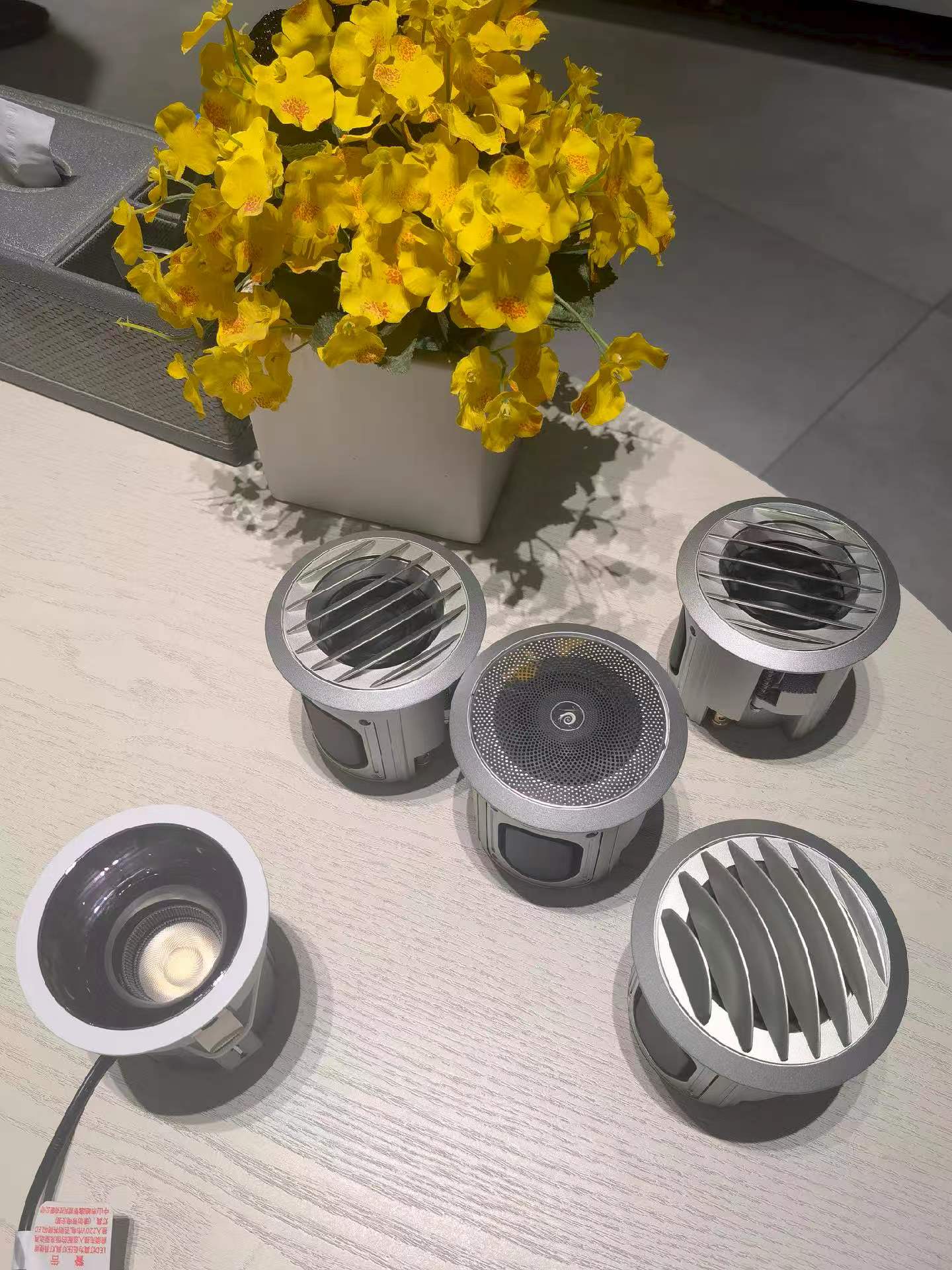
2. The Ø80~85mm Cut-Out Decides Where It Can Hide
On a construction drawing a concealed speaker comes down to three numbers: cut-out, faceplate, depth. The IW3mini uses a Ø80~85mm cut-out, the same as the IW series and the Mini. For comparison, the CW90 uses a Ø90mm cut-out, a Ø105mm faceplate and 100mm of height.
The common practice is a hole of around 27cm in the ceiling for an in-ceiling cabinet. Once the hole is that size the joists must be altered, the downlights moved and the vents shifted; the ceiling is effectively rebuilt. The value of Ø80~85mm is not that it is more premium; it is that there is less work. One hole saw goes in and most of the surrounding joists stay where they are. This is where small-home cinema projects usually stall: not the price of the cabinet, but a ceiling that cannot take that much change.
| Model / series | Cut-out | Faceplate | Height | Note |
|---|---|---|---|---|
| IW3mini | Ø80~85mm | — | — | The cabinet in this package |
| IW series | Ø80~85mm | — | — | Same cut-out |
| Mini | Ø80~85mm | — | — | Same cut-out |
| CW90 | Ø90mm | Ø105mm | 100mm | Wireless, dedicated 5.8G channel |
| B28 | Floor-standing | — | — | Subwoofer, no cut-out |
A smaller hole does not mean more sound. Ø80~85mm limits the installation size, not the acoustic size: cone area is what it is, and hiding a cabinet in a ceiling does not add mid-bass.
The trade-off: Ø80~85mm is an installation dimension, not a promise that any wall can be cut. Cut-out depth, the cavity behind and the wall material all change the result; the same cabinet in a plasterboard ceiling and in a solid wall differs by a clear margin in the low end, so it must be tuned per room. A small hole is an installation advantage, not an acoustic one.
3. Why the Low End Is Handed to the B28 on Its Own
Taking the low end out of five small cabinets and giving it to the B28 is the core of how this package divides its work.
The CW90 uses a 2.75-inch full-range driver with a passive radiator, and a driver that size cannot reach very low. Apply the same thinking to the IW3mini, whose cabinet is smaller still, and expecting it to hold 80Hz and below on its own is unrealistic. So the five IW3mini handle the mids, the highs and the imaging, the B28 owns the bottom, and the small cabinets are no longer forced lower than they can go. That is what "the sub catches the low end, so the full-range drivers stay relaxed" means in practice.
One point worth clearing up: a small diameter is not the same as no output. The CW90 runs 90W per unit and reaches 111dB maximum SPL from a Ø90mm cut-out and a Ø105mm faceplate, through power management and the passive radiator working together.
The trade-off: there are three costs. Footprint: the B28 is a floor-standing cabinet, so it needs a place beside the sofa, in a corner or next to the media console, plus a mains socket. Placement: a subwoofer is more sensitive than a cabinet, and moving it to another corner changes weight and cleanliness audibly, so on-site tuning is not optional. Leakage: low frequencies travel through the slab and the walls, and the flats above, below and next door all hear them. No subwoofer can promise not to disturb the neighbours; if the flat below is unusually sensitive, a floating floor and isolation pads do more than a more expensive sub would. A small living room can save the volume of the cabinets, but it cannot save the footprint of one subwoofer.
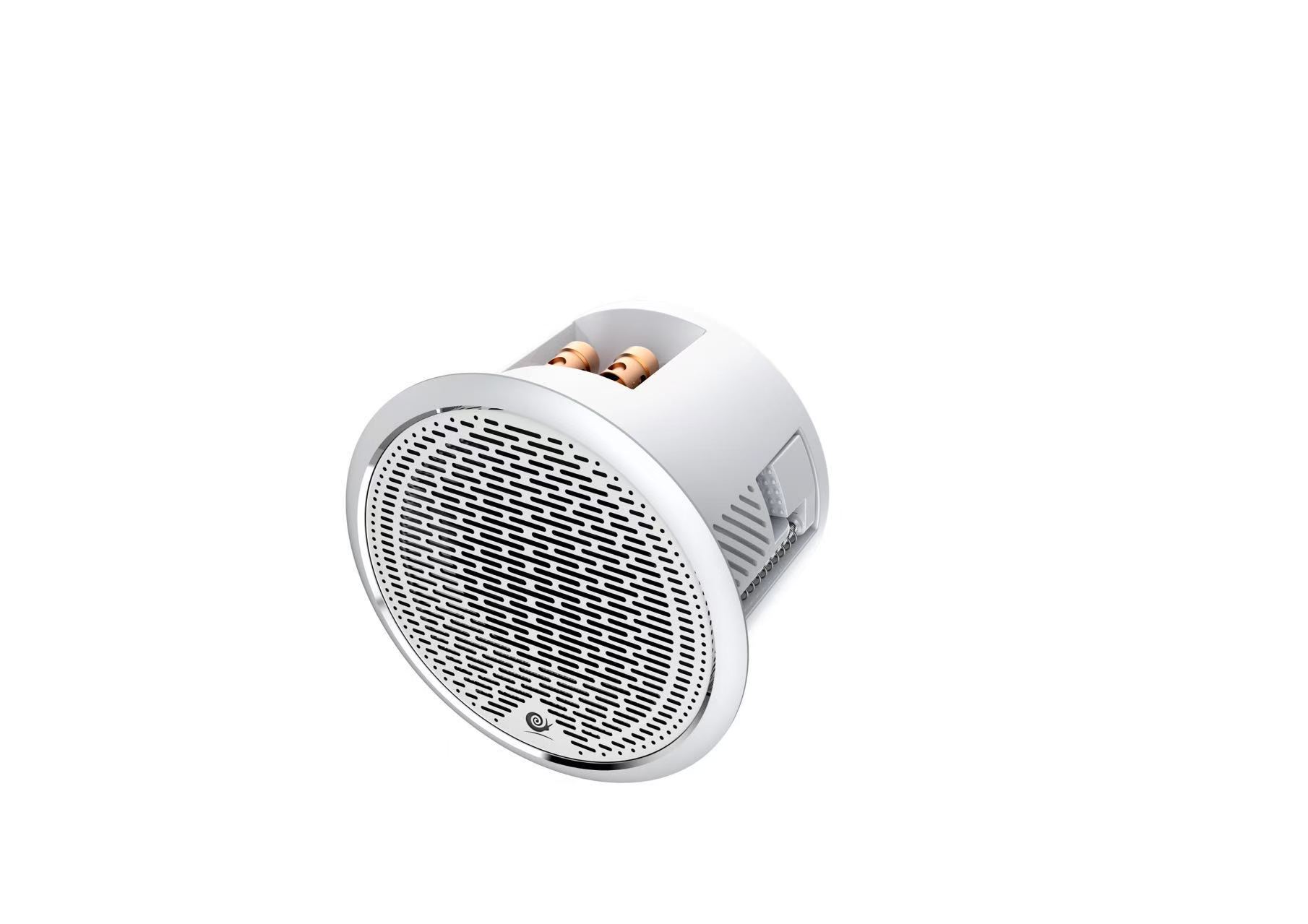
4. Wiring: the Renovation Timeline Should Not Decide Whether a Cinema Is Possible
Home cinema wiring must be settled before the carpentry starts: from the AV receiver position to each cabinet, to the projector position and to the subwoofer position, all of it in buried conduit. After that, model choice stays open.
The IW3mini package is driven from the AV receiver, so five cabinets mean five runs. This belongs in the "decided before the renovation" category.
The other route is wireless. The CW90 runs a dedicated 5.8G channel and needs no cable. Dedicated here means it has its own audio channel, not that it uses the home Wi-Fi band.
The trade-off: wireless saves cable, not power. The cabinets still need a supply or a host to drive them, so sockets and positions have to be thought through in advance, and a dedicated 5.8G channel is not stable in every environment: a house with metal ceilings and a lot of load-bearing wall still gets measured on site. The wired side is the same story: a cable buried in the wrong place is harder to put right than redoing the carpentry. Money spent on wiring is insurance against rework, and the order does not reverse: bury the cable in a house that is not finished, and talk wireless in a house that is.
5. Where the Money Goes: The Steps on the ¥17,200-and-Up Line
Two quotes can carry the same "5.1" label and differ by a factor of two, and the gap is rarely in those five cabinets. It is in the subwoofer and the AV receiver.
| Product line | Configuration | Package price |
|---|---|---|
| CW90 wireless cinema | CW90×5 + W10 subwoofer + MS-1 | ¥17,200 |
| U3 | U3×5 + B28 subwoofer + AV-700III + MU-1 + F60D×2 | ¥19,600 |
| Mini | 5×Mini + B28 subwoofer + AV-700III + MU-1 + F60D×2 | ¥21,000 |
| IW3max | 5×IW3max + B28 subwoofer + AV-700III + MU-1 | ¥23,600 |
| IW3mini + B28 | 5×IW3mini + B28 subwoofer | Confirmed per configuration |
The CW90 package at ¥17,200 is the entry step. Up from there the Mini package is ¥21,000 and the IW3max package is ¥23,600, with the difference sitting in driver size, subwoofer specification and receiver configuration. The IW3mini package has to be confirmed against the actual configuration, and one speaker's price is not a package price. The "IW3max for just over nine thousand" that circulates online is not an official package price either.
Who should not buy this, stated plainly:
- A budget locked just above ten thousand with no intention of adding to it soon. This line starts at ¥17,200, and below it there is only the ¥3,999 background music line, which is a different kind of product.
- A house with no ceiling, and no plan to build one. Without a hole there is no concealed option to speak of.
- Renting, or a move within two or three years. Cutting, patching and removal are all sunk cost.
- A household whose main use is karaoke at high volume. This package is designed around cinema duties, and karaoke needs its configuration confirmed separately.
The trade-off: this is not a cheaper version, it is a hidden version. On the same budget, anyone who does not care how it looks can buy larger drivers and more headroom in a surface-mounted cabinet, because driver size is locked by the cut-out size. That is the concealed bill.
6. In One Sentence: It Solves "No Space", Not "Budget"
Back to the opening line: the IW3mini plus B28 is a 5.1 concealed package for a small living room, a Ø80~85mm cut-out, five cabinets and one subwoofer, on the ¥17,200-and-up line.
The conditions under which it works are specific: a 15-25 m² living room, a ceiling that can be built or a wall that can be cut, a renovation that has not been signed off yet or a willingness to open the ceiling once more, and a household that is not especially sensitive to low-frequency leakage. Miss two of those four and the money is better spent somewhere else.
The paperwork position: Dolby Atmos and DTS:X certification in progress, updated here once approval closes.
The video records the package after installation. Written notes cannot stand in for hearing it; listen to a passage yourself before deciding.
The trade-off: its premise is a house that can be cut, a willingness to open the ceiling once, and acceptance of one more floor-standing subwoofer in the living room. Miss one of those three and the arithmetic stops working. If the problem is that the living room has no space, this package solves it; if the problem is budget, it does not.
Related articles
- Why Sealed Cabinets Beat Ported Ones in Ceilings
- Will a Wireless Cinema Stutter? 5.8G vs WiFi
- How In-Ceiling Speakers Solve Directivity
END
#IW3mini #B28Subwoofer #ConcealedSpeakers #FivePointOnePackage #CeilingRenovation #LivingRoomCinema #RenovationSequence
Written by Digital Xiaoniu, first published on the SNAIL POWER official site, Product News.