Home / News / Product News / CW90: How a Ø90mm Hole Produces 111dB, and What It Costs
CW90: How a Ø90mm Hole Produces 111dB, and What It Costs
2026-11-17 18:05 · Product News
The CW90 is SNAIL POWER's 5.1 wireless cinema system: a Ø90mm ceiling cut-out, a Ø105mm faceplate, 90W per unit, a 111dB maximum SPL and ¥17,200 for the full package, for households that do not want to see a speaker in the living room. The figure that decides whether it fits your home is not the 111dB, it is the Ø90mm cut-out.
Its driver is a 2.75-inch full-range unit plus one passive radiator. Reporting 111dB from a size like that is not something the words "good driver" can explain. You have to take four things apart: the waveguide, the radiator, the power and the crossover. This article takes those four apart, and writes down the cost of each one.
Key points
- 111dB is a maximum SPL. It happens at peaks, not as a continuous output figure.
- A waveguide does not add power. It gathers energy into one coverage angle and trades directivity for efficiency.
- The 2.75-inch full-range driver covers the mid and high frequencies; the low end is handed to the W10 subwoofer. That division buys composure, and it comes with conditions.
- "90W per unit" is the power boundary for this driver size, not a number you can freely push higher.
- The package starts at ¥17,200. In a living room over 45 m², or under a double-height ceiling, the margin on this system gets tight.
1. 111dB Is Four Things Stacked Together, Not One Driver's Achievement
Where the number comes from: sound pressure is efficiency multiplied by power, multiplied again by directivity gain, and then reduced by distance loss. A driver a little over two inches across has only so much diaphragm area, and one stroke can only move so much air. To reach 111dB at one metre there are exactly three routes: a longer stroke, higher efficiency, or concentrating the energy where people actually sit.
The CW90 takes all three at once. Stroke is handed to the passive radiator: a small cabinet cannot fit the length of a reflex port, so a passive diaphragm takes its place and carries the low-frequency airflow, which means the full-range driver does not have to run itself back and forth at full travel chasing bass. Efficiency and concentration are handed to the waveguide.
The 111dB figure needs qualifying. It is a peak ceiling, reached on transients such as an explosion or a drum hit. Cinema calibration convention sets dialogue at an 85dB reference with 20dB of headroom on peaks, up to 105dB. 111dB means there is still something in reserve when a peak arrives. It is not an invitation to listen at 111dB.
The trade-off: a small driver making large output does it on stroke, and the longer the stroke, the sooner midrange cleanliness goes. That is why cabinets of this kind have to hand the low end to a subwoofer. A 2.75-inch full-range driver cannot reach very low on its own. That is not a design regret; it is a physical limit.
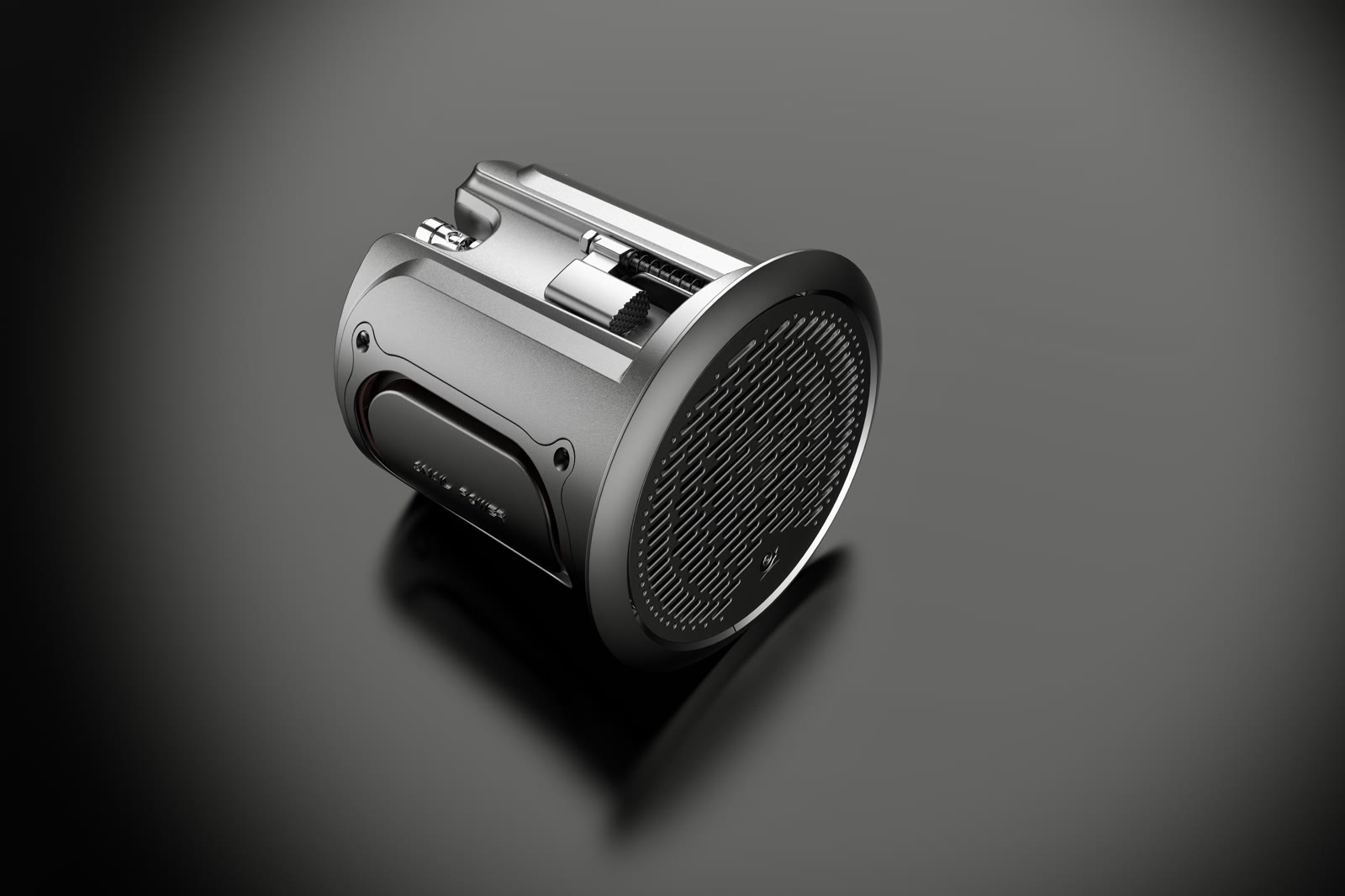
2. The Waveguide Funnels Sound Into the Sofa, and the Trade-Off Is a Smaller Sweet Spot
Ceiling drivers are mounted facing down. A bare driver radiates like half a sphere, and part of that lands on the side walls, the curtains and the floor as reflected sound. What a listener on the sofa hears is direct sound mixed with reflections, and once the reverb is heavy the leading edges of dialogue smear.
The variable waveguide is a short horn with a fixed flare angle, fitted in front of the driver, narrowing the radiation angle to a set range, and its aim can be adjusted. It does two things: the same power is louder inside the angle and quieter outside it. SNAIL POWER built this structure in 2016 and put it into the IW3 in 2018.
This is also what makes concealed cinema speakers genuinely difficult. Hiding the hardware is the easy part. The hard part is that the sound still has to point accurately once hidden: inside a Ø90mm opening the driver, the waveguide and the radiator are packed into 100mm of height, and not one of them can simply be made bigger.
The trade-off: coverage angle. The stronger the directivity, the faster the level falls outside the angle, so lying across the sofa, sitting in the side chair, or a child on the rug will all sound a step thinner than the centre seat. There are two fixes: widen the flare angle, or add more positions. Both cost money; the first gives up some efficiency, the second means more holes and more cable.
3. The Spec Sheet: Everything the CW90 Has
| Item | Figure |
|---|---|
| Cut-out | Ø90mm |
| Faceplate | Ø105mm |
| Cabinet height | 100mm |
| Driver | 2.75-inch full-range + passive radiator |
| Rated power | 90W per unit |
| Maximum SPL | 111dB |
| Wireless link | 5.8G dedicated channel |
| Package configuration | 5.1 wireless cinema and karaoke: CW90×5 + W10 subwoofer + MS-1 |
| Package price | ¥17,200 |
| Immersive formats | Dolby Atmos and DTS:X certification in progress |
Why the cut-out gets a line of its own: in home theater design it is the one dimension that cannot be changed once it is set, and every position after it depends on it.
Set the same brand's lines side by side and the price gaps sit in the subwoofer and the AV receiver:
| Model | Cut-out | 5.1 cinema and karaoke package price |
|---|---|---|
| CW90 | Ø90mm | ¥17,200 |
| Mini | Varies by model | ¥21,000 |
| IW3max | Varies by model | ¥23,600 |
| IW4pro | Varies by model | ¥33,200 |
The CW90 is Ø90mm; on the Mini and the IW series it varies by model, by as little as 1mm. That is not a typo: the cabinets and the mounting brackets are built differently. Pick the drill from the drawing, not from memory.
The trade-off: a cut-out cannot be undone. Patching a hole in the wrong place in plasterboard costs more than cutting a new one, and it needs fresh joint compound and paint. Get the dimension wrong and every position adjustment afterwards is wasted work. Fix the model, produce the layout drawing, then cut.
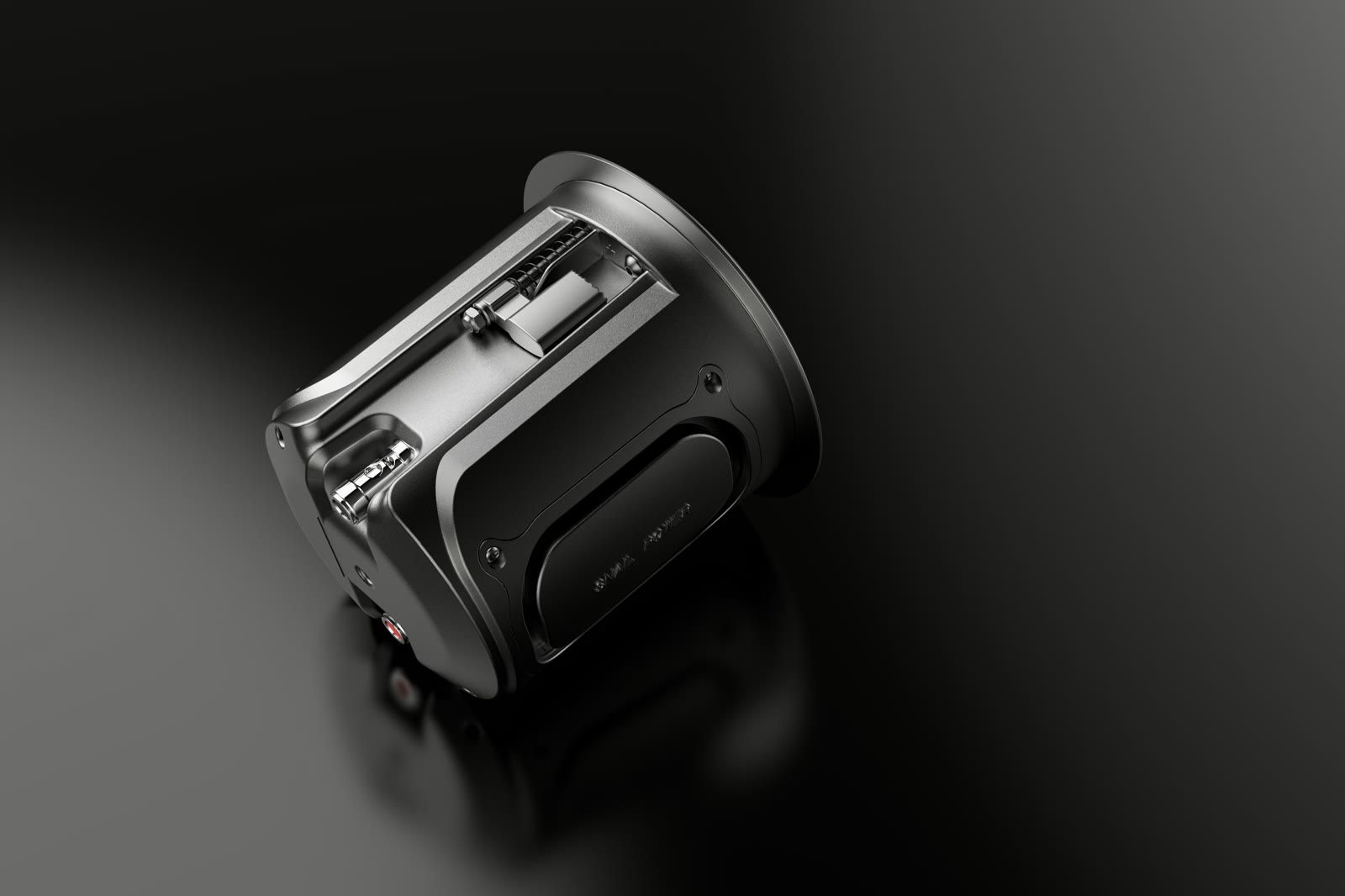
4. The 90W Limit Deserves More Attention Than the 111dB
Power has a counter-intuitive property: double it and you gain 3dB. Take 90W up to 180W and the theory says 3dB more, but what actually arrives first is distortion and thermal compression. The voice coil heats, impedance rises, sensitivity falls, and the extra power turns into heat.
So "90W per unit" is a boundary value for this driver size, not a starting point to push from. When you match an amplifier, do not lower the crossover to 60Hz to test its limit; that only means hitting the stroke limit first on a drum hit. The CW90 runs a 5.8G dedicated channel, sits outside the band your home Wi-Fi uses, and can be retrofitted without running cable. For someone halfway through a renovation, that is worth more than another 3dB.
On immersive formats, put it plainly up front: Dolby Atmos and DTS:X certification in progress.
The trade-off: margin. 90W behind a Ø90mm cut-out is comfortable in a 20–35 m² living room. Above that the headroom has to come from more positions or a larger driver, and forcing it only brings distortion forward sooner, so this is not a system to use as the budget answer for a large space.
5. Once It Is in the Ceiling, How Much Do Upstairs and Downstairs Hear
The mounting surface for living room cinema speakers is usually a plasterboard ceiling, and the insulation comes from the original slab, not from the ceiling boards.
Four layers are available: the waveguide presses energy toward the sofa so less of it travels above the ceiling; the full-range driver and the passive radiator keep the airflow inside the cabinet; and the absorber cup in the base of the cabinet soaks up rearward energy, reducing vibration into the joists. Together the effect is full on the sofa and light on the floor above.
The honest part: it is physically impossible to make the room below completely silent. Low frequencies have long wavelengths, a concrete slab gives limited isolation at 40–80Hz, and the energy travels down through the structure. If the neighbour downstairs is sensitive, float the floor first. A resilient mat plus a fine-stone concrete screed traps the vibration in the slab, and that does far more than changing speakers.
The trade-off: schedule and ceiling height. A floating floor eats several centimetres of height, plus a structural budget and at least a week of work. So this route suits people who have already decided to renovate. If all you want is new speakers and the floor stays as it is, accept that the room below will hear low frequencies; moving the subwoofer off the middle of the slab and over against a wall or a beam is the cheap mitigation.
6. Who Should Not Buy It, and the One-Sentence Verdict
In these cases I would talk you out of it:
- A living room over 45 m², or a double-height space with the ceiling above 3.5m. The margin on the CW90 gets tight; within the same brand, look at the IW6 WIDE (¥44,800) or the X series.
- A ceiling you cannot touch. Renting, a structure that cannot be drilled, a finished apartment where nobody wants to repaint: all of these count. Surface-mount is the other route: the U3 package is ¥19,600, the U4max ¥31,800.
- You want to feel 30Hz and below, but will not put a subwoofer in the living room. A small cabinet cannot do it. That is not a brand problem; it is physics.
- You have a dedicated room and are happy with large floorstanding cabinets. At the same budget a big cabinet is more relaxed, and there is no reason to pay extra for the word invisible.
That is the cost: the whole package stands on one premise, that a hole can be cut. If the premise does not hold, none of the advantages count. Turn it around and the case is just as clear: you have measured the ceiling, a Ø90mm hole is possible, and you do not want visible cable runs to the two positions behind the sofa.
One sentence: 111dB is the result, not the reason to buy it. The reason is Ø90mm, because that cut-out decides whether a 5.1 system can go into your living room without changing its style.
The exit conditions belong here too: if no Ø90mm hole will go through the ceiling at all, because of beams or central air-conditioning ducts, or you plan to move within three years, this is the wrong system. Settle the structure and the budget first, and do not ask speakers to cover for them.
The trade-off: every advantage here is bought with a hole, and the holes are cut before anyone hears the system. What is being decided is not which speaker sounds better; it is whether the ceiling can carry the decision at all.
Related articles
- What a Passive Radiator Is, and Why a 100mm Cabinet Needs One
- IW3mini + B28: The Smallest 5.1 Package for a Small Living Room (Video)
- Why Sealed Cabinets Beat Ported Ones in Ceilings
END
#CW90 #SnailPower #ConcealedSpeakers #Wireless51Cinema #WaveguideTechnology #LivingRoomCinema #HomeCinemaKaraoke
Written by Digital Xiaoniu, first published on the SNAIL POWER official site, Product News.