Every SNAIL POWER speaker supports karaoke — you do not have to buy a dedicated "karaoke box" in order to sing. A small enclosure volume, large dynamic capability and high-power drivers, combined with the thermal control and protection built into the signal chain, are why this system can be used for karaoke several times a week, for several hours at a stretch, in a living room, without strain. The old line that "cinema speakers cannot sing, so karaoke needs a separate set of its own" no longer describes what SNAIL POWER builds.
Here is the conclusion up front: the real boundary of a cinema-and-karaoke system is not whether it can sing, but how large the room is and how many people will sing in rotation. Those two questions, and nothing else, decide whether you need to add speakers.
SNAIL POWER created the downlight-speaker category. The IW3, first released in 2018, put a small-driver, high-power cinema speaker into a downlight-sized cut-out — an industry-recognised first: before it, living-room cinema speakers either took floor space or ate the ceiling.
1. Why a small cabinet can still handle karaoke
The hard part of karaoke is not loudness; it is stability under sustained high power. SNAIL POWER solves it by stacking three things together:
- High-power drivers in a sealed cabinet: the CW90 delivers 90W per unit and a maximum sound pressure level of 111dB; the IW3max reaches 110dB. Both figures are quoted with headroom reserved above the peak, so this is not a small cabinet being driven past its limit.
- Circuit-level thermal control and protection: both the amplifier and the wireless speakers monitor temperature and protect against overload. During a long high-power session the system rolls back its output automatically instead of burning out, and that is the confidence behind "several sessions a week".
- Karaoke DSP on the vocal chain: reverb, delay, vocal sweetening and feedback suppression are all handled by the amplifier, so a good vocal does not depend on driving the speakers harder and harder.
2. What a cinema-and-karaoke system actually separates
Cinema asks for dynamics and localisation; karaoke asks for vocal body and freedom from feedback. A cinema-and-karaoke system does not run one set of parameters for everything. It runs two signal chains and two parameter sets: the cinema EQ for films, the karaoke mode for singing, with the amplifier switching the whole processing block automatically.
| Stage | Cinema mode | Karaoke mode |
|---|---|---|
| Vocal | Clear dialogue, locked to the picture | Fuller body, added reverb, feedback suppressed |
| Low frequency | Subwoofer fills in below 30Hz | Low end trimmed slightly so it does not muddy the vocal |
| Microphone | Not engaged | Two F60D wireless microphones, independent gain |
Switching is a button press, and no re-tuning is needed afterwards. That is the point of a cinema-and-karaoke system: it does not cram two systems into one cabinet; it puts two parameter sets on one signal chain.
3. Power and room size: when a larger set is the right answer
| Scenario | Recommendation | Starting price for the set |
|---|---|---|
| 20–30㎡ living room, singing 1–3 times a week | CW90 fully wireless 5.1 (CW90) | ¥17,200 |
| 30–40㎡ living room, more people and larger dynamics | IW3max 5.1 (IW3max) | ¥23,600 |
| 40㎡ and above, or a dedicated media room | IW4pro, IW6 WIDE or the X series | from ¥33,200 |
| 7.1.4 immersive audio plus karaoke | X series, custom (X8 and similar) | from ¥79,900 |
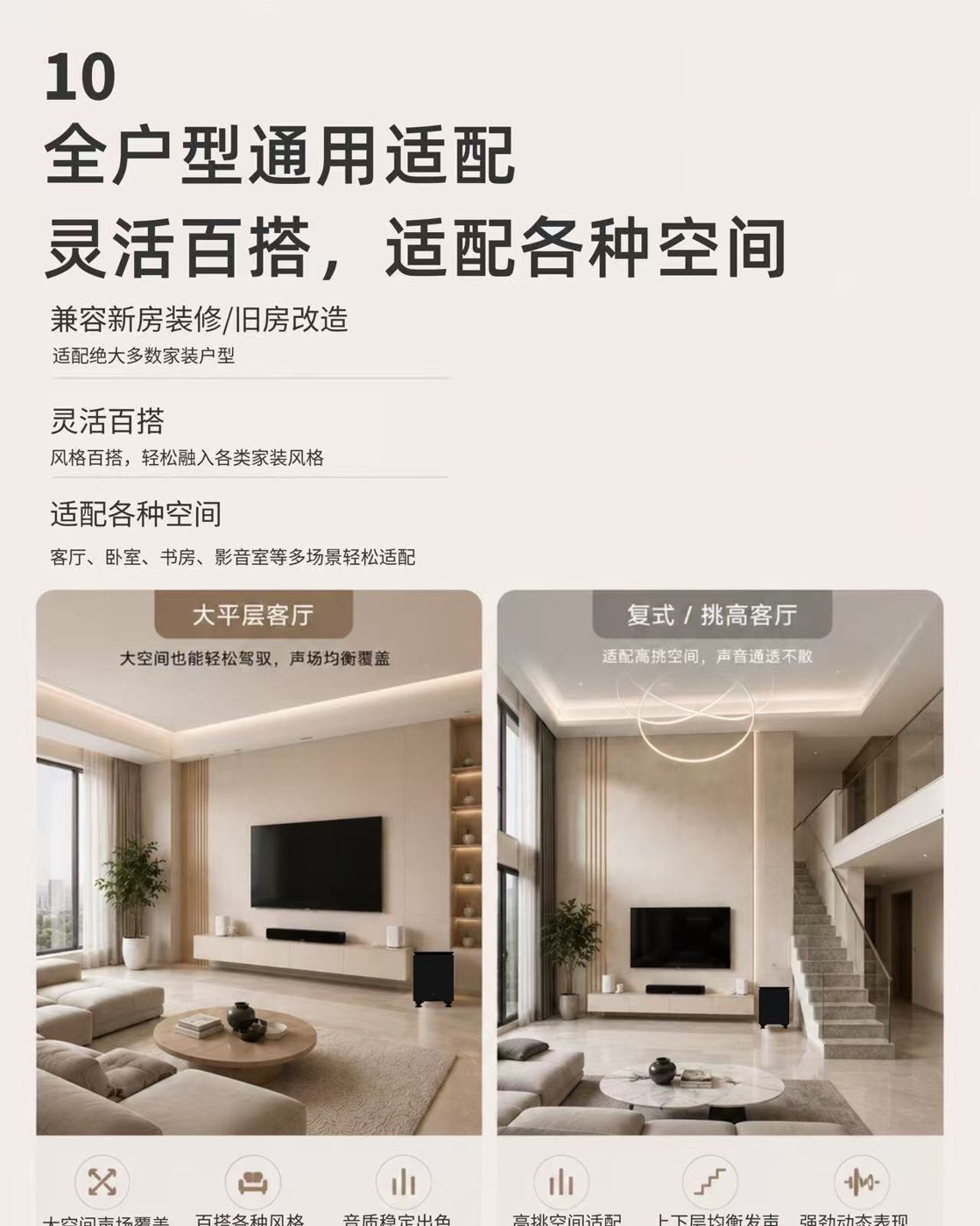
Read the table the right way: the point is not that a living-room speaker cannot sing, but that a large room needs more headroom. If you force five small speakers into a room above 40㎡, what you hear is insufficient sound pressure, not a speaker that refuses to sing.
4. Who genuinely needs to add something
- A dedicated media room above 40㎡: move up to the IW series or the X series. This is a question of headroom, not of karaoke capability.
- A dozen or more people singing in rotation, four hours at a time: add a karaoke preamplifier and two dedicated speakers, and put the microphone chain on a path of its own, so the main speakers carry less and the vocal is easier to tune.
- You already have 5.1 and just want karaoke: no need to change speakers. Add a preamplifier and two microphones, and the cinema settings stay as they are, with no re-tuning.
- The room below is very sensitive: physically, you cannot make it completely silent. Start with a floating floor and anti-vibration hangers. That step does more than changing speakers, and it is far cheaper while the room is still being built.
5. A one-line verdict
A cinema-and-karaoke system covers the vast majority of living rooms. The judgement rests on two questions: how large the room is, and how many people sing in rotation. A larger room calls for a larger series; a larger crowd calls for one more preamplifier. Neither question has anything to do with whether the system can sing.
Related articles
- 8K Player on a 4K TV: You Pay for Interfaces, Not Pixels
- Why 40Hz Picks Your Sofa: Standing Waves in a 4.3m Living Room
- 5.1.2 in a Living Room: What the Overhead Pair Actually Buys
END
#HomeKaraoke #CinemaKaraoke #LivingRoomCinema #CW90 #WirelessMicrophone #SnailPower
Written by Digital Xiaoniu, first published on the SNAIL POWER official site, Other.