Home / News / Featured Projects / Six-Metre Ceilings: Installing IW6wide in a Double-Height Living Room (Video)
Six-Metre Ceilings: Installing IW6wide in a Double-Height Living Room (Video)
2026-11-23 09:05 · Featured Projects
The IW6 WIDE is SNAIL POWER's concealed cinema system for double-height living rooms: the IW series opens a Ø186–191mm cut-out, and the official 7.1 concealed package — IW6LCR-II×3 + IW6max×4 + S10D subwoofer — is quoted on request. It is built for a six-metre ceiling, where the usual ceiling positions sit far from the sofa.
The video is a finished double-height living room, and there is exactly one thing it can confirm: the speakers are in the ceiling, and standing up you cannot see them. So this piece will not describe the footage. It works through the six-metre ceiling itself.
Key points
- The difficulty in a double-height living room is distance and coverage, not volume.
- The IW6 WIDE 7.1 concealed package is quoted on request.
- The IW series cut-out is Ø186–191mm; the CW90 is Ø90mm. The two holes are not the same hole.
- This system has to be wired into the ceiling, and the cheap window is before the boards go up.
- A ceiling under 3 metres, or a budget in the entry bracket, and this package does not apply.
1. Six Metres of Ceiling: The Loss Starts With Distance
Sound pressure falls with distance, and that is the inverse-square law: double the distance and the direct sound drops by roughly 6dB. In a living room with a 2.8-metre ceiling, a ceiling speaker sits just over two metres from your ears. At six metres, the same mounting position is four to five metres away, and 3 to 4dB is gone just like that.
Those 3 to 4dB cannot be bought back with the volume knob. Turn it up and what runs out of headroom first is distortion and the neighbour downstairs; the sound pressure itself does not climb with the dial. Directivity shifts as well: the angle a cabinet covers at two metres is spread across a wide area at five metres, so the edge of the sofa gets the edge of the pattern and the middle gets something too close. The item home theater design most often leaves out is that stretch between sofa and ceiling. It decides whether you need a louder speaker, or a system that can be aimed at the listening area.
Then there is a quantity nobody measures: air volume. A living room with a six-metre ceiling holds at least twice the air of an ordinary one, so the low end has more air to move and the subwoofer's workload rises with it. Asking the small drivers overhead to reach that far is not realistic; that part of the job belongs to the subwoofer.
The trade-off: in a double-height living room, any solution that amounts to turning it up only moves the problem from clarity to neighbour complaints. If your floor slab is thin and the people below are sensitive to low frequencies, a floating floor will achieve more than a new set of speakers — and that sentence holds for any brand.
2. Mounting Where the Downlight Goes Is Not a New Subject
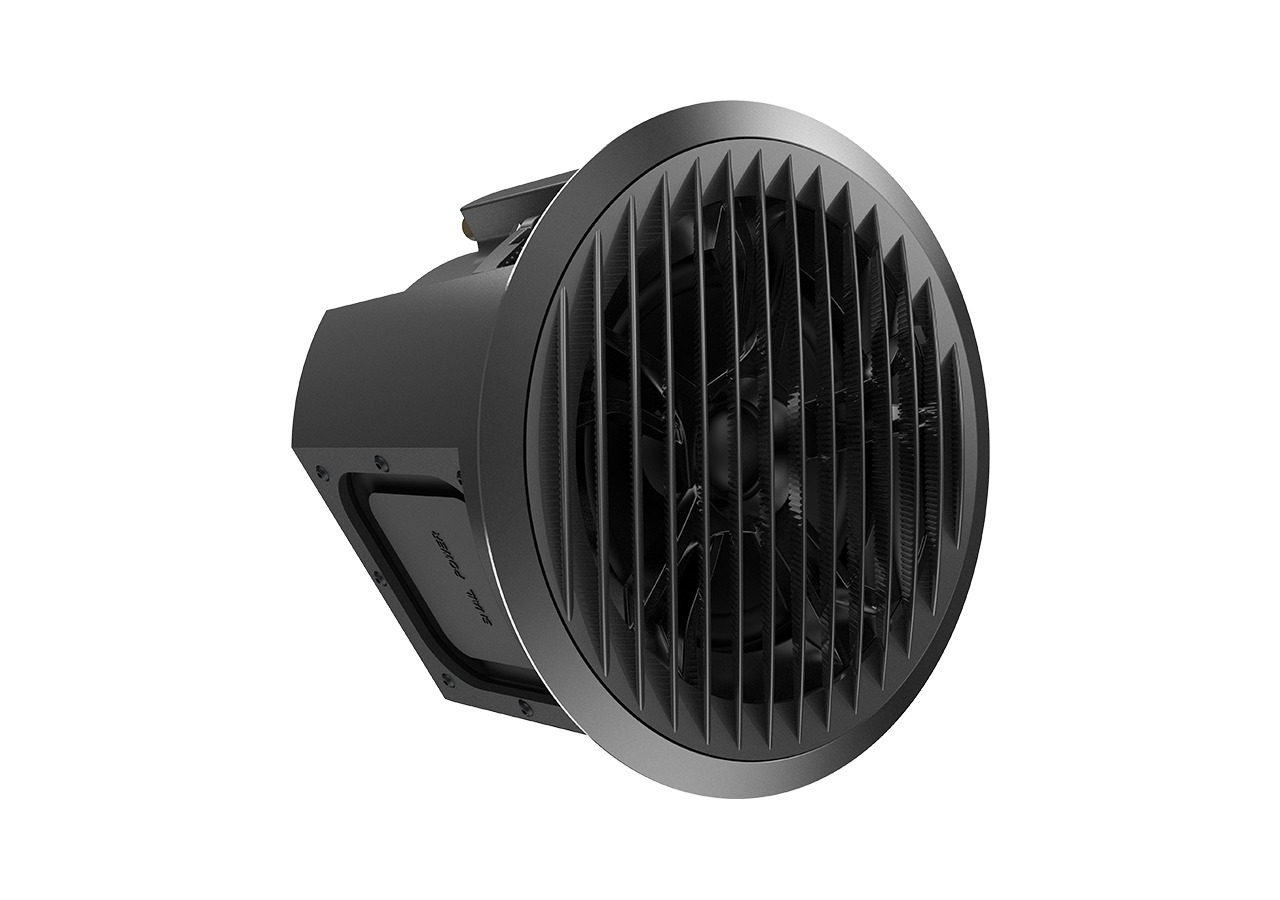
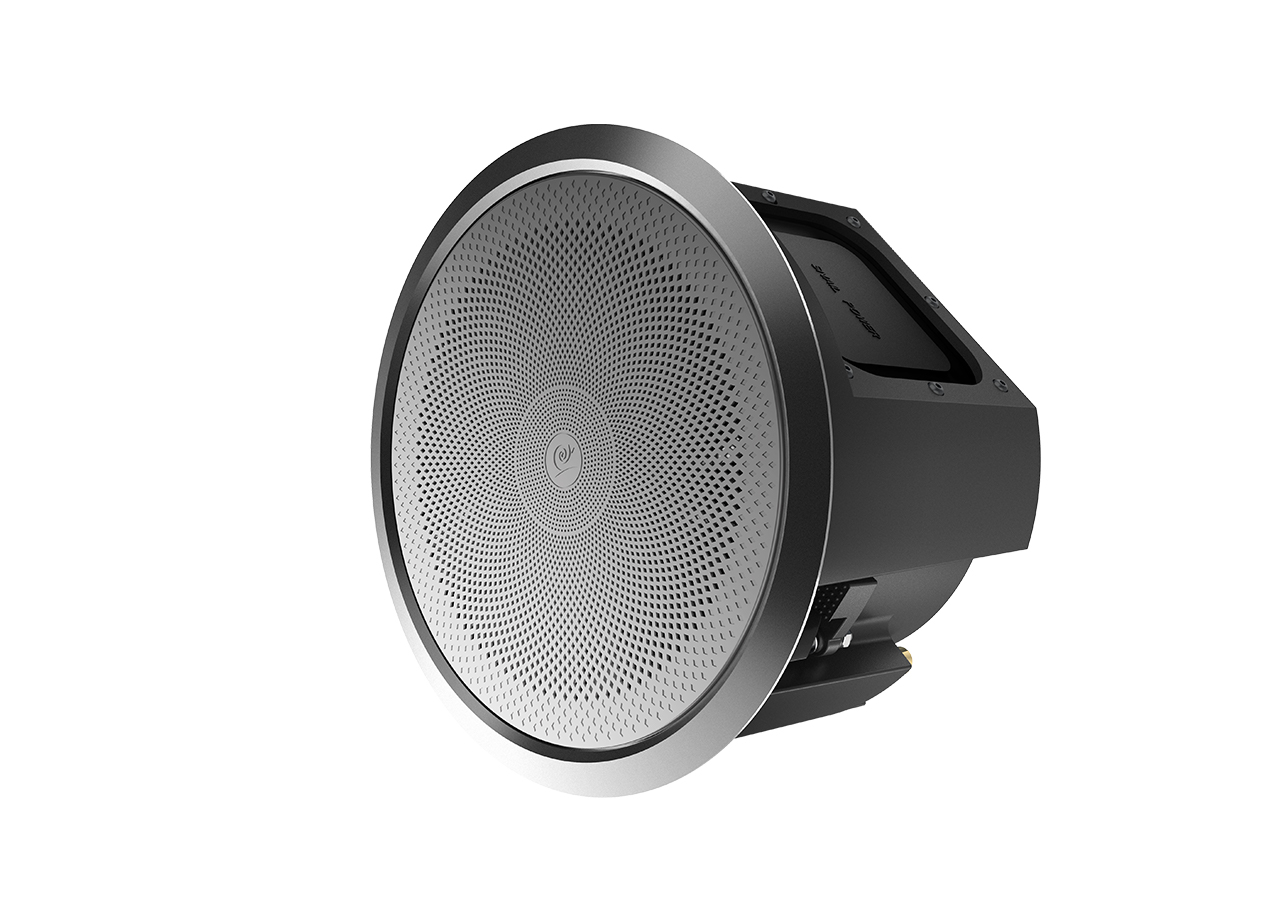
SNAIL POWER was founded in Milan in 1995, worked out its variable waveguide structure in 2016 and launched the IW3 in 2018; hiding a speaker in the downlight position has been the thread for close to ten years now. The IW6 WIDE is the branch aimed at tall spaces: the faceplate follows downlight dimensions, the cut-out is Ø186–191mm, and once it is in, all that remains on the ceiling is a trim ring.
The reason a double-height living room picks it has to do with the word invisible. But what customers mean by invisible is usually not a specification; they mean that when friends come over, nobody can tell a cinema was installed. What makes that possible at six metres is not how small the cabinet is. It is that the cabinet has been moved out of the furniture layer: the ceiling belongs to the ceiling, the sofa belongs to the sofa, and nothing stands in between — no floorstanding cabinet, no stand, no cable.
One thing that gets skipped: the hard finishes in a double-height living room are mostly stone, glass and large areas of painted plaster, so reverberation time normally runs longer than in a single-storey flat. A speaker's directivity can settle whether the sound reaches the sofa. It cannot settle sound bouncing back and forth across the ceiling.
The trade-off: once a concealed speaker goes into the ceiling, its position is fixed. Shifting it half a metre afterwards means opening the ceiling again, re-doing the trim and repainting. It does not suit fitting it first and adjusting later. It suits people who settle the sofa and the screen positions while the drawings are still open.
3. Specifications and Price: Do the Arithmetic First
The 7.1 arithmetic is laid out like this: three IW6LCR-II carry the front three channels, four IW6max carry surround, and one S10D subwoofer holds the bottom. The point of that division of labour is that the units overhead never have to reach for low frequencies themselves, which is what keeps the full-range span relaxed.
| Model | Cut-out | Package configuration | Official package price |
|---|---|---|---|
| CW90 wireless cinema | Ø90mm | CW90×5 + W10 subwoofer + MS-1 | Price on request |
| IW3max | Ø186–191mm | 5×IW3max + B28 subwoofer + AV-700III + MU-1 | Price on request |
| IW4pro | Ø186–191mm | 5×IW4pro + C110 subwoofer + AV-700III + MU-1 | Price on request |
| IW6 WIDE | Ø186–191mm | IW6LCR-II×3 + IW6max×4 + S10D subwoofer | Price on request |
The two holes are easy to mix up. The CW90 has a Ø90mm cut-out, a Ø105mm faceplate and a 100mm cabinet height; the IW series cuts Ø186–191mm. A millimetre is nothing on a drawing and everything on site — it is the difference between a cabinet that drops in and one that will not seat. The CW90 row in that table is a 5.1 wireless configuration on a dedicated 5.8GHz channel with no speaker cable pulled. The IW6 WIDE row is wired into the ceiling. The two routes have completely different construction windows.
The single-unit figures for the CW90 sit here for reference: a 2.75-inch full-range driver plus a passive radiator, 90W per unit, 109dB sound pressure. Its stablemate the IW6 WIDE does not take the larger-driver route; it takes the directivity-and-coverage route for tall spaces. Dolby Atmos and DTS:X certification in progress.
The trade-off: specifications only answer whether it fits and whether it can be driven; they do not answer whether it sounds good. That figure is the price of the speakers and the subwoofer as a set, with amplification, ceiling work and calibration charged separately. A double-height room usually needs scaffolding or a hoist on top of that, and that line item is frequently more expensive than mounting the speakers themselves.
4. Wiring: There Is Only One Window, and It Shuts
In a double-height living room, home theater wiring is the large cost line, and the difficulty is not technical. On a six-metre ceiling the cable runs in tray or trunking, and somebody has to stand up there to do the work. Come back after the boards are up and the sequence reads: take the ceiling apart, pull cable, make good, repaint. Four operations, and their price and their noise both land inside a home people are already living in.
So the order for this system is fixed. Settle the plan before the ceiling is boarded; after the boarding, the only way left is wireless. The CW90 5.1 wireless cinema exists for exactly the retrofit crowd: a dedicated 5.8GHz channel, plug in and use, quoted on request. Anyone already finished who still insists on 7.1 concealed has to accept surface trunking or a local opening in the ceiling, and neither of those looks good.
With living room cinema speakers, fitting in and being heard are two different things, and in a double-height room the second one is clearly the harder.
The trade-off: wiring is the one step in the whole process where the window shuts behind you. You can economise on the speakers. You should not economise on the conduit. One extra cable in the pipe during the build costs very little; one added afterwards costs far more, and you live with a patched line across the ceiling.
5. Who Should Not Buy This System
This section is worth reading first. It decides whether the system suits you far better than the specification table does.
- A living room with a ceiling under 3 metres. Height is not a precondition for this package; sound does not have to be paid for at six metres. The CW90 5.1 wireless cinema sits at the entry of the range, and its hole is smaller as well: Ø90mm.
- Anyone who has already finished and does not want the ceiling touched. There is no retrofit route for wired-in-ceiling, so under that condition the package does not hold up; go straight to the wireless set.
- Anyone who wants one system to cover karaoke as well. On the official price list the cinema-and-karaoke configurations sit on the CW90, IW3max and IW4pro lines; the IW6 WIDE is listed as a 7.1 concealed system, so get a definite answer on that point before you order.
- A budget that stops below this tier. That figure is the speaker package alone, with amplification and installation on top, so the delivered total will be clearly higher.
- A room of only 10–15 m². A tall-space version has nothing to do in a small room, and the extra money does not buy back an acoustic return.
The trade-off: the acceptance standard for concealed cinema speakers is not on the specification sheet. It is on the ceiling surface. Installed with no visible trace only counts as half the job; invisible but unintelligible means it was never installed. Both have to hold at the same time, and that comes from fixing the sofa, the screen and the lighting positions at design stage, keeping the decisions on the drawing.
6. In One Sentence: Three Conditions, All of Which Must Hold
The judgement in one line: for a living room with a six-metre ceiling, the IW6 WIDE holds only if three conditions are true at once — the ceiling really is over 4 metres, the ceiling is not yet boarded, and the budget reaches that line. Miss any one of the three and the premium buys nothing that matches it. The CW90 5.1 wireless cinema is easier to live with, and a great deal harder to get wrong.
The living room in the video is finished, and all you can see is a clean ceiling. The real decision is not in that footage. It is on the drawing you hold before the ceiling boards go up.
The trade-off: all three tests have to be done before you buy. Discover afterwards that the ceiling is too low, or that the boards are already up, and there is no returning it and no rescue through installation work.
Related articles
- IW4pro On-Site Install: One Case Start to Finish in 77 Seconds (Video)
- IW3mini + B28, Long Cut: A Full 5.1 Handover in 46 Seconds (Video)
- Luxury Homes: 10 Seconds Inside a Finished SNAIL POWER Living Room (Video)
END
#IW6WIDE #SnailPower #ConcealedCinema #SixMetreCeiling #LivingRoomCinema #HomeCinemaWiring #DownlightCinema
Written by Digital Xiaoniu, first published on the SNAIL POWER official site, Classic Cases.