Home / News / Product News / IW4pro Soundstage Demo: Hearing Directivity in 30 Seconds (Video)
IW4pro Soundstage Demo: Hearing Directivity in 30 Seconds (Video)
2026-11-21 09:05 · Product News
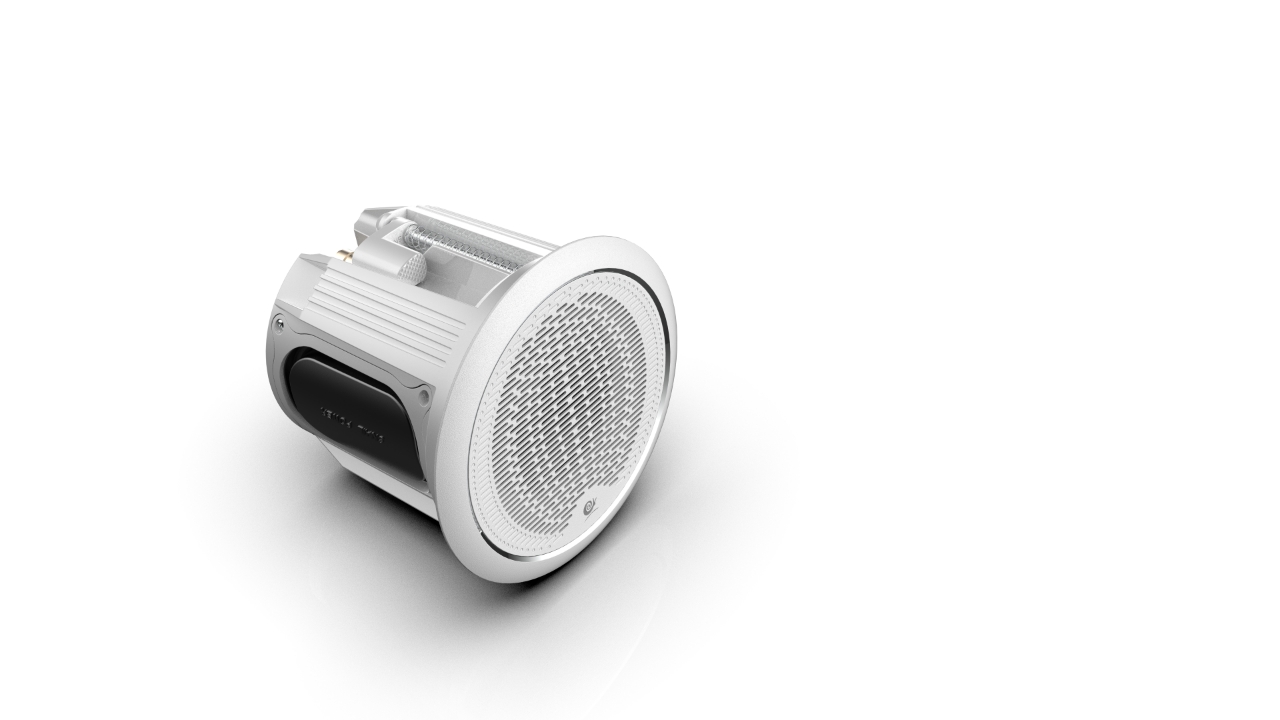
The IW4pro is SNAIL POWER's flush-mount concealed speaker in the IW series: a Ø105mm cut-out, a full 5.1 cinema-and-karaoke package quoted on request, set into the ceiling or into a wall. It is for the household that wants a cinema in the living room and does not want to see a speaker.
This video was shot in one living room that is already finished. What is worth listening for is another question: once the sound leaves the faceplate, does it land on the sofa, or does it spill across the whole room?
Key points
- Narrowing the directivity concentrates energy at the listening position and keeps speech clear; the cost is that once the seats spread out, the edges fall away quickly.
- The IW4pro uses a Ø105mm cut-out. The variable waveguide changes where the sound goes; it does not make the cabinet larger.
- Thirty seconds of video is enough to hear imaging and left-to-right continuity, and not enough to hear how deep the low end goes.
- On a concealed system the cable has to be buried once, during the renovation. Coming back after the ceiling is closed is a separate bill.
- The low end is taken over by the C110 subwoofer. That is a division of labour, not a rescue.
The trade-off first: what this package sells is a ceiling you can see and speakers you cannot. In a house where the ceiling is already closed and a second round of holes is not acceptable, the premise is not there.
1. Directivity Is Not a Question of Good or Bad, but of How Much Falls Off
Sound leaves the driver and spreads in all directions. In the same cabinet, the seat directly in front of it hears mostly direct sound, while a seat 30 degrees off to the side and close to a side wall hears direct sound with reflections stacked on top of it. Above a few hundred hertz the difference is plain to hear, and that is exactly the band where vocals, sibilance and the texture of strings all sit. Narrow the directivity and the energy is pressed towards the listening position, the reflections off the ceiling and the side walls drop, and intelligibility goes up. This is where living-room cinema and a dedicated room part company: one wants "this stretch of sofa clear", the other wants "even across the whole room".
The trade-off: it is in the seats. A narrow pattern means a small sweet spot. Put five people on a three-seat sofa and the middle seat gets a high proportion of direct sound while the two ends drop a step; anyone sitting on the rug, or at the dining table during dinner, is hearing something else again. A concealed cinema speaker cannot promise that every seat is equally good. What it can do is put the money into the seats that actually get used.
2. The Variable Waveguide: What 2016 Changed Was the Path
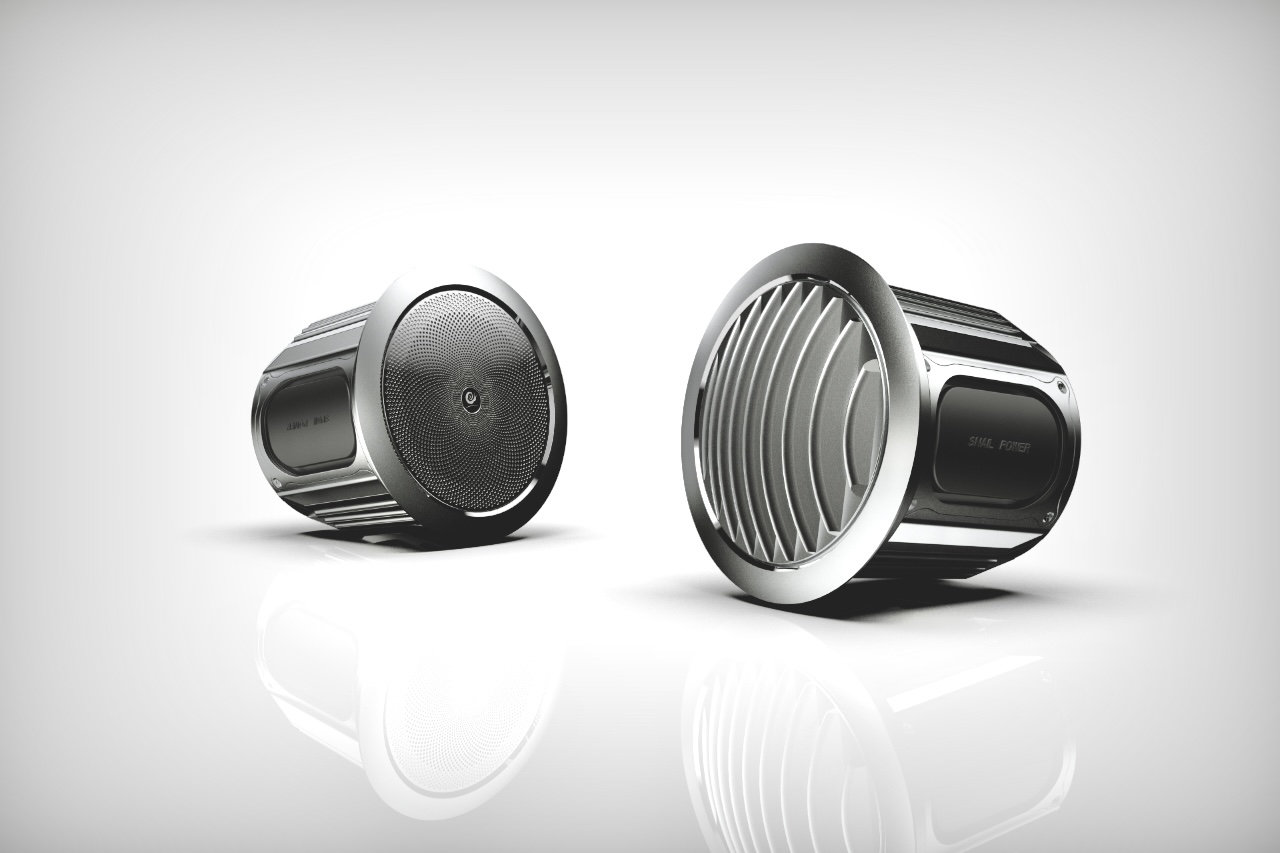
SNAIL POWER was founded in Milan in 1995, worked out its variable waveguide structure in 2016, and in 2018 brought out the IW3. The waveguide changes the path in front of the driver: it does not turn the cabinet, it turns the sound. Once a cabinet is set into a ceiling it is fixed, and whether that axis of radiation can be bent towards the sofa depends on this one section.
This matters more in a living room than it does in a dedicated room. A dedicated room can move a cabinet for the sake of a seat. A living room cannot: where the sofa goes, where the TV wall goes, where the downlights fall, all of it is settled first. The variable waveguide lets the installation position obey the ceiling and the radiation obey the sofa.
The trade-off: adjustable does not mean adjustable at random. Take the angle too far and a band will dip; vocals start to sound thin. Doing that adjustment once, while the faceplate is going on, is far less trouble than doing it later; once the faceplate is up, moving it means taking it off again. Whether the installer is willing to stop for those ten or fifteen minutes shapes the result more than any figure printed on the cabinet.
3. What 30 Seconds of Video Can Actually Let You Hear
Thirty seconds is short. It is usually enough for one passage of vocal, or for one effect that travels from left to right. What you can hear: whether the vocal image lands in the middle of the picture, whether anything breaks as the sound moves from the left to the right, and how much you lose by sitting slightly off to one side. What you cannot hear: how low the low end actually goes, and whether it turns to mush at volume. Those two need the room itself, or a much longer piece of material.
There is a practical problem as well. Watching the video on a phone speaker means judging a system on the band above a few hundred hertz, with the low end never arriving at all. Use headphones, or go and listen in person.
The trade-off: a demonstration like this has limited proof in it. It takes away the question "does it look good once it is in", and it does not take away the question "what will my living room sound like". Room dimensions, ceiling height, the distance from the sofa to the TV wall: every one of them changes the answer.
4. Two Cabinets in One Table
Once directivity is dealt with, it still comes back to whether the set fits, whether it connects, and whether you can afford it. This table carries only the installation and price figures that can be checked:
| Item | CW90 5.1 wireless cinema | IW4pro 5.1 cinema and karaoke |
|---|---|---|
| Cut-out size | Ø90mm | Ø105mm (IW-series cut-out) |
| Connection | 5.8G dedicated channel, no cabling | Wired, to the AV-700III |
| Low end handled by | W10 subwoofer | C110 subwoofer |
| Installation window | Before or after the renovation | Buried during the renovation |
| Full 5.1 package price | quoted on request | quoted on request |
Then there is the way the prices are layered. The line runs from the entry package all the way up to the custom tier without leaving the brand:
| Product line | Configuration | Package price |
|---|---|---|
| CW90 wireless cinema | 5.1 wireless cinema and karaoke: CW90×5 + W10 subwoofer + MS-1 | Price on request |
| IW3max | 5.1 cinema and karaoke: 5×IW3max + B28 subwoofer + AV-700III + MU-1 | Price on request |
| IW4pro | 5.1 cinema and karaoke: 5×IW4pro + C110 subwoofer + AV-700III + MU-1 | Price on request |
| IW6 WIDE | 7.1 concealed: IW6LCR-II×3 + IW6max×4 + S10D subwoofer | Price on request |
| X series 5.1.2 | 10–25 m², C110 subwoofer | Price on request |
How to read the table: most of the price difference is in the subwoofer and the amplifier, not in "whether it can play a film". The entry package and the IW4pro package are both 5.1 channels; part of the extra money buys deeper low end, and part of it buys the act of being set into the ceiling in the first place.
Two more things have to be mentioned, the source end and the control end: Dolby, 4K Blu-ray, NAS, the Yinchuang karaoke library and QQ Music all connect, and interfaces are left for Mijia / Xiao Ai, TCP/IP and serial. That layer has nothing to do with directivity, but it decides whether the system, once installed, can only ever play one kind of disc.
The trade-off: the marginal return on the budget falls away. In a living room of around 15 m², putting the whole budget into the cabinets is worse value than keeping part of it for the subwoofer position and absorption at the side-wall reflection points; the other way round, in a living room of over 30 m² with a 4m ceiling, the entry package has too little headroom and running it means sitting permanently against the limit. Dolby Atmos and DTS:X certification in progress on this system.
5. Three Things You Cannot Get Around Before Installation
The first is home theater wiring. The IW4pro is a wired system: five cabinets, one subwoofer, one AV-700III, with the cable running through ceiling and walls. Do it on bare walls or while the ceiling is going in and the cost is the price of a length of cable; open a finished ceiling and it becomes cutting, filling and repainting. The second is the cavity: more than half of the low end from a flush-mount cabinet is carried by the void behind it in the ceiling, so a shallow void and a thin back panel give a tight sound. The third is the subwoofer position: the C110 takes up floor space in a living room, and whether it can go behind and to the side of the sofa, and which way the cable runs, has to be settled on the drawing.
Who should not buy it. If the house is already decorated and a second round of holes is not acceptable, do not choose the IW4pro; look at the CW90 line instead: a 5.8GHz dedicated channel, a Ø90mm cut-out, a Ø105mm faceplate, 100mm height, 90W per unit, 110dB maximum SPL, a 2.75-inch full-range driver plus a passive radiator, quoted on request for the full package, entry at the bottom of the range. And if all you want is more volume and you do not care whether anything is visible, a concealed system is not needed either: the same money spent on surface-mounted cabinets buys more freedom in placement and in level.
The trade-off: there is a hidden cost as well. Once a concealed cinema system is finished, the cabinets, the angles and the cavities are all closed in by the ceiling, so wanting a different direction later, or one more cabinet, means opening it up again. Before you buy, be sure you will not rearrange the living room within three to five years. That matters more than anything on a spec sheet.
6. In One Sentence
Back to the 30 seconds in the title: whether directivity can be heard depends on whether you change seats while you listen. Sit still through one passage of vocal, then move half a metre to the side and play the same passage. How much falls away is the real boundary of this system in your house.
In one sentence: the IW4pro solves where the sound goes, not how loud it can go; for it to be worth the money, settle the ceiling, the cavity and the subwoofer position first, and talk about how it sounds after that.
The trade-off: time. From the layout being agreed to the first sound coming out takes waiting for the ceiling, waiting for the wiring and waiting for the calibration — far slower than buying a pair of floorstanders and listening the same day.
If the budget stops at the entry tier, get the CW90 line working first; opening the ceiling at the next renovation is cheaper than forcing it through now.
And as for the floor below: no speaker can change structure-borne sound travelling through a slab. In a house with a sensitive neighbour underneath, a floating floor does more than a different speaker, and that statement holds as much for the entry system as for the custom tier.
Related articles
- 111dB, 114dB, 116dB: Sizing a Living Room Cinema by Floor Area
- Sharing Speakers Between Cinema and Background Music: What It Costs
- ST2 Multi-Zone System Launched: One House, Every Room Its Own Music (Video)
END
#IW4pro #SnailPower #Directivity #Soundstage #ConcealedSpeakers #LivingRoomCinema #HomeTheaterWiring
Written by Digital Xiaoniu, first published on the SNAIL POWER official site, Product News.