Home / News / Product News / Living Room Cinema: 30 m² vs 60 m² — What Actually Changes
Living Room Cinema: 30 m² vs 60 m² — What Actually Changes
2026-11-13 · Product News
Conclusion: what separates 30m² from 60m² is not the number of speakers, it is power headroom and low frequency
Many people size a living-room cinema by floor area: 5.1 for 30m², 7.1 for 60m². That is half right. Area really decides two things: how much sound pressure you need, and how large the subwoofer has to be. Whether you run 5.1 or 7.1 depends on whether there is space behind the sofa, not on the area.
Below I take the two living rooms apart: sound-pressure budget, low-frequency budget, amplifier budget, placement budget, and give one configuration for each.
1. Sound-pressure budget: double the area, the requirement rises by 3dB, but the amplifier has to work twice as hard
Sound pressure falls with distance, and a larger room means a longer listening distance. The rough rule: double the listening distance and you lose 6dB. So for a 60m² living room to reach the same loudness as a 30m² one, both the speakers and the amplifier need to keep more headroom.
| Item | 30m² living room (listening distance about 3m) | 60m² living room (listening distance about 5m) |
|---|---|---|
| Target maximum sound pressure | 100–105dB is enough | 105–110dB is comfortable |
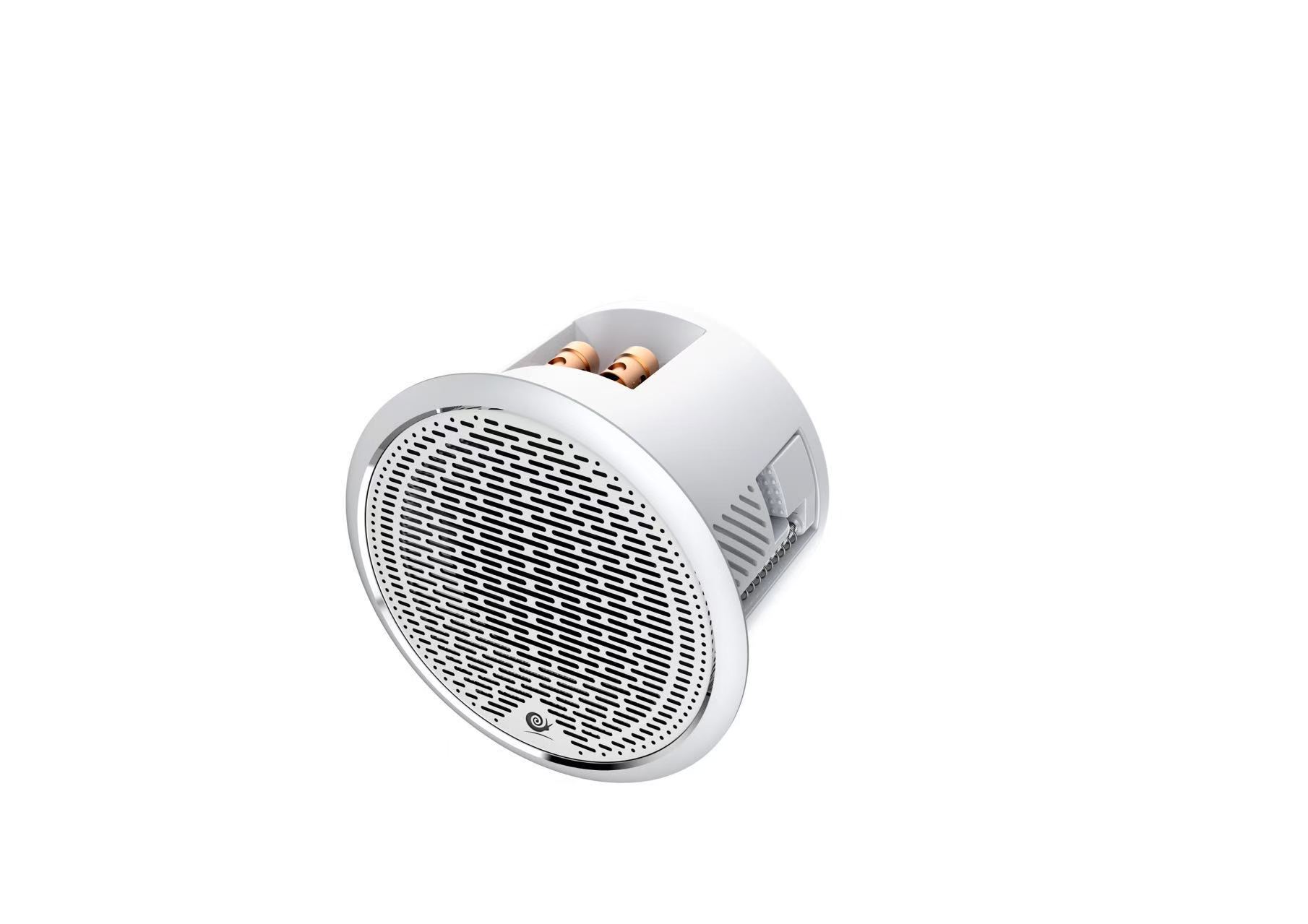
| Driver size | Ø85mm cutout (IW3max) is sufficient | IW4pro (Ø105 cutout) or IW6 WIDE suggested |
| Amplifier | 7×100W is enough | one step up to 150W/8Ω gives more headroom |
| Subwoofer | 10-inch class (B28 / C110) | 12-inch class and above (S10D / X135) |
Note what is not in the table: "bigger area, more speakers". 5.1 or 7.1 is decided by the sofa position: with 40cm or more of space behind the sofa, 7.1 makes sense; with the sofa against the wall, the two extra rear surrounds have nowhere to sit, and the money spent is inaudible.
2. Low-frequency budget: in a small room the enemy is standing waves, in a large room it is a lack of output
A 30m² living room has one unavoidable problem: some band booms at some spot, usually between 40–80Hz, and you can hear it clearly from the sofa. This is not a bad subwoofer, it is a standing wave set by the room dimensions; a new subwoofer will not fix it; placement and DSP will.
The 60m² living room has the opposite problem: low-frequency energy is absorbed by the space, and the same subwoofer sounds weak in a large room. The answer here is not more volume, it is a subwoofer with a larger driver and more power.
- 30m²: placement comes before hardware. Do not push the subwoofer into a corner; keep it 20–30cm from the wall and walk the room with a sound-pressure meter app on your phone, listening as you move, to find a spot that does not boom. That is far cheaper than a new subwoofer.
- 60m²: work out the volume before anything else. 60m² with a 2.8m ceiling is 168m³; in that volume a 10-inch subwoofer is just enough, 12 inches and above is comfortable.
3. Two configurations you can copy directly
30m² living room: the RMB 23,600 tier
| Component | Model | Key specifications |
|---|---|---|
| Main + surround ×5 | IW3max | Ø85mm cutout, Ø100mm faceplate, 110dB maximum sound pressure |
| Subwoofer | B28 | 10-inch class, small enclosure, suits the side of the sofa |
| Amplifier | AV-700 III | 7+2 channels, 7×100W |
| Player | MU-1 | 4K decoding |
The prerequisites for this set: ceiling clearance ≥7cm (the IW3max enclosure is 66.5mm), and more than 30cm behind the sofa. If either one is missing, either switch to on-wall (U3) or accept 5.1 instead of 7.1.
60m² living room: the RMB 55,800 tier
| Component | Model | Key specifications |
|---|---|---|
| Main + surround ×7 | IW6 WIDE | 186–191mm cutout, Ø202mm faceplate, 109dB maximum sound pressure |
| Subwoofer | X135 | High power, holds up in 168m³ |
| Amplifier | AV-1800 | 7 channels, 150W/8Ω per channel, 250W/4Ω |
The most common mistake at 60m² is forcing the 30m² solution: the speakers are adequate, the subwoofer is not, and big scenes always fall short by a breath. If the budget is capped at RMB 40,000, build 5.1 with a large subwoofer rather than 7.1 with a small one — low frequency decides whether it feels like a cinema; channel count merely decides how much it wraps around you.
Official pages for the two configurations
The 30m² set corresponds to Mini-B28 5.1 in-ceiling set and IW3max-C110 5.1 in-ceiling set; the speaker itself is on the IW3max product page, and the amplifier on AV-700 III. The 60m² set corresponds to IW6 WIDE + X135 subwoofer + AV-1800 amplifier; for a complete package see the X-Series-714B 7.1.4 set.
4. Pitfalls in both area classes
- Ceiling height reported wrong. The "7cm ceiling" people talk about is the distance from the finished surface to the original slab; after joists and gypsum board the real clearance often comes to just 6cm. Measure upward from the finished surface, do not trust the drawings.
- The sofa moves back. The design has the sofa against the wall; after installation it moved back 30cm, and the rear surrounds are blocked by the sofa. Fix the sofa position before cutting any hole.
- Using the TV wall as the single datum. The symmetry centre of the surround speakers is the sofa, not the TV. If the TV sits off to the left and the surrounds follow it, the sound field skews.
5. Frequently asked questions
Q: Does 30m² have to be 5.1? Can it be 7.1?
It can, provided there is space behind the sofa. 7.1 at 30m² is not "too big"; it just puts the rear surrounds close to your ears, so their level needs its own calibration.
Q: Will 5.1 sound empty in 60m²?
No. At 60m² with one size larger speakers and a large subwoofer, 5.1 already wraps around you adequately; what makes a large space sound empty is a lack of low frequency, not a lack of channels.
Q: Is the area the gross floor area or the usable area?
Use the actual dimensions of the listening area, length × width, excluding balcony and corridor. Use the clear height for ceiling height.
One-line verdict
At 30m² fix the standing waves before anything else; at 60m² fix the low-frequency headroom before anything else; channel count follows the sofa, not the area. Measure the room length, width, clear height and sofa position accurately, and the configuration list writes itself.