Home / News / Product News / How to Choose In-Ceiling Speakers: Cut-Out, Angle and Directivity
How to Choose In-Ceiling Speakers: Cut-Out, Angle and Directivity
2026-11-13 · Product News
Verdict: nine out of ten ceiling speaker mistakes come down to cutout, angle and aim
Ceiling speakers all look alike: a round hole and a grille. Once they are installed the difference is large. Some make voices sound as if they come through a blanket; some are accurate at the centre of the sofa and thin out half a meter to the side. The cause is not the brand. It is three parameters: cutout size, mounting angle and directivity.
This article takes those three in turn and closes with a comparison table and a note on who should not buy.
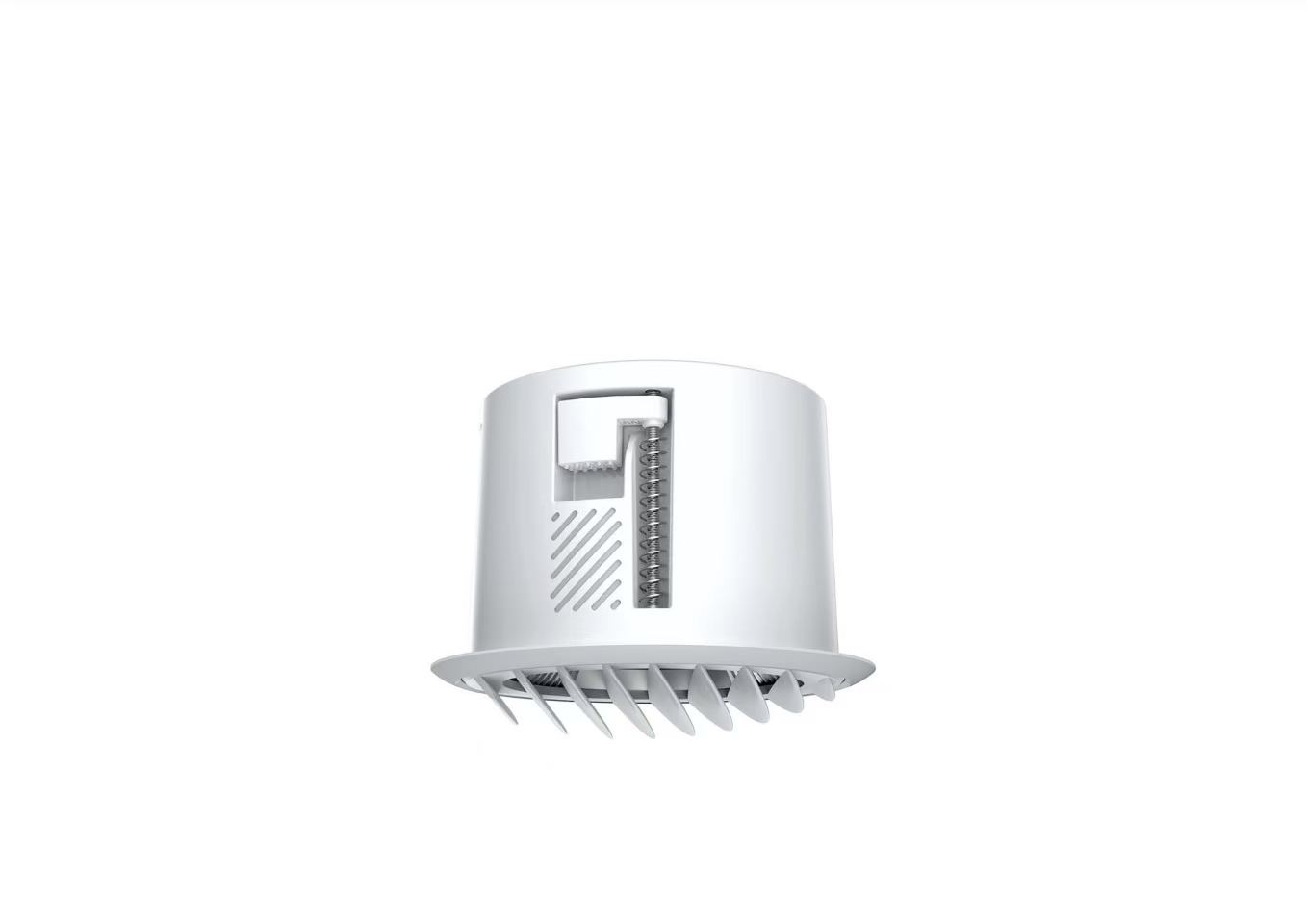
1. Cutout: the number you cannot take back once it is cut
The cutout is the hole the installer cuts in the ceiling; the baffle is the cover that goes over it. The two numbers must not be confused. Once the hole is cut wrong, patching the board, skim-coating and repainting cost far more than changing the speaker.
| Model | Cutout (hole) | Baffle (outer diameter) | Max SPL | Use |
|---|---|---|---|---|
| Mini | Ø80–85mm | Ø91mm | 111dB | small rooms, surround |
| BMmini | Ø90–95mm | Ø105mm | 106dB | background music |
| IW3max | Ø85mm | Ø100mm | 110dB | living room mains and surround |
| CW90 | Ø90mm | Ø105mm | 111dB | wireless, fits a finished ceiling |
| IW4pro | Ø105mm | Ø120mm | 110dB | large rooms, high dynamics |
| IW6 WIDE | 186–191mm | Ø202mm | 109dB | high ceilings, villas |
Driver size and cutout are not related linearly: the outer diameter is usually about 15mm larger than the cutout. A table in which the cutout is larger than the outer diameter has the two columns reversed.
2. Angle: the flatter the ceiling, the more the position has to compensate
Most ceiling speaker drivers fire straight down. With a listener on a sofa the ear-to-speaker angle is 60°–90°, so the high frequencies fall away. Three remedies:
- Steerable tweeter: on some models the tweeter can be tilted through a small angle and aimed at the sofa.
- Placement: do not put the main speakers on the sofa centreline; pull them back towards the TV wall so that the sound arrives at an angle.
- A different mounting surface: if nothing else works, wall-mount and trade angle for direct radiation.
Do not expect EQ to solve a directivity problem. EQ can change the frequency response; it cannot change the direction of the sound field.
3. Directivity: narrower is not automatically better
A speaker with narrow directivity is accurate dead centre and drops off as soon as you move. A speaker with wide directivity reaches the whole sofa but localizes less sharply.
- Films as the priority: the mains can be narrower in the interest of localization; the surrounds should be wide so that the result does not depend on one seat.
- Music and background music as the priority: choose wide directivity; music does not need localization that strong.
- A very wide room (over 4m): angle both side speakers inward, otherwise the SPL at the outer seats falls too far.
4. Three things to confirm before installation
- Ceiling void: measure up from the finished surface. The IW3max enclosure is 66.5mm deep, so leave at least 70mm. A ceiling quoted as 7cm often has 6cm left after installation.
- Joist position: the cutout must not cut a main joist; keep the position 5–10cm clear of it. Decide this before the boards go up; after the boards are fixed you can change the plan.
- Cable position: one audio cable from each speaker to the amplifier position; with a wireless system, leave a mains outlet at each position.
5. How to lay out the five positions of a 5.1 system
The most common use of ceiling speakers is a living room 5.1 system. The reference for the five positions is the sofa, not the TV wall.
| Channel | Position | Suggested wall clearance | Common mistake |
|---|---|---|---|
| Left main | about 30° left of the sofa centreline | 50cm or more from the side wall | following the width of the TV cabinet, so left and right are not symmetric |
| Right main | about 30° right of the sofa centreline | 50cm or more from the side wall | as above |
| Centre | directly above or below the centre of the screen | flush with the edge of the screen | mounted to one side, so dialogue shifts |
| Left surround | 10–20° behind and left of the sofa | 40cm or more from the rear wall | mounted level with the sofa, right against the ear |
| Right surround | 10–20° behind and right of the sofa | 40cm or more from the rear wall | as above |
If the sofa stands against the wall there is no place for rear surrounds, so build an honest 5.1 system instead of forcing 7.1. The two extra speakers have nowhere to go, and the money spent will not be heard.
6. Who should not buy
- Ceilings with just 5cm of void: a standard enclosure will not fit, and a hard install means an ultra-slim model at the cost of low frequency.
- Upstairs neighbours who are sensitive to sound and no insulation: a ceiling speaker sits close to the slab, so build a floating floor or a decoupled ceiling and discuss speakers afterward.
- Anyone who wants to move the speakers later: a ceiling speaker is a fixed installation, and moving it means cutting a new hole.
- Budgets that cover the speakers but not the work: cutting, cabling and commissioning account for about 30% of the cost, and skipping them discounts the result.
7. Frequently asked questions
Q: Can a ceiling speaker act as a main speaker?
Yes. In a living room cinema the mains, the centre and the surrounds can all be ceiling models. The cost is that the height of the sound field is fixed and cannot be adjusted as it can with a floor-standing speaker.
Q: How much area does one ceiling speaker cover?
For background music, allow one speaker per 6–8m². Cinema channels are laid out by position, not divided evenly by area.
Q: Can one ceiling carry different models?
Yes, but the same channel (left, centre, right) should use the same model; otherwise the timbre differs and the sound field shifts.
Q: If a position turns out wrong, can it be changed?
Not without cutting a new hole, patching the board and skim-coating. That is why positions have to be settled before the boards go up.
8. Matching models and systems
Two common tiers for a living room 5.1. The IW3max-C110 5.1 in-ceiling system (from CNY 23,600) suits 20–30m²; for a larger room with more dynamic range, see the IW3max-S10D 7.1 system (from CNY 33,200). A single enclosure is the IW3max; for a finished room where no cable is to be run, see the CW90 wireless (Ø90mm cutout).
One-line verdict
The order for choosing ceiling speakers is this: settle the cutout (it cannot be undone), then settle the positions (they decide the sound field), and the model and the power last. Pick the model before cutting the hole and you will rework the ceiling nine times out of ten.
If the cutout and the positions are uncertain, send the ceiling height, the sofa position and the room dimensions, and the technical team will produce a position plan before installation.