Home / News / Product News / What Is an Invisible Cinema? Concealed Home Theater Explained
What Is an Invisible Cinema? Concealed Home Theater Explained
2026-11-13 · Product News
Conclusion: an invisible theater is not small speakers, it is removing the cabinet from sight
"Invisible theater" is easily read as "very small speakers". Wrong. Small speakers just subtract; an invisible theater makes the cabinet disappear: sound leaves ceiling and walls, equipment goes into a cabinet, and the finished surface keeps a few round grilles in the ceiling color.
Three preconditions, and missing one degrades it into small speakers: the ceiling or wall can still be cut; someone can plaster and finish the cut; the amplifier and player have a cabinet to hide in and can cool. All three or it is not invisible; with one missing, the visible parts simply got smaller.
A second misreading treats it as a decoration style. It is not a style but a sequence of works; the same cabinet installed before and after boarding gives two different products.
One thing up front: the cost sits in the construction, not the equipment. Cabinets are a small share; the money goes into positions, cut-outs, cabling, plastering and finishing. So it suits a house before boarding, not a finished one whose owner wants new audio.
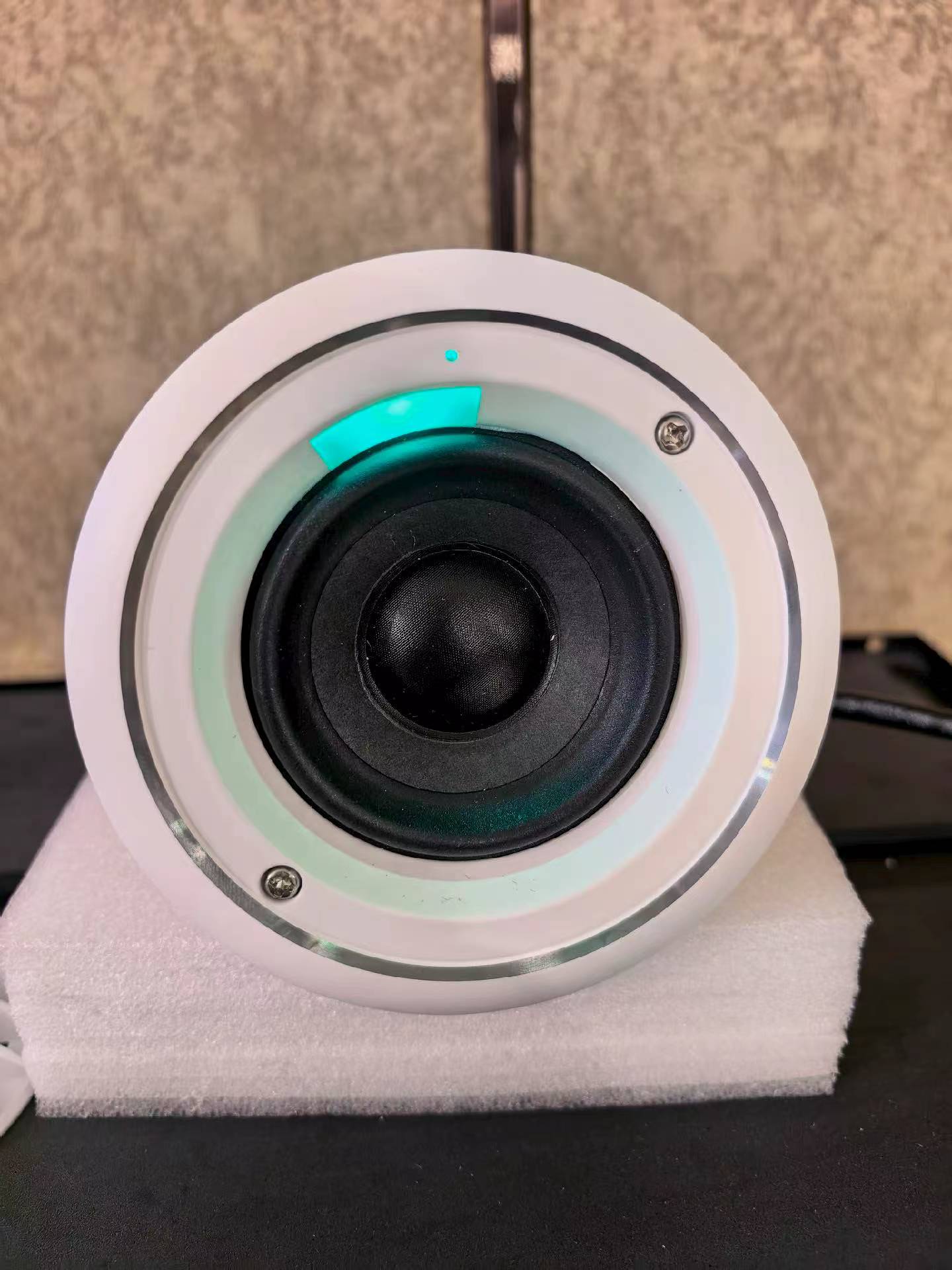
1. Invisible theater and small speakers: two things
A few points make it easy to judge whether a scheme is invisible.
- Visible area. Floor-standing and bookshelf speakers occupy volume: distance from the wall, a walkway, floor on each side of the TV wall. Invisible work leaves an 85–105mm hole and a grille on the finished surface, the cabinet in the ceiling or wall cavity.
- Acoustic path. In-ceiling and in-wall cabinets sit in a cavity and couple to the wall, so boundary gain and baffle effects differ from free placement. Not "a floor-stander pushed into a wall" but a fresh calculation for a cavity: baffle width, cavity size, distance to the corner, bass and sensitivity reworked.
- Where the equipment goes. A floor-standing system keeps amplifier, player and TV box in a row of black boxes on the TV cabinet. Invisible work wants them in a cabinet or utility box, with cooling; that step is often missed, and sealed airtight the amplifier overheats and derates.
- Room to adjust. Floor-standers move a dozen centimeters to find their place; in-ceiling and in-wall units are fixed once installed, leaving crossover, delay and equalization. The second bill: "adjust over time" becomes "calculate once".
In one line: small speakers solve volume, an invisible theater solves presence. They overlap but are not the same. Floor-standers go not because they are quiet but because they block the walkway, show cable and eat the TV wall.
2. Three paths, chosen by the house
In-ceiling, in-wall, wireless: not which is better, but which holds in your house.
| Item | In-ceiling (IW3max) | In-wall (IW4pro / IW6 WIDE) | Wireless (CW90) |
|---|---|---|---|
| Condition | Clearance ≥70mm, ceiling cuttable | Wall cuttable, framing cavity has depth | Power reachable at every cabinet |
| Cut-out | Ø85mm | Ø105mm (IW4pro), 186–191mm (IW6 WIDE) | Ø90mm |
| Cabling | Speaker cable pre-run to cabinet | Speaker cable pre-run, wall chased | No audio cable, power alone |
| Stage | Utilities or carpentry | Utilities or carpentry | Renovation or after move-in |
| Result | Grille on the ceiling | Flush with the wall, grille | As in-ceiling, hidden in ceiling or wall |
The trade-off is direct: ceiling for the ceiling, wall for the wall, wireless for a finished house. With wireless, it saves the audio cable, not the power; every cabinet needs power nearby, and a wrong position still means extra cable.
Mixing is normal: in-ceiling on the living-room ceiling for surround and heights, in-wall on the TV wall so mains share the picture plane, two wireless units in a finished room. Three paths in one house is often easier than forcing one.
Position outweighs model choice. Three constraints: surrounds at both sides and slightly behind the seat, a little above ear height; heights in front of and above the seats, not overhead; main channels at or slightly below picture height, the picture center as reference for in-wall. Positions before cut-outs; reversed, the wall gets patched.
3. Three criteria for "cannot be seen"
Specifications decide whether it sounds good; the three points below decide whether it can be seen. At handover, one glance tells.
| Criterion | Flaw at a glance | Construction requirement |
|---|---|---|
| Flush | A shadow line at the grille edge in side light, or a bump you can feel | Cut-out depth allows for grille thickness; clamp the cabinet tight before finishing; magnetic grille |
| Gap | A black ring at the hole edge, or a hole 1–2mm wider than the grille | One cut at nominal size; chamfer the edge 45° when filling; keep the seam off the face |
| Color | Grey grille on a white ceiling, or a grille that glares | Grille in the ceiling color, matte; black on dark ceilings, white on white |
Of the three, a gap barely recovers. Flush is saved with a magnetic grille and trim, color by swapping the grille, a gap by rework. The cut decides it, so a tight fit beats "a bit larger for easier fitting". No instruments: lights full on, look along the surface at 30° from the side; a shadow marks a spot not done.
Plastering is the other step missed. After the cut the edge needs filler, sanding and paint; done rough, an irregular ring shows once the grille is on. Whether the crew gives a few Ø85mm holes three passes of filler decides how the invisible work looks.
Invisibility costs acoustics. Grille, plastered edge and narrow baffle introduce diffraction at mid and high frequencies, and a cabinet inside a cavity sounds darker in the treble than free placement. Not a defect but part of the mounting: these models are designed around the mounting surface, and the grille must sit flat, since a lifted corner is, audibly, a treble notch.
4. The cost: front-loaded, hard to change, higher unit price
Better to lay the costs out than explain them later.
- Front-loaded. Positions, cut-outs, cabling and plastering all fall early; after boarding, any change is "open, patch, repaint". One wrong hole costs more to fix than the cabinet.
- Hard to change later. Moving a position means a new hole and patching the old; a driver upgrade means the diameter no longer matches and grille and cut-out are redone. Spend two extra days on the drawing, not on the wall.
- Higher unit price. In-ceiling and in-wall units carry cabinet, mounting structure, grille and trim, plus cutting, plastering and cabling labor, so one position costs clearly more than a floor-standing or wall-mounted unit.
- A minimum ceiling height. Finished clearance must be ≥70mm (IW3max cabinet 66.5mm); another 7cm feels oppressive in a low room. A shallow cabinet helps, but shallow bass is limited by physics, and that does not come back.
The other side: no walkway for floor-standers, no agonizing over wall distance, no making way for children and robot vacuums. Which way it tips depends on what you value.
A sequence without rework: positions and cable at utilities; cut and fix cabinets before the carpenter closes up; fill, sand, paint; grilles and calibration last. Grilles last because sanding dust blocks the acoustic openings, and a blocked grille is replaced.
5. Who should not buy this
Boards already up, no wish to cut. Invisibility needs a surface still open to work. A closed ceiling and no cutting leave wall or surface mounting, which is not invisible. Damaging a finished ceiling for the word is a poor trade.
Very low ceilings. Under 70mm of finished clearance, an in-ceiling cabinet will not fit; forcing a shallow one costs bass and level. Below 2.4m finished height, wall mounting is better and the ceiling stays clean.
Budget for equipment alone. Half the money goes into cut-outs, plastering, cabling and finishing. With equipment budget alone, the result is holes cut, grilles mismatched or a visible gap, and an honest wall mount is at least complete.
These three can still have a theater; they should not let "invisible" dictate budget and schedule.
6. Common questions
Q: Is an invisible theater the same as in-wall speakers?
No. In-wall is one path, invisible is the goal. In-wall solves just "the cabinet is in the wall"; grille plastering, color, equipment cabinet and cable routing remain.
Q: Does a Ø85mm hole affect the structure?
Not if it sits between framing members and does not cut the main framing. Confirm framing direction before cutting, do not guess; light positions and the service hatch show it.
Q: Can the grille be repainted?
Yes, in thin coats and matte. Thick paint blocks the openings and the sound goes dull. Take it off before spraying.
Q: What about height channels later?
With routing space left, run one cable from the cabinet to the ceiling. Boards up without provision: surface trunking, or two wireless units.
One-line verdict
The acceptance test is not "how does it sound" but "standing in the room, can you point to the speakers within two minutes". If you cannot, it is done; if you can and think "that is fine", those are small speakers, not an invisible theater.
Three paths: ceiling open and a clean look, in-ceiling; a flat TV wall, in-wall; finished with no wall work, wireless. For a whole system the bundle pages are quicker: IW3max-C110 5.1 in-ceiling bundle (from ¥23,600), CW90-W10 5.1 wireless bundle (from ¥17,200), both bundle starting prices.
Product pages: IW3max in-ceiling · IW4pro in-wall · CW90 wireless · IW3max-C110 5.1 bundle · CW90-W10 5.1 bundle