Home / News / Product News / Choosing a Subwoofer: Size, Power and Extension
Choosing a Subwoofer: Size, Power and Extension
2026-11-13 · Product News
Conclusion: three calculations, and the model is basically settled
The usual mistake is copying a configuration list and buying one size larger. A subwoofer is not standalone: it adds 40–100Hz energy to one specific room, and the same unit is judged oppositely in an 18m² living room and a 45m² media room.
Three calculations: driver size against volume, power against dynamic demand, extension against whether the room supports that frequency; what they leave unsettled is placement, not budget. Directly: 15–25m² with a 2.6–2.8m ceiling takes the 10-inch class — B28, C110, S10D; above 30m², a dedicated room, or a wish for tactile output below 30Hz, points to the 13.5-inch X135; a 13.5-inch under 12m² wastes the money.
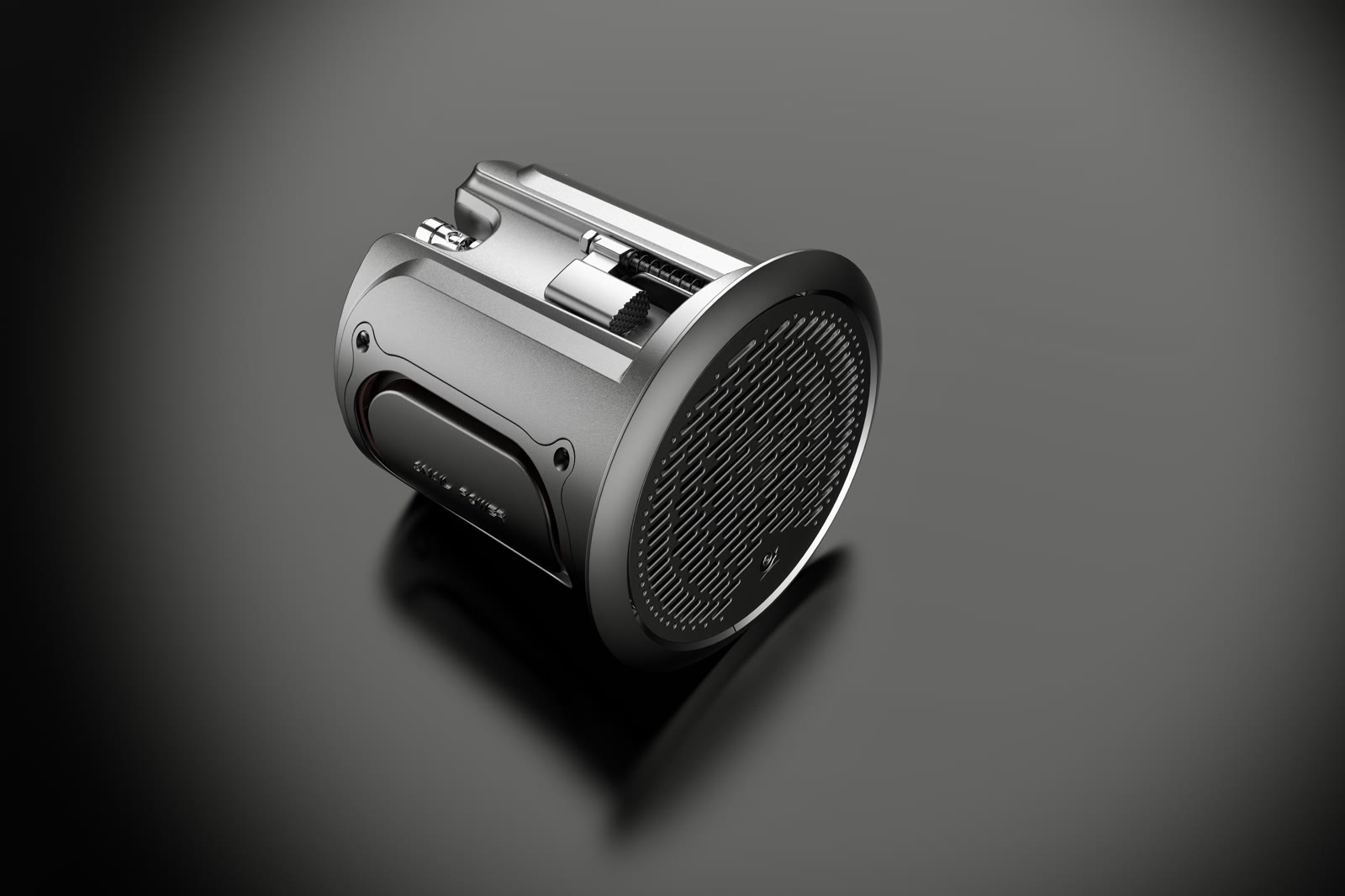
1. Driver size: volume before inches
Driver size is how much air moves at once; each step up adds half again to double the area, but area is not displacement, and displacement = area × excursion: a long-excursion 10-inch out-displaces a short-excursion 12-inch, hence twin 8-inch drivers in B28 and a 10-inch plus passive radiator in S10D.
For the room it is volume in m³, not floor area: 25m² × 2.6m is 65m³, 20m² × 3.3m is 66m³ — the same demand, though area answers differently.
| Model | Drive | Driver size | Enclosure | Rated extension | Suitable room |
|---|---|---|---|---|---|
| B28 | Active (built-in amplifier) | Twin 8-inch + twin 8-inch passive radiators | Sealed | 30Hz (±3dB) | Not published |
| C110 | Active (built-in amplifier) | Single 10-inch | Ported (twin ports) | 25Hz (±3dB) | Not published |
| S10D | Active (built-in amplifier) | 10-inch + 10-inch passive radiator | Sealed | 25Hz (tolerance not published) | Not published |
| X135 | Active (built-in amplifier) | 13.5-inch | Sealed | 20Hz (tolerance not published) | Not published |
Not published because the site does not rate rooms by area; estimate from volume, never from the model. 35–60m³ (about 15–22m²): 10-inch class; 60–100m³ (about 22–35m² or open plan): the 10-inch with most displacement, or a 13.5-inch; above 100m³: the 13.5-inch tier. Small rooms suit none — narrower modal spacing, a broad 40–80Hz peak, boom from a small driver — so use DSP (all four have it) or a 70Hz crossover.
2. Power: active or passive is where the money goes
Active versus passive matters more than wattage: active builds amplifier, crossover, phase, volume and DSP in; passive needs an external amplifier. Cinema is nearly all active because a subwoofer needs a dedicated amplifier and tuning, cheaper and better matched inside; all four are active.
The basis: 1000W RMS short-term is sustained for tens of seconds, not the 10ms programme peaks — honest, but no promise of indefinite loudness. Loudness is power with sensitivity, and all four sit in 86–88dB, so doubling power buys 3dB, and power is no grade. The other half is tuning: cinema, standard, music and computer presets on B28 and S10D, cinema, small room and music on C110, automatic testing and real-time EQ from a phone app on X135 — pressing down what placement cannot fix.
3. Extension: -3dB and -6dB are not the same
Extension is published as 25Hz–200Hz (±3dB); the ± is the tolerance: -3dB is 3dB below the passband average, -6dB is 6dB below. Both read 25Hz while the -6dB unit is 3dB — half the power — down; without a tolerance (X135 at 20Hz, S10D at 25Hz) it says where the limit roughly lies, not that response is flat to 20Hz.
Room gain lifts a sealed cabinet, so heard extension often beats the rating; a ported cabinet rolls off at 24dB/oct below tuning and needs high-pass protection. Each step lower costs excursion, cabinet size and power, and 20–30Hz modes often sit in a null, so the 20Hz you paid for may be inaudible from the seat: flatten 40–80Hz, which carries punch and dialogue body. Sealed and ported are two characters, not grades:
| Item | Sealed | Ported |
|---|---|---|
| Roll-off | Gentle, about 12dB/oct, assisted by room gain | Efficient near tuning, about 24dB/oct below it |
| Character | Clean transients, drum hits stop cleanly | Plenty of weight, the low end pushes harder |
| Size at equal extension | Smaller | Larger |
| Placement tolerance | High, a nearby corner stays controllable | Medium, wall distance changes tuning |
| Suits | Cinema and music together, smaller rooms | Weight wanted, larger rooms, film-led systems |
One middle path: S10D replaces the port with a passive radiator — ported-like roll-off, no port noise, less fussy about wall distance, at the cost of an extra radiator, weight and money; part of why it weighs 20kg.
4. Placement: the room supplies the bass, and the boom
Below 80Hz the room outranks the subwoofer: three positions shift 40–80Hz by more than 10dB, more than a change of model.
- Position decides which modes are excited, not how much bass exists: a corner excites nearly all of them, giving weight and variation; mid-wall gives less, flatter.
- The seat matters as much: half and a quarter of the room length are nodes where frequencies vanish; a sofa on the rear wall gains boundary lift and deeper nulls.
- The crawl costs nothing: set the subwoofer at the listening position, crawl the room, find the flattest spot, move it there.
Two subwoofers buy flatness, not loudness — offset sources fill each other's nulls if delay or phase is adjustable, otherwise they cancel. Crossover from 80Hz; with CW90 or IW3max, 90–100Hz sounds cleaner.
Then diagnosing boom. Standing waves and a weak subwoofer need opposite responses, subtract versus add:
- It moves: stand, take two steps, the boom shifts or vanishes — a standing wave.
- It booms on certain notes: another film stops it, so that frequency sits on a mode.
- Everything is thin: near full scale for impact, then mud and distortion — output is short.
Measurement is better: a phone meter and a 20–200Hz sweep, or a microphone and a response curve; a peak or dip over 10dB is a room mode. Order: placement, seat, second subwoofer, equalisation, bass traps.
| Symptom | Likely cause | Start here |
|---|---|---|
| One band, say 40Hz, booms, gone at another seat | Standing-wave peak from a room mode | Move subwoofer and seat; then a second subwoofer; equalise last |
| Thin, and turning up turns muddy | Too little displacement or extension, or the crossover cuts early | Crossover to 90–100Hz; then consider a larger driver |
| Enough at the corner, the middle of the room empty | Boundary gain doing the work, modes over-excited | Move 30–50cm out of the corner, or try mid-wall once |
| Bass tails off, drum hits smear together | Long low-frequency decay, subwoofer at a pressure antinode | Off the side and rear walls, then add bass traps |
| A hum but no impact | Phase and delay between mains and subwoofer unaligned | Align phase and distance, then crossover and level |
| Still uneven after several positions | Length and width near a whole-number ratio, modes coincide | Two subwoofers plus equalisation; keep seating off the centre line |
5. Who should not buy one
Three groups get back less than they spend. Very small rooms: under 12m² and 35m³ a 10-inch runs hot between 40 and 80Hz, modal spacing exceeds 20Hz, and flattening costs more than the subwoofer; fix the mains, or use a small driver with strong DSP split at 60Hz, since a 13.5-inch booms even at minimum volume. Sensitive neighbours: tactile 20–30Hz travels through the slab: high-pass below 35Hz, or isolation pads off structural walls, or none. Music listeners: with mains reaching 45Hz in a modest room, a subwoofer adds the 40–100Hz foundation, which needs finer integration — phase, crossover, delay, level; miss one and the bass muddies, so prefer sealed and clean.
Not a refusal but a sequence: a subwoofer adds quantity and extension, not an even room or good integration.
6. Common questions
Q: 10-inch against 12-inch?
About 40% more effective area, but what you hear depends on displacement and cabinet; in one series each step adds roughly 3–6dB, and inches compared across series mean nothing.
Q: How do I connect an active subwoofer to my amplifier?
One signal cable from the low-frequency output (SUB OUT / LFE); without that output, check high-level input on the subwoofer.
Q: Is one enough?
For 20–30m², yes. Where length and width are near a whole-number ratio, or the seat is off centre, a second subwoofer gains more than one larger model.
Q: Front or back?
Front, on the same side as the mains, where delay and phase align easily. At the back it fills nulls but needs independent delay, or it fights the mains' low end.
One-line verdict
Measure the volume before fixing driver size, check that the power figure is sustainable, check that the extension figure states a tolerance; about 80% of satisfaction comes from placement, not the model. Those three lines on paper beat half an hour with a configuration list.
Following that logic: small rooms and living rooms, B28; tactile output below 30Hz above 30m², X135; if configuring part by part is not for you, the bundles are simpler — IW3max-S10D bundle (from ¥33,000) and X series bundle (from ¥79,900), both quoted at package starting prices.
Product pages: B28 active subwoofer · X135 active subwoofer · IW3max-S10D bundle · X series bundle