Home / News / Product News / Living Room Cinema Without a Dropped Ceiling: 5.1 in 7 cm
Living Room Cinema Without a Dropped Ceiling: 5.1 in 7 cm
2026-11-13 · Product News
Verdict: a 5.1 set can go in without a dropped ceiling, but one precondition has to be settled up front
The sentence "a living-room cinema without a dropped ceiling" actually hides three different questions: how deep the ceiling void really is, whether it can be cut, and whether cable can be run through it. Those three conditions differ, and the options differ with them.
Here is the verdict: as long as the clear ceiling void is ≥7cm, a whole 5.1 set can be hidden in the ceiling with no second-layer dropped ceiling; at 5–7cm you are down to a slim enclosure or a switch to wall mounting; where even a cutout is not allowed, go surface-mounted or wireless.
1. Measure the "7cm" before anything else
The 2.8m a developer quotes is the structural floor-to-floor height; the clear height you actually get is often 2.65–2.7m. The space usable inside a dropped ceiling equals the distance from the finished surface up to the original slab, minus the joists and the gypsum board.
| What people say | Real usable clearance | What fits |
|---|---|---|
| Dropped ceiling 10cm | About 8–9cm | Standard in-ceiling boxes such as IW3max (66.5mm enclosure) |
| Dropped ceiling 7cm | About 5.5–6cm | A slim enclosure, or switch to CW90 wireless (amplifier built in, mains power required) |
| No dropped ceiling (original slab) | 0 | Wall mounting, surface mounting or floorstanding |
How to measure: measure upward from the finished ceiling surface; the void counts as real clearance when you can reach the original slab there. The "ceiling height" marked on drawings usually leaves out the thickness of the gypsum board.
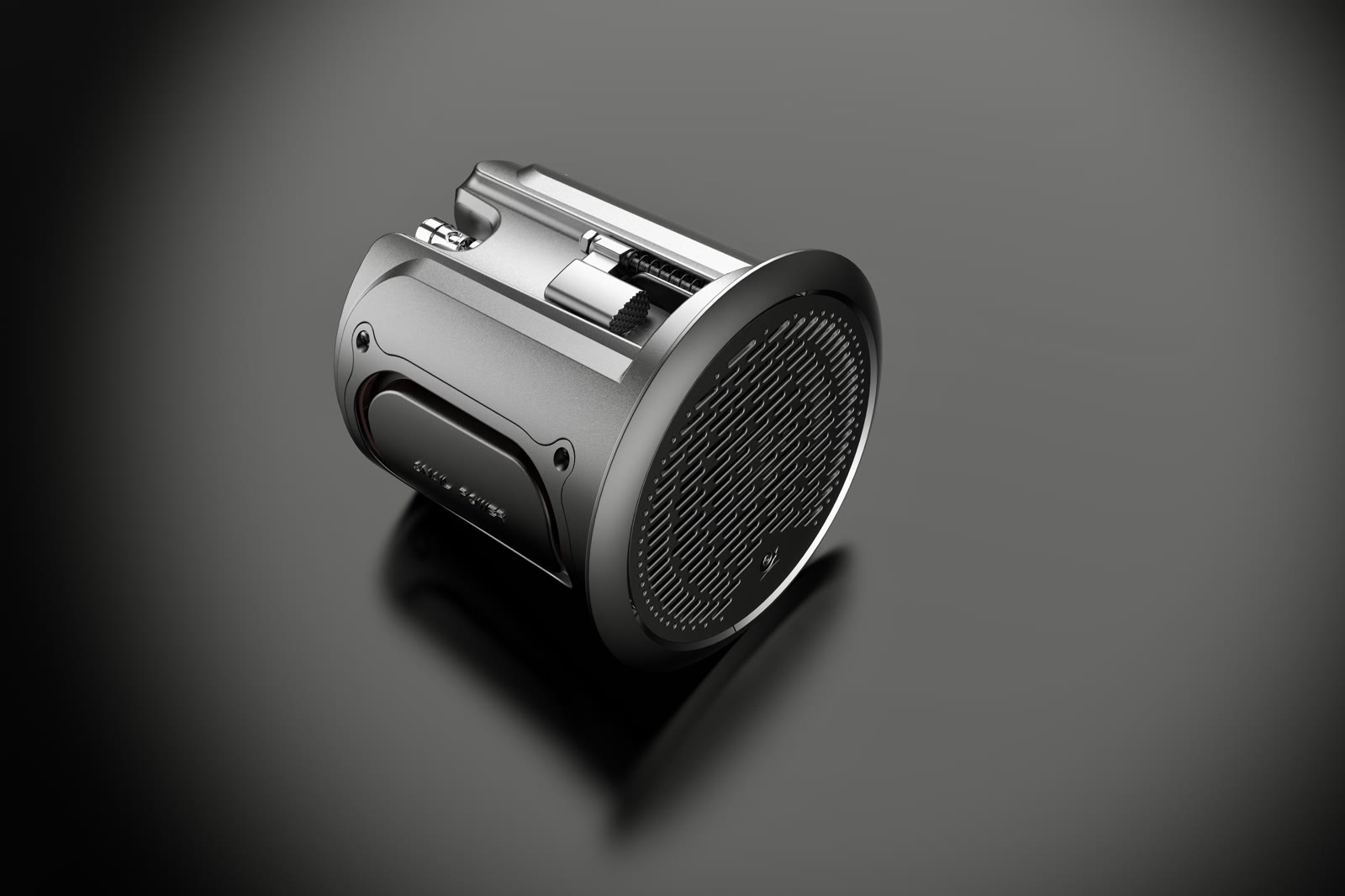
2. Three routes, chosen by condition
| In-ceiling (IW3max) | Wall mount (U3 / U4max) | Wireless (CW90) | |
|---|---|---|---|
| What it needs | Clearance ≥7cm, cutout allowed | Wall can be drilled, room on both sides of the sofa | A mains socket per speaker, a fixing point on the ceiling or the wall |
| Cutout | Ø85mm | No cutout | Ø90mm (ceiling) or wall mounted |
| Cabling | Audio cable chased in during the build | Audio cable chased in, or run surface | No audio cable, mains power alone |
| Stage it suits | Mid-renovation | Mid-renovation / retrofit | Retrofit |
| Look | Neatest: all you see is the grille | Stands about 10cm proud of the wall | Same as in-ceiling, hidden in the ceiling |
These three are not "which one is better", they are "which condition holds". Mid-renovation with enough ceiling height: in-ceiling; not enough ceiling but a usable wall: wall mount; already finished: wireless.
3. What to do when the clearance is 5–6cm
This range is the awkward one: the cutout can be made, but a standard enclosure will not drop into it. Three ways to handle it:
- Switch to a slim enclosure: some models keep enclosure depth within 60mm. The price is low-frequency extension and sound pressure level, which makes them fine for surrounds and not for the main channels.
- Wall-mount the mains, put the surrounds in the ceiling: a common hybrid. The mains stay on the wall to keep their dynamics, the surrounds use slim enclosures tucked into the ceiling.
- Go wireless across the board: the CW90 has the amplifier built in and an enclosure designed differently from a wired model, with a Ø90mm cutout, so it asks less of the clearance than "enclosure plus outboard amplifier".
One point to be clear about: a slim enclosure is not a shrunken standard box; its low frequency is limited by physics. Accept that price, then talk about the layout.
4. Three approaches for retrofit (the room is already finished)
- Wireless with borrowed power: take power from a downlight position, cut a Ø90mm hole in the ceiling, and no cable shows once the job is done. This is the neatest retrofit route.
- Surface trunking: run it along the skirting or the wall-ceiling corner, in a colour as close to the wall as you can get. Cheap, but visible.
- Wall mount with a local cable run: mount either side of the sofa and hide the cable behind the furniture. Suits anyone who does not want to touch the ceiling.
5. Frequently asked questions
Q: Without a dropped ceiling, can the surrounds sit on the floor?
Yes, but a floorstanding surround takes up floor space, is easy to knock into, and sits below ear height, which pulls the sound field off centre. If it can go on the wall, put it on the wall.
Q: For a 5.1 set with no height channels, is a dropped ceiling needed at all?
No. The five channels of a 5.1 set all sit at ear height or slightly above; the ceiling is merely where the boxes hide.
Q: Will the cutout hit a joist?
It can, which is why the speaker positions have to give way to the joists. Scan the ceiling with a detector before cutting, or read the joist direction off the downlight positions.
Q: Does the wireless route spoil the finished look of the room?
No. The enclosure sits inside the ceiling and what you see is a Ø105mm grille, the same as a wired install.
One-line verdict
"No dropped ceiling" does not mean no cinema; it forces a decision up front: either lower the demand on the ceiling (slim enclosures) or change the mounting method (wall mount / wireless). Measure the clearance, then pick the route, and stop going round in circles over whether to build a dropped ceiling — the ceiling is just where the boxes hide, not a precondition for a cinema.