Home / News / Product News / What Are Invisible Speakers? A Guide to Concealed Home Cinema
What Are Invisible Speakers? A Guide to Concealed Home Cinema
2026-11-13 · Product News
Verdict: an invisible speaker is not a type of speaker, it is a way of installing one
The term misleads. It is no separate category: it means a cabinet inside the ceiling or wall, so that afterwards the room shows nothing but a round grille. In a ceiling it is a ceiling model, in a wall an in-wall model; where neither can be cut, a slim surface box. "Invisible" is a result, not a product.
The order is fixed: method, then cutout diameter, then model. Pick a cabinet up front and force it into a ceiling and eight attempts in ten fail, the other two cutting a joist.
Quick routing: mid-renovation with 7cm of clear depth above the finished ceiling, IW3max or similar in-ceiling; a cuttable wall where fronts matter, in-wall; finished, no holes allowed, a slim surface box, or a Ø90mm hole with a CW90 wireless unit.
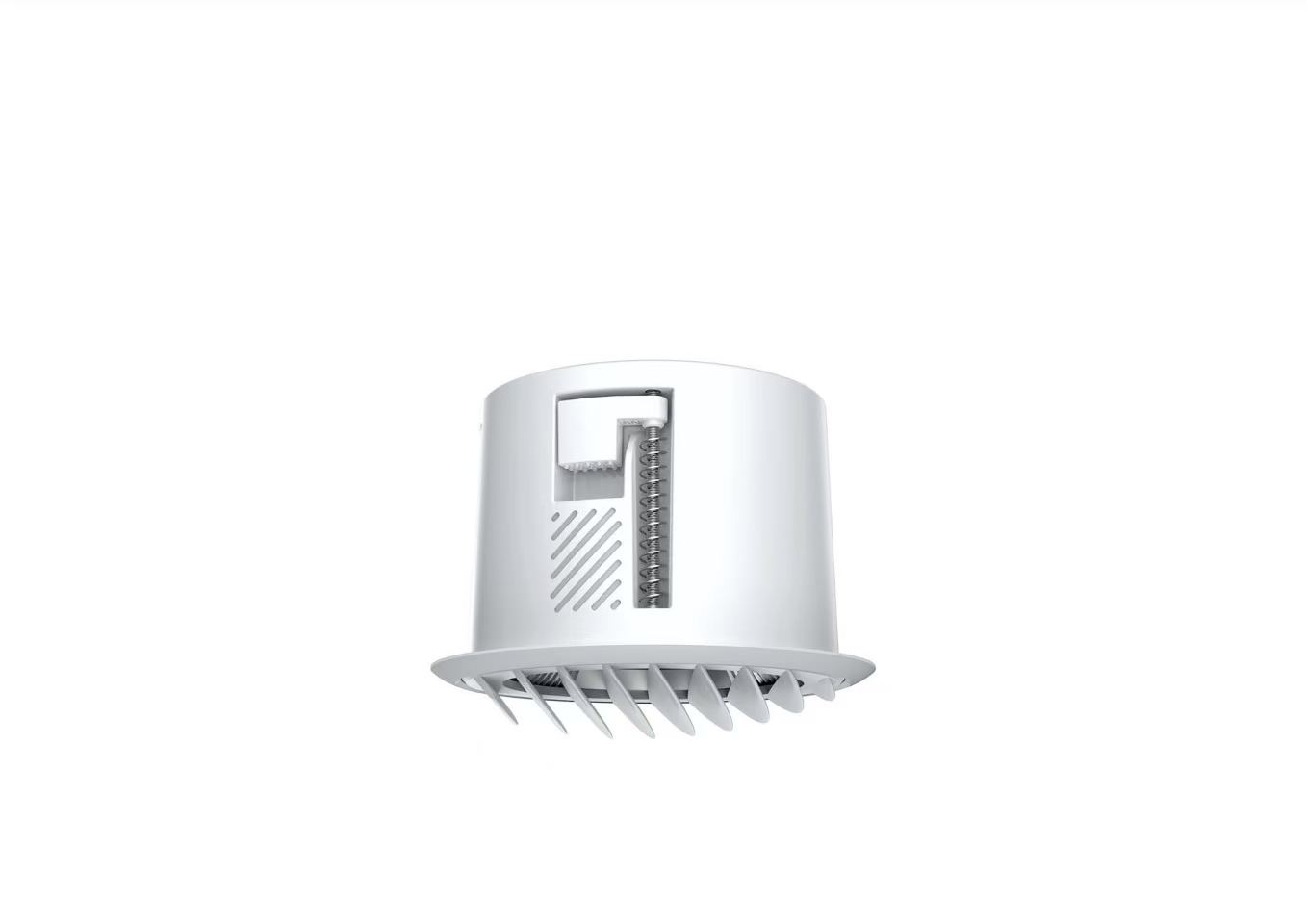
1. Three ways to hide, and the difference from a ceiling speaker
Split "invisible" into three installations. They differ less in how invisible they look than in reversibility: once cut, there is no going back.
| Item | In-ceiling cutout | In-wall | Slim surface mount |
|---|---|---|---|
| How it hides | Cabinet into the void, grille flush | Cabinet into the wall, faceplate flush | Cabinet on the wall, slightly proud |
| What it needs | 7cm+ from finished surface to slab, cutting allowed | Cuttable wall, cavity 7cm+ | Wall takes anchors, no cavity |
| Cutout | Yes, Ø85mm on IW3max | Yes, Ø105mm on IW4pro | None |
| What you see | One round grille | One round faceplate | A thin box on the wall |
| Serviceability later | Low, the ceiling has to be opened | Medium, faceplate off, cabinet out | High, two screws |
| Acoustic cost | Void joins resonance, needs damping wool | Wall acts as a baffle, gain and colouration | Edge diffraction, placement limited |
| Build stage | During renovation, at board fixing | During renovation, before the skim | During or after renovation |
The cabinet never enters the room in any of the three; the difference is the price. In-ceiling is irreversible: hole cut, bracket in, a change of plan means patching the ceiling. In-wall is half reversible, plaster easier than a ceiling. Surface mount is fully reversible, at the cost of standing proud.
A distinction that recurs: an invisible speaker and an ordinary ceiling speaker are not the same thing. A typical ceiling speaker is a shallow shell with spring clips on the plasterboard, no enclosure, fitted for background music. A cinema box has a real cabinet (66.5mm on IW3max), fixes through the cutout onto a bracket, and is placed per channel.
One brand divides the work too: BMmini (faceplate Ø105mm, cutout 90–95mm, 106dB) is background music, IW3max and IW4pro are cinema channels. Decide between whole-house sound and a cinema at the sofa; the arithmetic differs.
2. Cutout and faceplate sizes: read the table
The table serves quotes and site work. Two columns matter: cutout is the hole that gets cut, faceplate is the disc that covers it, always 10–15mm larger, a ring that hides the cut edge.
| Model | Faceplate OD | Cutout dia. | Cabinet / clearance | Max SPL | Role |
|---|---|---|---|---|---|
| CW90 | Ø105mm | Ø90mm | Wireless, amp built in, needs ceiling power | 111dB | Surround, ceiling |
| Mini | Ø91mm | 80–85mm | Small cabinet | 111dB | Small rooms |
| IW3max | Ø100mm | Ø85mm | Cabinet 66.5mm, needs ≥70mm clearance | 110dB | Main channels, surround |
| IW4pro | Ø120mm | Ø105mm | Extended cabinet | 110dB | Front left, centre, right |
| IW6 WIDE | Ø202mm | 186–191mm | Large cabinet | 109dB | Front channels, large rooms |
| BMmini | Ø105mm | 90–95mm | Background music cabinet | 106dB | Whole-house background music |
Be explicit: give the faceplate diameter and the hole comes out larger than the cabinet, so the grille cannot cover it; give a smaller figure and the cabinet will not go in.
Clearance is measured, not calculated: from finished ceiling to slab, less board and joist, is the depth available. "12cm ceiling" on a drawing usually excludes the board. IW3max asks ≥70mm against a 66.5mm cabinet, 3.5mm spare for cable and decoupling.
A larger driver brings low-frequency and SPL headroom, but the cutout grows and structure is harder to clear. In a 20–30㎡ living room Ø85–Ø105 cabinets suffice for surround and height; front channels in large rooms alone justify 186–191mm. In a small room a large cutout hits lights and ducts, the box moves, symmetry breaks.
3. Which build stage has to lock it in
The schedule follows the carpenter and the electrician, not the equipment. Four stages, one missed means rework:
- Power and cable stage: mark positions, run audio cable, 2×1.5mm² or 2×2.5mm², with 30–50cm of slack at both ends; route it above the cabinet, never across the cutout.
- Before the ceiling boards: confirm joist clearance, cut holes, fit brackets. Positions are locked after this.
- Boarding and skimming: leave cabinets out, cover the openings with card or plastic against dust, keep the faceplates for the end.
- Before moving in: fit cabinets, add grilles, set levels and delay.
One rule worth repeating: cut before or around board fixing. Cut after the skim and the board edge crumbles; the patch is never round and the faceplate gaps. The sofa comes before that too: positions fixed before it leave a soundstage 30cm off axis that no calibration recovers.
Spacing follows channels, not an equal division: in 5.1 the fronts sit 20–30° off the sofa axis, surrounds just behind ear height. Set the axis from the sofa, then mirror the pairs; with a beam overhead move both boxes in by 10cm rather than one against it.
A finished house keeps a route: a Ø90mm ceiling hole plus power from a downlight takes a CW90 box without rewiring. Otherwise a slim surface box.
4. How to judge "invisible", and where the money goes
"Invisible" is not an adjective here but three measurable things:
- Flush: faceplate to finished surface within 1–2mm. Stand 5mm proud and any side light draws a shadow line, obvious from the sofa under a 2.8m ceiling.
- Same colour: white ceiling, white grille; dark ceiling, dark faceplate or on-site paint sprayed thin, since a thick coat blocks the mesh and muffles the sound.
- Distance and mesh: beyond 2.5m a fine metal mesh blends into the ceiling, a coarse one shows under spotlights.
Lights are often missed: a downlight grazing a faceplate edge always throws a shadow, and spacing lights and speakers 30cm apart does more than a thinner cabinet.
Sets: CW90-W10 5.1 wireless from ¥17,200, U3-B28 5.1 wall-mounted from ¥19,600, IW3max-C110 5.1 in-ceiling from ¥23,600 (B28 version from ¥21,000); above that IW3max 5.1 with S10D from ¥33,000 and IW6 WIDE 7.1 with X135 from ¥55,800. Same 5.1, in-ceiling runs six thousand more than wireless: the gap is not drivers but labour for cutting, brackets, joist reinforcement, patching and setting out.
5. Who should not buy it
Four groups I would leave waiting:
- Anyone short of ceiling height. Under 7cm from finished surface to slab the 66.5mm IW3max cabinet will not go in. A thinner cabinet limits low frequency by physics: the same money buys less bass.
- Anyone who cannot touch the joists. Beams, air-conditioning ducts, sprinkler pipe, or a manager who forbids holes. A cutout that meets a joist has to move, and a moved box breaks symmetry.
- Anyone whose whole budget is the speakers. The from ¥23,600 figure covers equipment and standard installation; reinforcement, patching, a second skim are extra. Read it all as "speaker money" and the cuts land on the amplifier or the acoustic treatment.
- Anyone treating invisible as a sound upgrade. It solves "you cannot see it", not low-frequency extension. Deeper bass comes from a subwoofer and its placement, not a flush faceplate.
6. Common questions
Q: Is an invisible speaker the same as a ceiling speaker?
No. Ceiling names the position, invisible names the result. An ordinary ceiling box is a shallow shell with spring clips for background music; a cinema box has its own cabinet and is placed per channel.
Q: Can invisible speakers go in after renovation?
Yes, on another route. With ceiling and walls untouched a slim surface box is left; with a Ø90mm hole and power nearby a CW90 box goes in without rewiring.
Q: Will a cutout crack the ceiling?
The hole will not, its edge treatment will. Keep off the joists, leave 2–3mm of clearance, do not force the cabinet against the board, sand the cut edge, mesh the filler joint.
Q: In-wall or in-ceiling, which sounds better?
Look at the channel, not the cabinet. Front left, centre and right on the wall at ear height anchor dialogue better; surround and height are more natural overhead.
One-line verdict
An invisible speaker is decided not by "invisible" but by the two or three weeks before the renovation: fix cutout diameter, positions, power and lighting once and it really is out of sight; leave it late and it stays visible. Ask three things: is there 7cm of clearance, can the joists be cleared, does the budget hold an installation line.
Models: IW3max in-ceiling speaker, IW4pro in-wall speaker, CW90 wireless speaker, IW3max-C110 5.1 in-ceiling set, CW90-W10 5.1 wireless set.