Home / News / Product News / Built-in Speakers: In-Wall, In-Ceiling and Surface-Mount Explained
Built-in Speakers: In-Wall, In-Ceiling and Surface-Mount Explained
2026-11-13 · Product News
Verdict: an in-wall speaker is chosen by installation method, not by cabinet depth
Eight problems in ten are not about which cabinet sounds better but about where it goes, how it is fixed, and whether it comes out later. The same IW3max in a ceiling is an in-ceiling model, in a wall an in-wall model; a wall that cannot be cut leaves surface mounting. One family of cabinets, three results.
The order should be: channel position, then method, then cutout size, then amplifier. Reversed, the usual outcomes are a centre in the ceiling with voices from above, a faceplate diameter quoted as a cutout, or a 4Ω cabinet on an amplifier rated at 8Ω.
Up front: front left, centre and right in-wall; surround and height in-ceiling; finished, walls untouched, slim surface mount. That covers most homes; the rest is dimensions and site detail.
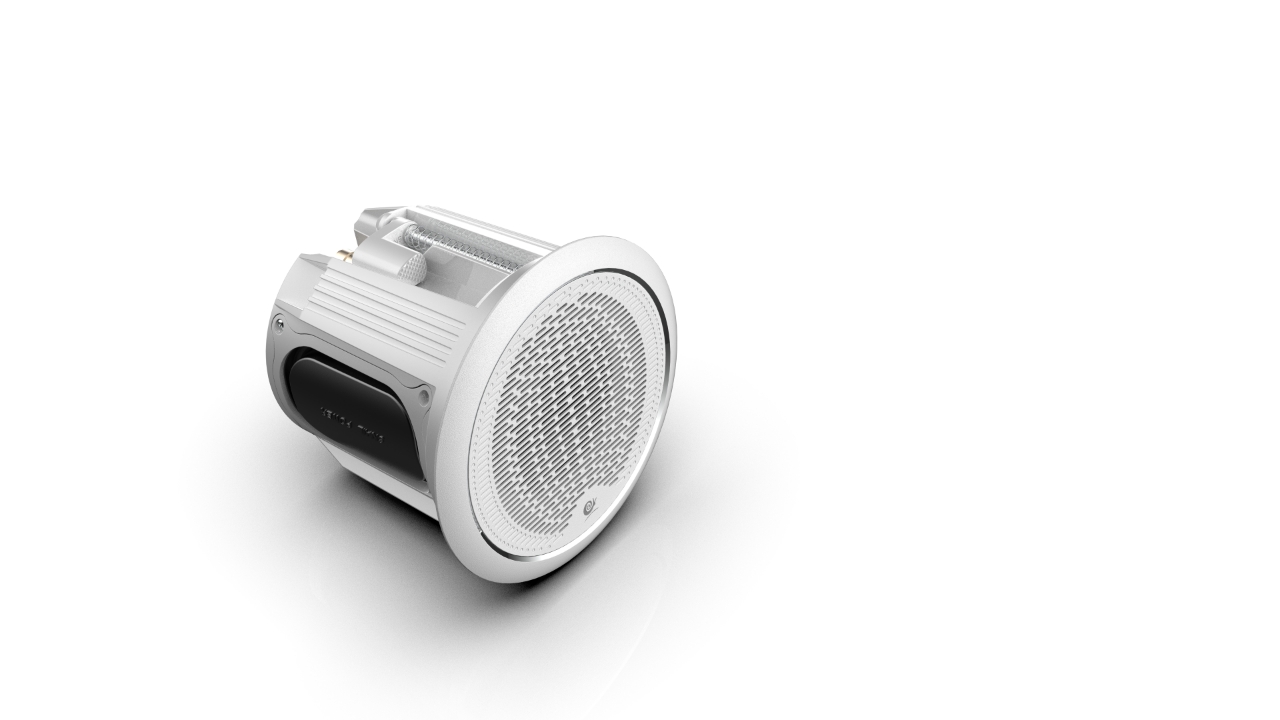
1. In-wall, in-ceiling, surface: one table for the trade-offs
The three differ in cutout conditions, serviceability later, and acoustic result: two site issues, then the sound.
| Item | In-wall | In-ceiling | Surface mount |
|---|---|---|---|
| Cutout conditions | Cuttable wall, cavity 7cm+; studs need reinforcement | 7cm+ above the ceiling, clear of joists and services | No cutout, wall takes anchors |
| Build stage | Before the skim coat | Around ceiling board fixing | During or after renovation |
| Serviceability | Medium: faceplate off, cable off, cabinet out | Low: open the ceiling, or reach through beside it | High: two screws, swap any time |
| Acoustic difference | Wall is the baffle, cleaner mid-bass; untreated cavity colours it | Void joins resonance, needs wool; angle limited | Edge diffraction, placement limited by the wall |
| Cabling | In the wall, out above the cutout | In the ceiling, above the joists | Concealed or in trunking |
| What you see | One round faceplate | One round grille | The cabinet |
| Typical models | IW3max / IW4pro / IW6 WIDE | IW3max / CW90 | U3 / U4max |
Serviceability runs high to low: surface, in-wall, in-ceiling. A driver ages and gets replaced: the in-ceiling box means opening the ceiling, the in-wall one comes out on screws.
One acoustic cost is often left out: a wall is not a free baffle. It stops diffraction and cleans the mid-bass, but without wool and a back box the low end circulates and sounds muddy. That work is not in the cabinet price, and a larger ceiling void needs more wool.
Surface mounting looks like a compromise, yet it is the most serviceable: swap a model, add a box, change the aiming, half an hour of work that costs a wall or a ceiling the other way. The price is a few centimetres proud and edge diffraction.
2. In-wall or in-ceiling: the channel decides
- Front left, centre, right: in-wall at ear height, the centre following the picture so dialogue lands. If the front wall cannot be cut (glazing, stone cladding, a shaped TV wall), fall back to surface mount; the ceiling puts voices overhead.
- Surround: in-wall at the sofa sides and 15–20cm above ear height; where the side walls do not allow it, in-ceiling just behind the sofa.
- Height channels: in-ceiling, clear of the light positions.
- Subwoofer: neither in-wall nor in-ceiling; it has its own cabinet and a placement found by measuring the low end.
Separation belongs in the trade-off: two in-wall fronts 2.5–3.5m apart with a sofa between them open the soundstage, while two in-ceiling boxes crowded into one patch hold their spacing just as far as the cutouts allow. Use the wall where one exists and leave the ceiling to surround and height.
Depth is a trade-off too: a stud partition often gives 9–12cm of cavity, which after the joists leaves just enough for the 66.5mm IW3max, while a deep ceiling allows a larger driver such as IW6 WIDE (faceplate Ø202mm, cutout 186–191mm). Measure the conditions, then pick the size, not the reverse.
3. Cutout sizes, and two common errors
Send this table to the crew.
| Model | Faceplate OD | Cutout dia. | Cabinet / clearance | Suggested position |
|---|---|---|---|---|
| CW90 | Ø105mm | Ø90mm | Wireless, amp built in, needs power | Surround, ceiling |
| Mini | Ø91mm | 80–85mm | Small cabinet | Surround in small rooms |
| IW3max | Ø100mm | Ø85mm | Cabinet 66.5mm, needs ≥70mm | Front, surround, height |
| IW4pro | Ø120mm | Ø105mm | Extended cabinet | Front left, centre, right |
| IW6 WIDE | Ø202mm | 186–191mm | Large cabinet | Fronts in large rooms |
| BMmini | Ø105mm | 90–95mm | Background music cabinet | Whole-house background music |
Error one: reading the faceplate as the cutout. IW3max is Ø100mm faceplate, Ø85mm cutout; IW4pro Ø120mm and Ø105mm; CW90 Ø105mm and Ø90mm. Each pair differs by 10–15mm, and that ring is design, not tolerance: it covers the cut edge and absorbs wall unevenness. Wrong, and the hole is too big for the faceplate or too small for the cabinet.
Error two: assuming thinner is better. A thin cabinet holds little volume, so low-frequency extension and SPL headroom shrink. The 66.5mm of IW3max is the depth that fits the driver and the volume it needs, not a margin to squeeze; thinner boxes mostly target surround or background music and sound tight as mains. The thinner the cabinet, the closer its back sits to the plasterboard, so vibration transfers and the ceiling rattles.
4. Matching the amplifier: channels, power, impedance
In-wall speakers carry no amplifier (CW90 excepted, with one built in and just power needed), so the amplifier is chosen on three things:
- Channels: 5.1 needs five power channels, the low end handled by a self-powered subwoofer that takes none; 7.1 needs seven. The AV-700 III is 7+2 channels at 7×100W; the AV-1800 is 7 channels at 150W into 8Ω and 250W into 4Ω, for larger rooms or lower-sensitivity cabinets.
- Impedance: check the cabinet's nominal 4Ω or 8Ω, then the amplifier's continuous power into that impedance. A 4Ω load asks more current, so a machine rated at 8Ω protects itself after long loud passages on 4Ω cabinets. Do not parallel extra pairs either: below 2Ω most domestic amplifiers give up.
- Power matching: ignore peak figures, look at continuous power and sensitivity. These cabinets reach 106–111dB, so in a 20–30㎡ room normal listening uses a few watts to the mid-teens per channel; headroom is for transients, not volume.
Two more traps: do not mix fixed impedance with fixed voltage, since domestic systems run fixed impedance while 70V/100V is for public address and background music; and leave enough cable, 2×1.5mm² or 2×2.5mm² oxygen-free copper with 30–50cm of slack at each end, because a short tail breaks when fitting.
Go wireless and the amplifier line disappears, replaced by power points: every CW90 needs one, planned at the electrician stage, with a downlight feed a fallback.
5. Who should not buy
- Anyone with a single-skin steel-stud partition and no plan to reinforce it. Such a wall will not carry a large cabinet, and a Ø202mm cutout such as IW6 WIDE sets the plasterboard vibrating. Reinforce with a back box, drop a size, or go surface mount.
- Anyone whose ceiling is crowded with services. Ducts, sprinkler pipe and ventilation push the cutouts aside, and once they shift the channels lose symmetry.
- Anyone who wants the space saving but not the setting out. The complexity moves earlier, and what it saves is room space, not schedule; a wrong position costs a patched wall.
- Anyone whose budget covers the equipment but not the work. Cutting, brackets, wool, reinforcement and patching often cost as much as the cabinets; budget on cabinet prices and the project gets cut halfway.
- Anyone renting, or moving within two or three years. A cutout is irreversible, cannot be taken along, and no landlord pays for your soundstage.
6. Common questions
Q: Does an in-wall speaker need a back box?
It plays without one, but an untreated wall or ceiling cavity muddies the mid-bass. Two options: damping wool behind the cabinet, cheap and effective, or a separate back box, better and bulkier. Stud partitions deserve the box.
Q: Will an in-wall system annoy the neighbours?
It leaks, mostly at low frequencies, because the cabinet is fixed to the studs and vibration travels through the structure. Pads between cabinet and studs, wool in the cavity and sensible volume are enough.
Q: Can a cutout be moved after fitting?
It can, but it is rework: patch, skim, cut again, re-run cable, and one position costs close to redoing a wall. Set the points out with a laser level before the boards go up.
Q: How many speakers and channels does 5.1 take?
Five cabinets: left, centre, right, left surround, right surround, plus a self-powered subwoofer. The amplifier needs five power channels; add height channels and both grow, so buy cabinets after the amplifier.
One-line verdict
An in-wall system is decided before the cutout: once position and diameter are fixed, the model means something. Measure wall and ceiling, place by channel, report faceplate and cutout as two numbers, then discuss amplifier and budget. In the right order the result is sound from a wall with no visible cabinet; in the wrong order it is a patched wall.
Models: IW3max in-wall speaker, IW4pro in-wall speaker, IW6 WIDE in-wall speaker, AV-700 III amplifier, AV-1800 amplifier.