Home / News / Product News / Ceiling Speakers vs In-Ceiling Speakers: Two Different Installations
Ceiling Speakers vs In-Ceiling Speakers: Two Different Installations
2026-11-13 · Product News
The short answer: usually the same thing, but two mounting methods that behave very differently
"Ceiling speaker" is the everyday term; "in-ceiling speaker" is the trade term. Both mean a speaker installed in the ceiling. In practice there are two ways to mount it, and mixing them up leads to the wrong purchase:
- Recessed: cut an opening, drop the unit in, leave just the grille showing, flush with the ceiling.
- Surface-mount: the enclosure is fixed to the ceiling surface and stands roughly 10cm proud of it.
The acoustic difference is small. The difference lies in site conditions, appearance and how serviceable the system is later on.
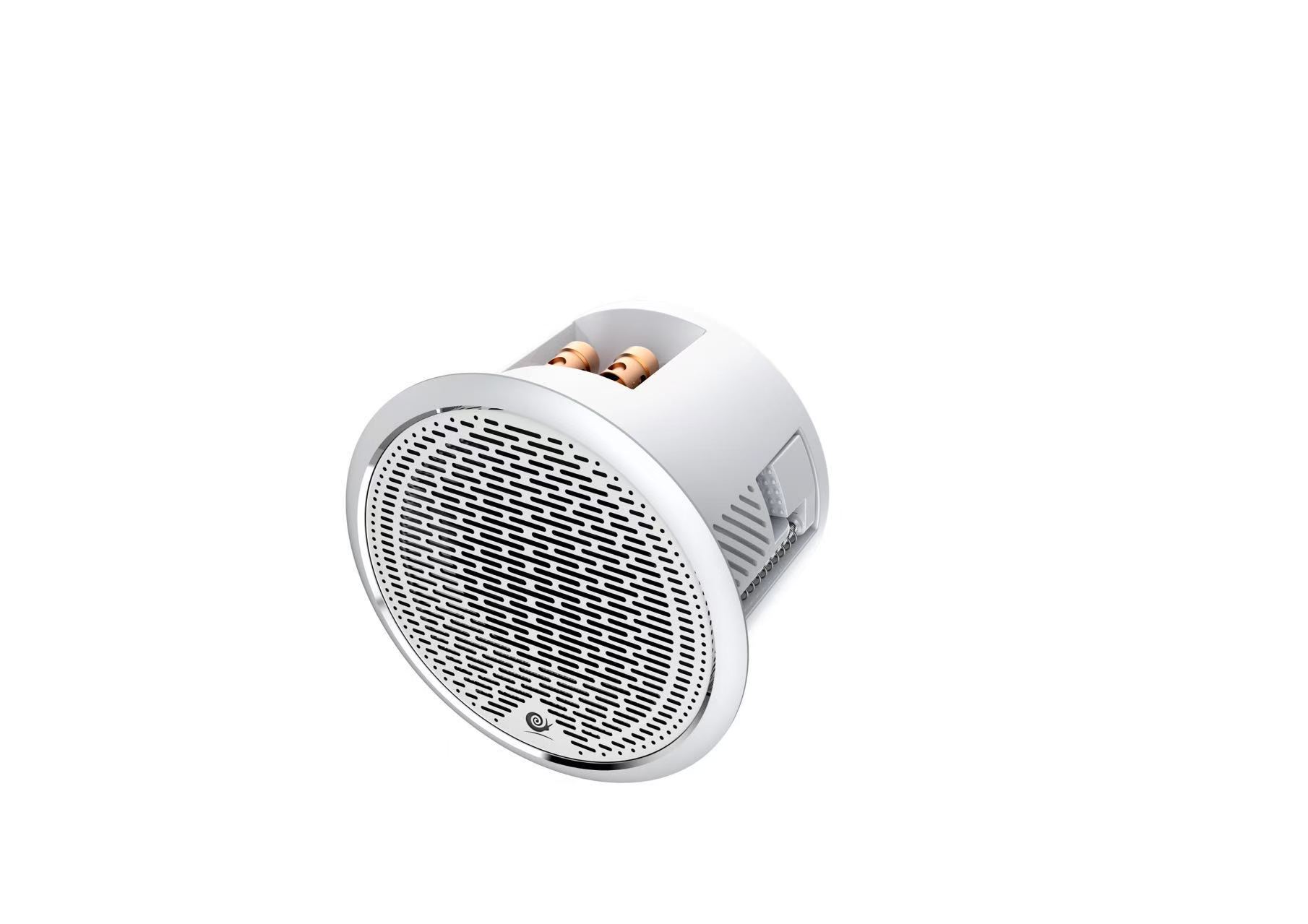
1. Aligning the terms
| Term | What it means | Where it shows up |
|---|---|---|
| Ceiling speaker / ceiling-mounted speaker | Everyday term for a speaker installed in the ceiling | Home renovation talk, e-commerce search |
| In-ceiling speaker | Trade term, usually recessed | Contracting, AV system design |
| Recessed speaker | Covers both in-wall and in-ceiling types | Design drawings, specification sheets |
| Surface-mount speaker | Enclosure fixed to the surface, no cutout | Finished ceilings, cutting not allowed |
So when people ask whether a ceiling speaker and an in-ceiling speaker are the same thing: the same in name, two different things in how they are mounted.
2. How the two mounting methods differ
| Recessed (in-ceiling) | Surface-mount | |
|---|---|---|
| Installation | Cutouts must be made before the ceiling is closed, and the positions cannot be wrong | Can be installed after the ceiling is finished; fixing and cabling are all it takes |
| Appearance | Flush with the ceiling, grille visible | 8–12cm proud, the enclosure is visible |
| Acoustics | Driver faces down; high frequencies are affected by the ceiling angle | Angle adjustable, so it can be aimed toward the sofa |
| Service | Grille off, unit pulled out through the cutout | Direct removal and refit, the simplest case |
| Suits | Mid-renovation, aiming for an invisible result | Finished ceilings, or where the angle has to be adjusted |
3. Check cutout dimensions before ordering (recessed mounting)
| Model | Cutout | Faceplate | Max SPL |
|---|---|---|---|
| IW3max | Ø85mm | Ø100mm | 110dB |
| CW90 | Ø90mm | Ø105mm | 111dB |
| IW4pro | Ø105mm | Ø120mm | 110dB |
| IW6 WIDE | 186–191mm | Ø202mm | 109dB |
One rule worth remembering: the cutout is the hole you cut, the faceplate is the lid, and the outer diameter is usually about 15mm larger than the cutout.
4. How to choose: let the construction stage decide
- Still at the electrical or ceiling stage: go recessed. Set the positions now, run the cable now, and the finished result is the cleanest.
- Ceiling already closed and you do not want cutouts: go surface-mount or on-wall and accept the protruding enclosure.
- Ceiling already closed but cutouts are possible: go for a recessed wireless option such as CW90, with a Ø90mm cutout, and a power point at each unit.
5. Coordination on site: the ceiling drawing and the speaker plan have to be checked against each other
The step that most often forces rework with in-ceiling speakers is not the speaker itself, but two drawings that do not match: the ceiling drawing (luminaires, joists, access panels) and the speaker layout plan (cutout positions).
- Luminaire positions take precedence. Downlight and spotlight openings are already fixed; keep speakers at least 30cm away from them, or the grille will press against the edge of the light.
- Give way to joists. A cutout must not cut a main joist, so shift the position by 5–10cm; secondary joists can be reinforced with hanger rods.
- Keep access panels clear. Do not place units near the access panels for central air conditioning or fresh air; a hand will not fit in there later.
- Re-check before the ceiling is closed. Measure from both walls to the centre of each cutout with a tape, record the coordinates, and photograph them for the file.
For surface-mount work the order is reversed: mark the enclosure positions on the ceiling, run the surface trunking, then fix the enclosures. Surface-mount work does not fear a wrong cutout; it fears trunking and light runs that will not line up.
6. Price reference: where the cost difference sits
For the same channel configuration, recessed and surface-mount prices are close, and the difference is mainly in the installation work:
| Item | Recessed | Surface-mount |
|---|---|---|
| Cutouts and patching | Required, priced per position | Not required |
| Cabling | Buried before closing, cannot be changed afterwards | Surface trunking, can be added later |
| Labour | Tied to the ceiling work | A separate site visit |
| Reference total | From CNY 17,000 for the 5.1 set (wireless) / from CNY 23,600 (in-ceiling, including amplifier and player); installation is billed separately | |
7. Three common misconceptions
- Using the faceplate as the cutout: cut to the faceplate size and the unit will drop through the hole or sit unevenly.
- Assuming surface-mount must sound worse: surface-mount units can be angled, and in some rooms they sound better than in-ceiling units.
- Assuming in-ceiling units need no cable: apart from wireless options, each unit needs an audio cable back to the amplifier position.
8. Who should not buy
- The ceiling cannot be touched, and surface-mount is unacceptable: there is no third route, so switch to on-wall or floorstanding.
- Ceiling height below 2.4m: in-ceiling units reduce the perceived ceiling height, and surface-mount reduces it further.
- You want to move the speakers later: in-ceiling is a fixed installation, and relocating means renovating again.
9. Frequently asked questions
Q: Can ceiling speakers and in-ceiling speakers be mixed?
Within one channel, keep them uniform. Across channels they can be mixed, but the tonal balance has to stay close.
Q: Does surface-mount look bad?
It depends on the enclosure. A white, narrow-bezel surface-mount enclosure is not conspicuous on a light ceiling; a large black enclosure is.
Q: How is a recessed unit repaired if it fails?
Grille off, unit out through the cutout. That is also why cutout positions have to avoid joists and services.
10. Specific models
Recessed: IW3max (cutout Ø85mm), IW4pro (Ø105mm), IW6 WIDE (186–191mm). If the ceiling is finished and you do not want cutouts, look at CW90 wireless (Ø90mm cutout, power point at each unit). For a complete configuration, compare the IW3max-C110 5.1 set.
One-line verdict
In terminology, ceiling speaker = in-ceiling speaker. Before buying, ask one question: can the ceiling still be cut? If yes, go recessed; if no, go surface-mount or on-wall. Once the mounting method is settled, the model choice means something.