Home / News / Product News / Matching a Subwoofer to an AV Receiver: Inputs, Crossover and Headroom
Matching a Subwoofer to an AV Receiver: Inputs, Crossover and Headroom
2026-11-13 · Product News
Conclusion: matching a subwoofer to an amplifier depends on three things: connection, crossover, headroom
"Will this subwoofer work with this amplifier?" is not answered by piling up numbers from spec sheets. It comes down to three concrete questions: is the subwoofer active or passive, does the amplifier have the matching output, and can the crossover point and level be aligned. When all three line up, the pairing is sound.
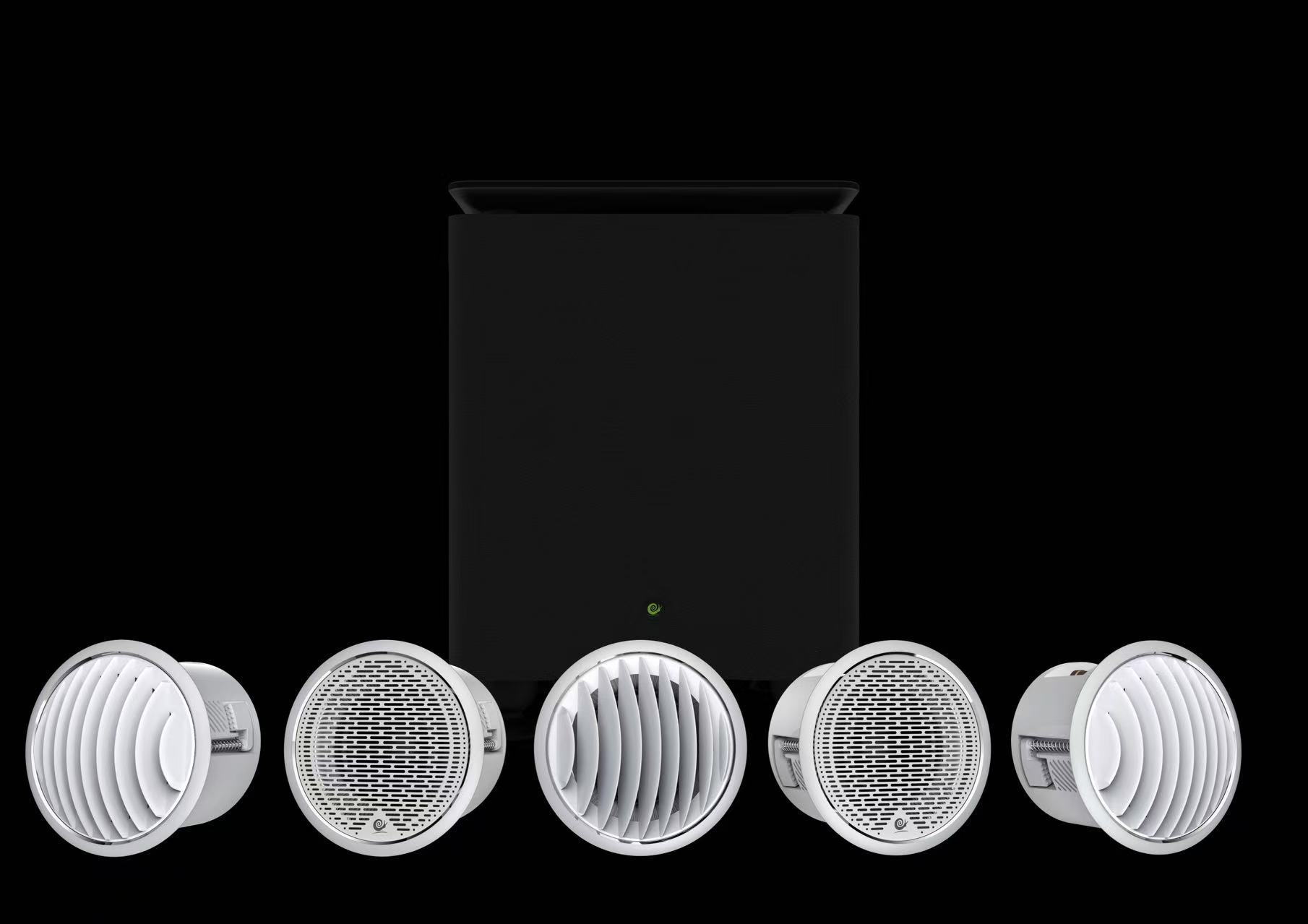
1. Sort out active and passive before buying
| Active (built-in amplifier) | Passive (needs external amplifier) | |
|---|---|---|
| Wiring | One RCA coax cable (or wireless) | Speaker cable to the subwoofer channel on the amplifier |
| Power | A socket is needed at the subwoofer position | No power needed at the subwoofer position |
| Amplifier requirement | A SUB OUT / LFE output is enough | The amplifier needs a dedicated subwoofer channel or a power amp |
| Typical use | Most living-room cinemas | Custom installation, systems that already have a power amp |
Check the back of your amplifier before buying: if it has a single RCA SUB OUT, buy active; a subwoofer output on speaker terminals is what makes passive possible.
2. Crossover: the point must meet the main speakers, not go as low as possible
The crossover point decides which driver covers which band. Set it too high and the subwoofer runs into the vocal range, which sounds muddy; set it too low and small main speakers cannot pick up the gap, leaving a hole in the mid-bass.
| Main speaker size | Suggested crossover | Reason |
|---|---|---|
| Ø85–90mm (e.g. IW3max, CW90) | 90–100Hz | Limited low-end reach, so the subwoofer covers more |
| Ø105mm (e.g. IW4pro) | 80Hz | Standard setting, natural blend |
| Ø186–191mm (e.g. IW6 WIDE) | 60–80Hz | The main speakers reach low, so the subwoofer adds sub-bass |
Phase (0/180°) and crossover are adjusted together: sit at the listening position, listen to both phase settings, and keep the one with tighter bass.
3. Power budget: amplifier headroom decides whether big passages hold up
Subwoofer power is not about the rated watt figure; it is about how much headroom the amplifier has left during large dynamics. If the amplifier runs out of steam, a good subwoofer still cannot deliver.
| Amplifier | Channels and power | Suits |
|---|---|---|
| AV-700 III | 7+2 channels, 7×100W | 20–30 m² living room, 5.1 |
| AV-1800 | 7 channels, 8Ω 150W / 4Ω 250W | 35 m² and above, more dynamic range |
For a passive subwoofer, add one more check: the subwoofer impedance must match the amplifier channel. A 4Ω subwoofer on a channel rated for 8Ω will overheat and protect itself at high volume over long periods.
4. Three-minute calibration: wiring, level, phase
- Wiring: connect an active subwoofer to the SUB OUT with an RCA coax cable; connect a passive subwoofer with speaker cable to the amplifier subwoofer channel, watching polarity.
- Level: set the subwoofer volume to the 12 o'clock position, play a familiar low-frequency passage, and trim the subwoofer level on the amplifier so bass has weight without covering dialogue.
- Phase: at the listening position, switch between 0° and 180° for 30 seconds each, and keep the setting with tighter, more forward bass; if you cannot hear a difference, summing near the crossover is weak, so go back to the crossover.
- Crossover: start at 80Hz, try one step up and one step down (e.g. 60/90Hz), and keep the setting with the cleanest vocals.
These four steps need no instruments and take ten minutes. Settle them before discussing whether to change the subwoofer.
5. Three common mismatches
- An active subwoofer on a pre-out with no crossover set: main speakers and subwoofer both cover 80Hz, the bass sums up, and one band booms.
- Small main speakers with a 60Hz crossover: the main speakers already roll off between 60 and 80Hz, a gap appears, and bass seems to come and go.
- A passive subwoofer wired directly onto the main speaker terminals: the subwoofer sits in parallel with the main speakers, impedance changes, and the amplifier is prone to protection.
6. Who should not buy a passive subwoofer
- An amplifier with no dedicated subwoofer channel: it cannot be connected; forcing it leads to case 3 above.
- No speaker cable planned during renovation: a passive subwoofer must be wired, and adding cable later costs more.
- Frequent repositioning: a passive subwoofer needs rewiring when moved, while an active one just needs the RCA unplugged.
7. Common questions
Q: Is a wireless subwoofer the same as an active subwoofer?
No. A wireless subwoofer is active plus a wireless receiver: it removes the signal cable, while the power cable is still required.
Q: The amplifier is rated 100W and the subwoofer 300W; will it drive it?
An active subwoofer has its own amplifier, and the amplifier just sends the signal, so there is no driving problem; power matching applies to passive subwoofers.
Q: Can one subwoofer feed two amplifiers?
No. It is prone to a ground loop and hum. Use a splitter or a single amplifier.
Q: Phase changes made no difference?
That means summing near the crossover is not obvious, or the subwoofer sits too far from the main speakers. Adjust position, then phase.
8. Matching systems
For a 5.1 living room, the IW3max-C110 system (AV-700 III + C110) is a starting point; for larger spaces, the X-Series-714B 7.1.4 (AV-1800 + X135); single subwoofers include the B28 and X135.
Judging in one sentence
Check whether the connection works, then whether the crossover lines up, and the power question last. Reverse the order and you get specs that match on paper but not in the room.