Home / News & Projects / Product News / Soundstage Calibration: The Three Steps Before a 5.1 Handover
Soundstage Calibration: The Three Steps Before a 5.1 Handover
2026-11-28 12:05 · Product News
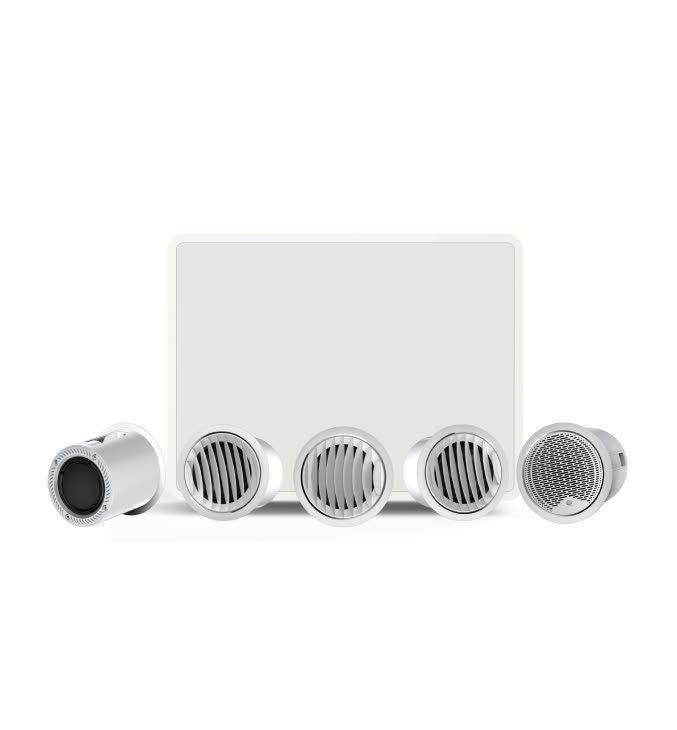
Soundstage calibration is the three-step close-out of a 5.1 wireless cinema: the CW90 takes a Ø90mm cut-out, a Ø105mm faceplate, 100mm of height, 90W per unit and 111dB maximum SPL, and the package is quoted on request — the entry level and up — for a living room. It comes from SNAIL POWER. Once installed you set level and distance, hand the low end to the subwoofer, then cut the room's peak by measurement. The order never changes; each step has less tolerance than a floorstander.
Draw the boundary first: calibration fixes whether it was installed right, not whether the room is any good. It pulls five cabinets onto one reference line, joins the subwoofer at 80Hz, cuts a few dB off the 40Hz peak. It cannot change slab isolation, the sofa position or the ceiling cavity. Three steps, in build order, each with a cost.
Key points
- Levels before EQ. Until they are level, every measurement sits on the wrong reference.
- Distance converts at about 34cm per millisecond, and a ceiling cabinet is measured on the slant.
- The crossover usually lands at 80Hz; sweep phase across the 60–100Hz overlap, not one point on the curve.
- EQ cuts peaks, never fills dips. Filling spends headroom and excursion, and usually returns a dip.
- The limit of calibration is the room: the 40Hz peak is eased by placement and PEQ, not erased by tuning.
1. Step One: Level the Five Cabinets and Fix the Distances
EQ before levels is treating the error as the reference. Drive pink noise at -20dBFS, SPL meter at the seat, C-weighted, slow, and trim each cabinet to 85dB; the subwoofer channel runs +10dB, so 95dB. Keep the spread inside ±1dB, or the image leans to the louder cabinet.
Do not skimp on the tool. A phone meter is commonly ±3dB out from 100 to 500Hz and worse below, so the "flat" it reports is flat only to the phone. Minimum, a C-weighted meter; properly, a calibration mic and software, a modest outlay, earned back at handover.
Distance is where ceiling cabinets go wrong: a floorstander is measured flat, a ceiling speaker sits above and forward of your head, so measure ear to faceplate. At 343m/s, 1ms is about 34cm; 1m forward of the seat, slant and horizontal differ by over 10cm — 0.3ms. On its own it is not obvious; five stacked and the dialogue stops sitting still.
The trade-off is headroom. Levelling drives all five to the same loudness; the least sensitive draws more power and that channel's headroom shrinks. Calibration does not create dynamics; it redistributes them.
2. Step Two: Hand the Low End From the Full-Range Units to the Subwoofer
The CW90 uses a 2.75-inch full-range with a passive radiator. That size does not reach low, and below 80Hz is the W10 subwoofer's job — division of labour, not a patch. The crossover usually sits at 80Hz; in a small room or near a wall, 90–100Hz gives the 2.75-inch unit less low end and loosens the midrange.
Position first, phase second. A corner gives plenty of low end and amplifies the standing waves with it; a quarter along the front wall the 40Hz peak is usually smaller, at the cost of feel at the bottom. Then phase: sweep or pink noise across 60–100Hz, turning while listening, stop at the shallowest dip. 0° and 180° are the ends; a continuous model sits between.
Delay gets missed. The subwoofer has delay of its own, and if it does not arrive with the mains the overlap cancels. Read the delay off an impulse or the software and line it up. Without gear, play sustained low cello or drums and add delay until the low end goes from loose to solid.
The trade-off is here: one subwoofer has peaks and dips at the seat, and flattening one position moves the problem. Two placed symmetrically cancel some standing waves, for a second subwoofer's price and two places to put it. A living-room cinema often has one corner only, so accept it: the target is the main sofa seat, not the whole room.
3. Step Three: EQ Cuts Peaks and Does Not Fill Dips
Start with the points. One point turns the 40Hz peak into a knife edge that collapses at the next seat; take 3–5 across the sofa, left, centre, right, and average. The more spread out they are, the less EQ can fix, which is right — the average has already smoothed the differences away.
EQ works below 200Hz only, mostly cutting, no band over 6dB, Q between 0.5 and 4. Beyond that the problem is placement or the room. Filling dips is riskier: a dip is usually reflection cancellation, and 6dB put back spends headroom and excursion together — the low end does not return, distortion arrives first.
Do not finish on the curve. Play dialogue you know, a news read or an old film, ten minutes at the 85dB reference: are consonants clean, does the voice push forward. Then an explosion: does the low end drag. A flat curve that tires you out is not tuned.
The trade-off is EQ itself. It compensates, it does not repair: a filter changes phase, and harder cuts tighten the low end's attack and decay. It cannot touch the room's reverb time or the cavity behind the sofa. Treat it as a universal tool and you get a good-looking curve and dull ears.
4. Specifications and Calibration Targets: Two Tables
Hard numbers first. The CW90 is SNAIL POWER's 5.1 wireless cinema: five ceiling cabinets, one W10 subwoofer, one MS-1 wireless module, the package quoted on request, from the entry level up.
| Item | Figure |
|---|---|
| Cut-out | Ø90mm |
| Faceplate | Ø105mm |
| Cabinet height | 100mm |
| Driver | 2.75-inch full-range + passive radiator |
| Rated power | 90W per unit |
| Maximum SPL | 111dB |
| Wireless | 5.8G dedicated channel |
| Package | 5.1 wireless cinema and karaoke: CW90×5 + W10 subwoofer + MS-1 |
| Package price | price on request |
| Immersive formats | Dolby Atmos and DTS:X certification in progress |
Targets for the handover sheet:
| Calibration item | Target | Tool |
|---|---|---|
| Channel level | 85dB (C-weighted, slow) | SPL meter |
| LFE channel | 95dB | SPL meter |
| Channel spread | within ±1dB | SPL meter |
| Crossover | 80Hz, can go up to 90–100Hz | Amplifier menu |
| Overlap, 60–100Hz | dip within 3dB | Software / sweep |
| EQ action | cut peaks only, ≤6dB per band, Q 0.5–4 | Measurement software |
| Measurement points | 3–5 on the sofa, averaged | Calibration mic |
| Peak headroom | 20dB above 85dB dialogue | SPL meter |
On a home theater design drawing, cut-out positions and calibration points are two things: one in the ceiling, one on the sofa. The cut-out deserves a sentence: the CW90 takes Ø90mm; the Mini and IW series differ by model, one millimetre apart. Two hole sizes on one drawing means drill to the drawing, not memory; the extra millimetre is a whole sheet to put right.
One item sits outside calibration: Dolby Atmos and DTS:X certification in progress — format-level calibration waits on the approval letter. These three steps cover the 5.1 channels and the low end, nothing more.
The trade-off is the limit of a table. Targets are a starting point, not the answer key. Every room's low end differs, and the same parameters next door can be too much; a filled sheet does not mean it sounds good.
5. Wireless Adds a Step: Delay, Channels and the Holes in the Ceiling
The CW90 runs a 5.8G dedicated channel, so a retrofit need not chase cable behind the sofa. The wiring is out of the way; what remains is the link's own delay, which the amplifier's distance setting compensates for: enter the measured distance and the hub works the delay out. Type "about 3 metres" and the compensation is wasted.
Channels also get mixed up: five cabinets and a subwoofer, each mapped to the right channel, with the MS-1 handling the wireless hop, so confirm them one by one after pairing. One cabinet on the wrong channel shows up as an odd level — a surround calibrated as a front pushes the soundstage forward.
How it looks counts too. At handover of concealed cinema speakers the first look is not at the sound but at the ceiling: Ø105mm faceplates flush, cut-out edges filled, no cable in the light cove. Fail that and no tuning afterwards settles the owner's account.
One truth beyond calibration: tuned properly the energy goes to the sofa and the floors above and below take less, but slab isolation is unchanged. A sensitive neighbour means floating the floor first — that beats speakers and beats parameters, at the cost of floor work and a few centimetres of height.
The trade-off is the link and the power. Wireless removes wiring, not delay; the hub compensates, and what it cannot shows as a slight drag in the overlap. Each cabinet needs a socket, not on the LED driver circuit — switching noise runs down the mains into the speakers.
6. Who Should Not Buy, and One Sentence to Decide
These are the cases I would talk you out of:
- The ceiling cannot take a Ø90mm cut-out, or only a very shallow perimeter drop was built. It will not go in, and calibration never gets a turn.
- The living room is over 45 m², or the ceiling is a 3.5m double-height void. Headroom gets tight; within the brand, look at the IW6 WIDE or the X series.
- You want to feel 30Hz and below and will not put a subwoofer in the living room. A 2.75-inch full-range plus a passive radiator cannot do it; that is physics.
- You already have a tuned system and only want different cabinets. Calibration has to be redone, and the gain may not be worth it.
A second group should not tune it themselves: no meter, no microphone, ears only. The first two steps can be fudged; EQ by ear turns a peak into a dip nine times out of ten. One visit costs a modest fee, cheaper than buying the wrong system.
The trade-off is time. Two or three hours the first time, and a new amplifier, a moved sofa or one more cabinet means doing it again. That time cannot be saved unless "close enough" is the standard.
One sentence: calibration does not make the system better; it puts it back the way it should have been — five cabinets level, the subwoofer and full-range units joined at 80Hz, the room's peak cut a few dB, the rest left to the room itself.
And the exit conditions: no Ø90mm in the ceiling, no cable route behind the sofa and no appetite for wireless, a sensitive neighbour and a floor that cannot move. If any one holds, fix the structure and the budget first; calibration will not tune it away.
Related articles
- S10D Subwoofer Close-Up: How the Low End Is Built (Video)
- The X Series: High-End Custom Cinema in 14 Seconds (Video)
- U4max in 6 Seconds: How the Surface-Mount Install Works (Video)
END
#CW90 #SnailPower #SoundstageCalibration #ConcealedSpeakers #LivingRoomCinema #HomeTheaterDesign #DolbyAtmos
Written by Digital Xiaoniu, first published on the SNAIL POWER official site, Product News.