Home / News / Product News / A 6 m Ceiling: How Five IW6 WIDE Make 5.1 Work
A 6 m Ceiling: How Five IW6 WIDE Make 5.1 Work
2026-11-02 · Product News
A 6 m ceiling, five IW6 WIDE and one S10D: turning "it won't fit" into "it works"
6 m ceiling · 5 × IW6 WIDE · 1 × S10D · 5.1
By Digital Xiaoniu
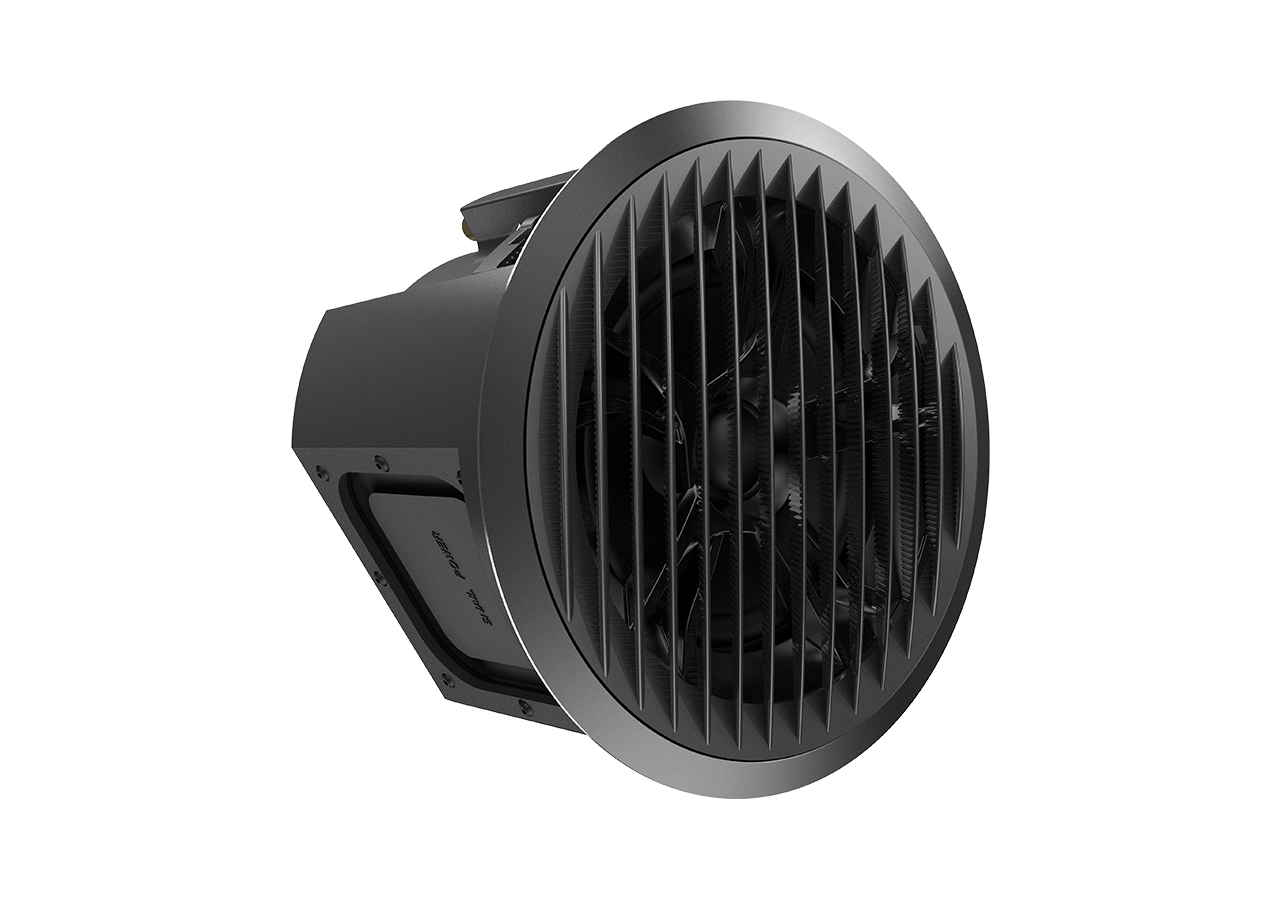
IW6 WIDE: Φ202×128 mm bezel, 185–190 mm cut-out, mounting depth >123 mm, 2.73 kg
Building a home cinema in a 6 m high space is never about which speakers to buy. It is about how the sound gets down.
A normal living room is 2.7–3 m high with 2–3 m from seat to speaker. Here the ceiling is 6 m and the speakers hang from it, so the distance to the listener more than doubles. **Every doubling of distance costs 6 dB of direct sound** — not a rule of thumb but the inverse-square law. The same speaker at 3 m and at 6 m differs by more than 12 dB at the ear.
The answer this system gives: **five IW6 WIDE and one S10D**, with a 5.75-inch full-range plus 1-inch tweeter handling the mid and high end, and a 10-inch active plus 10-inch passive radiator carrying everything below 25 Hz.
01 Three numbers first: 6 m, 190 m³, 12 dB
In a tall space you do not calculate floor area, you calculate **volume**. The same 40 m² is 120 m³ at 3 m and 240 m³ at 6 m — acoustically one room used as two.
| Item | Normal living room | This tall space |
|---|---|---|
| Ceiling height | 2.7–3.0 m | 6.0 m |
| Seat-to-speaker distance | 2.5–3.5 m | 5.5–6.5 m |
| Direct-sound loss | baseline | more than −12 dB |
| Reverberation (empty room estimate) | 0.4–0.6 s | 0.9–1.4 s |
The conclusion is clear: **either raise the SPL by 12 dB or shorten the distance**. A tall space cannot shorten the distance — the sofa is where it is — so the SPL must go up. And it must be *effective* SPL.
"Effective" is the key word. Adding more boxes to stack up SPL does not help, because sound from 6 m that radiates in all directions ends up in the air and on the walls; only reverberation reaches the seat. **What is needed is energy delivered downward, not energy emitted outward.**
02 Why WIDE: dispersion and directivity
The WIDE in IW6 WIDE refers to exactly this.
| Specification | IW6 WIDE | What it means at 6 m |
|---|---|---|
| Drivers | 1×5.75″ full-range + 1×1″ tweeter | The full-range carries the body, the tweeter adds air so voices do not sit "stuffed in the ceiling" |
| Response | 45 Hz – 20 kHz | Everything above 60 Hz is its job; the crossover to the S10D lands comfortably at 60–80 Hz |
| Sensitivity | 91 dB | 3–5 dB above the usual 86–88 dB in-wall box — half the amplifier effort |
| Max SPL | 109 dB | About 97 dB still available at 6 m, enough headroom for 5.1 peaks |
| Power | 80–300 W | Driven from 80 W upward; not fussy about the amplifier |
| Impedance | 8 Ω | Five in parallel is friendly to the amplifier |
Do the arithmetic: **91 dB sensitivity and 109 dB max SPL** leave roughly **97 dB** of usable peak at 6 m. A 5.1 system at Dolby reference needs peaks around 105 dB (C-weighted, slow), so a single speaker is about 8 dB short — **which is why five work together and why the amplifier's dynamic headroom matters**, rather than one box being pushed to its limit.
★ Honesty is required here: **a 6 m ceiling is a hard fight for any in-wall or in-ceiling box.** A 5.75-inch driver reaching 109 dB is already at the top of its class, but it is not an extreme product designed for 6 m — **it is the solution that still works at 6 m**, not the loudest thing available at 6 m. For a large margin at 6 m you would go to a professional horn. This system is positioned as: **a domestic 5.1 for a tall space that is intelligible, reaches down and actually fits.**
03 Where the S10D's 1000 W goes
The most easily overlooked part of a tall space is the low end.
Mid and high frequencies can be pushed with directivity and arrays. Bass cannot — **25–60 Hz has a wavelength of 5 to 14 m, the same order as the room itself**, so it obeys neither "aiming" nor "dispersion"; it obeys volume and power. A 6 m ceiling doubles the volume of a normal living room, and the low-frequency power has to double with it.
The S10D's specification matches exactly:
| Specification | S10D | Why a tall space needs it |
|---|---|---|
| Drivers | 1×10″ active + 1×10″ passive radiator | A radiator behaves like twice the box volume — the most effective way to extend a sealed cabinet |
| Response | 25 – 200 Hz | 25 Hz extension gives the space a proper low-frequency floor |
| Power | 1000 W RMS (short-term) | A large volume needs large power; this is the hard requirement |
| Max SPL | 119 dB | 10 dB above the IW6 WIDE, so the low end does not lag behind |
| Enclosure | Sealed · 295×295×405 mm · 20 kg | Fast transients, no port airflow noise |
"Dual 10-inch" does not mean two active drivers — one produces sound, the other radiates. A sealed box needs no port, which avoids airflow noise at high power and preserves the 25 Hz extension.
**Why not 20 Hz?** To push a sealed box to 20 Hz you must either build it too large for the corner of a tall room or drop the sensitivity until even 1000 W cannot drive it. **25 Hz is a trade-off: extension, size and efficiency — you may pick two.**
04 A 185–190 mm cut-out and 123 mm depth: the real construction threshold
The line most easily skipped in a specification sheet is often the one that decides whether the job can happen.
| Item | IW6 WIDE | Construction implication |
|---|---|---|
| Bezel size | Φ202 × 128 mm | What you see is a 20 cm circle |
| Cut-out diameter | 185 – 190 mm | The hole saw must land in this window: below 185 mm it will not go in, above 190 mm the bezel will not cover |
| Mounting depth | > 123 mm | Ceiling clearance must be at least 130 mm, leaving 7 mm for cable and decoupling |
| Net weight | 2.73 kg | Light per box, but it must be fixed to a joist or a suspension rod |
In a 6 m ceiling the framing is usually light-gauge steel or a steel frame, and **every cut-out must avoid the main joists and the mechanical and electrical runs**. Five boxes mean five Φ190 holes, and once they are cut the positions cannot be changed — **this is the only irreversible step in the whole plan.**
The recommended order: **fix the seating position first, then derive the five positions from the Dolby 5.1 angles (front ±22–30°, surround 90–110°), and only then cut the ceiling.** Done the other way round, it will almost certainly be redone.
05 Installing at 6 m: safety comes first
This section is not about sound quality. It is about **personal safety**.
Working at 6 m is harder than at 3 m not because of the height but because of **stability and resetting**: the platform must be tall enough, stable enough, and each speaker's aiming angle must be adjustable and lockable in the air.
- **Use a certified aerial work platform or full scaffolding** — never a domestic step ladder stretched to reach
- **Keep the down-tilt of all five consistent**: front speakers tilted 5–10° downward, surrounds calculated from seat height; eyeballing it at 6 m is unreliable, so use a laser level or an angle gauge
- **Shake each box after fixing** to confirm it is solid before removing tools
- **Keep people out from underneath while cutting**; a dropped object from 6 m carries twice the energy it would from 3 m
★ The system itself is fine — **but the risk of working on a 6 m ceiling is no smaller than any audio specification.** Whether the installation crew is certified for work at height and carries insurance matters more than which speakers are used.
06 How to check after installation
Commissioning a tall space differs from a normal living room: the question is not "is it loud enough" but "is it clear enough".
**First listen: voices.** Play a news broadcast or an interview from the sweet spot. The midrange is what most often goes wrong at 6 m — if voices sound muffled, distant or as if behind a cloth, there is too little direct sound and too much reverberation. The IW6 WIDE's 1-inch tweeter exists to fill that in.
**Second listen: the edge of the bass.** Play a test tone around 30 Hz and walk the four corners. A sealed box will not "chuff", but a tall space easily develops standing waves — if one corner is clearly louder, that calls for repositioning or bass traps, not a different subwoofer.
**Third listen: surround continuity.** Play F1: The Movie and let a car sweep past on the left. The classic failure of 5.1 at 6 m is surround that "floats overhead" — control the height difference between the side surrounds and the fronts, or the image breaks apart.
**Three checks:** look up and confirm all five bezels are flush with no gaps; press each bezel to check for movement; listen at the wall at high volume for resonance. If something is wrong, the mounting is usually not solid.
Frequently asked questions
Q At 6 m, will a 5.1 system sound too diffuse?
Yes — that is physics, not a speaker fault. The countermeasures are higher sensitivity (91 dB rather than 86 dB), aiming the boxes at the seats, and more low-frequency power. The IW6 WIDE plus S10D combination is built around exactly that.
Q Can I use only the three front speakers and skip the surrounds?
You can, but then it is no longer 5.1. In a tall space the surrounds matter more than in a low room, because there is more air overhead and the sound drifts more easily; a physical source at the sides and rear is what holds the image together.
Q Where does the S10D go?
A corner is the usual choice in a tall room (using the corner for low-frequency gain), but avoid a position directly facing the seats or the bass will become directional. At 295×295×405 mm and 20 kg it simply sits on the floor.
Q What amplifier do five IW6 WIDE need?
Five at 8 Ω and 80–300 W suggest 100–150 W per channel. Dynamic headroom matters more than the nominal rating — sound at 6 m needs reserves, not sustained maximum output.
Q The room is already finished — can it be added later?
It is harder than in a normal living room: cutting a 6 m ceiling needs a platform, and cable has to be run in surface conduit or re-pulled. **If you are still at the wiring stage, fix the five positions and the conduit now.**
Closing
Say the three numbers once more: **a 6 m ceiling, 12 dB of loss, 1000 W of low-frequency reserve.**
Building a cinema in a tall space is essentially a fight with the inverse-square law. This system's attitude is straightforward: **it does not pretend that 6 m is as easy as 3 m — it admits the difficulty and compensates with higher sensitivity, wider dispersion and more low-frequency power.**
**None of it comes for free.** Five 20 cm bezels on a 6 m ceiling look like five small dots; behind them are 25 Hz extension, 109 dB peaks and 1000 W of reserve.
If your home is also a tall space and still at the wiring or ceiling stage — **measure the ceiling height, the sofa position and the ceiling clearance first, then draw a layout plan.** Rework at 6 m costs far more than at 3 m.
END
#TallCeiling #6mCeiling #IW6WIDE #S10D #5.1HomeCinema #ArchitecturalSpeakers #SnailPower
Written by Digital Xiaoniu, first published in the Product News section of New Zeyu Audio Group.