Home / News / Featured Projects / 8 cm Cut-outs, 30 Hz Down: The Physical Limits of a Living-room 5.1
8 cm Cut-outs, 30 Hz Down: The Physical Limits of a Living-room 5.1
2026-11-02 · Featured Projects
Three numbers decide the shape of a living-room 5.1 system — everything else is derivation
8 cm cut-out · 8 cm depth · 30 Hz down · 5 × 100 W
By Digital Xiaoniu
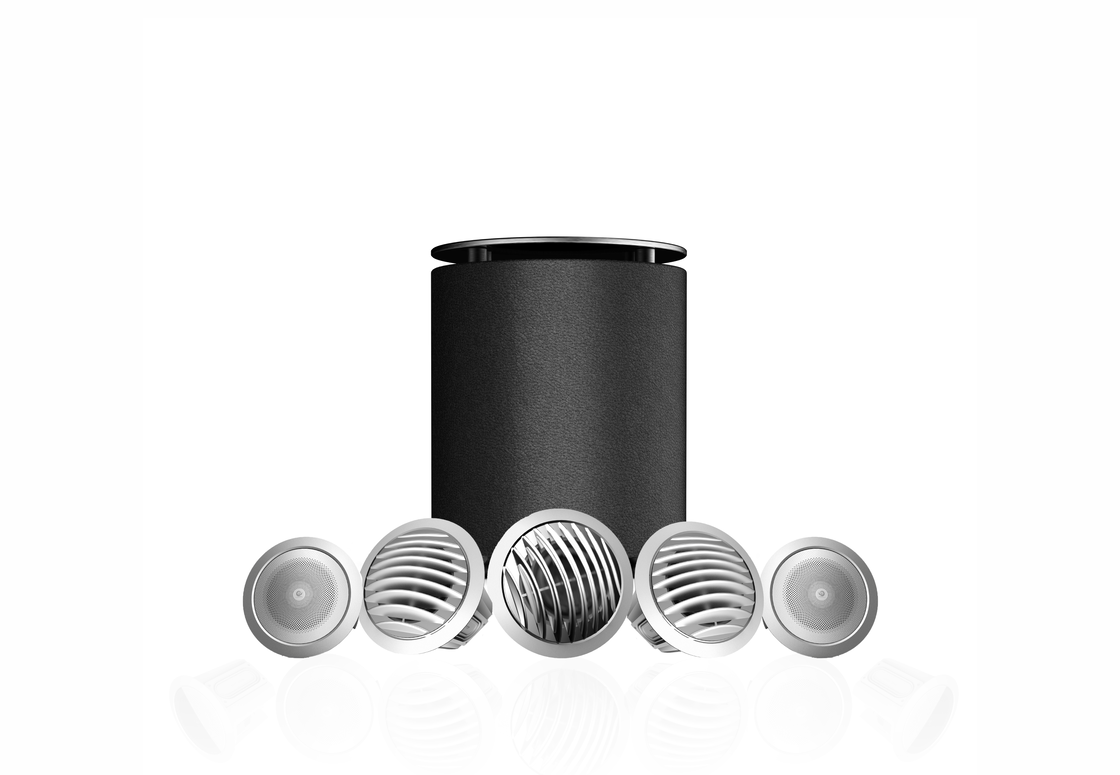
Mini ×5 + B28: five Ø91 mm in-ceiling speakers and one Φ274 mm sealed subwoofer
What a living-room 5.1 system can finally become does not depend on a designer's preference. It depends on three numbers: how large a hole you may cut in the ceiling, how low the bass can reach in hertz, and how much power the amplifier can deliver.
Once those three are fixed, the rest is largely derivation. Conversely, any proposal that does not state all three has not yet reached the engineering stage.
The conclusion first: an 8 cm cut-out, 30 Hz extension, 5 × 100 W. The three numbers constrain one another — the smaller the hole, the harder it is for the driver to produce low frequencies; the more bass you hand to the subwoofer, the larger the subwoofer must be. This system is one solution found among those three lines, not the optimum — it is the solution that fits under an 8 cm ceiling.
01 The first number: 8 cm
The hardest specification in architectural audio is not frequency response — it is cut-out diameter and mounting depth. That decides whether this can happen in this particular home at all.
| Model | Type | Driver | Cut-out | Mounting depth |
|---|---|---|---|---|
| Monitor CP-CT380 | In-ceiling | 8 in + 1 in | 274 mm | 181 mm |
| DALI PHANTOM M-375 | In-wall | 7 in + ribbon | — (rectangular) | 100 mm |
| Snail Mini | In-ceiling | 2.5 in coaxial | 80 mm | 80 mm |
Put the three rows side by side and the conclusion needs no explanation: all three are called "architectural", but the others start at 18 cm and 10 cm, and this one starts at 8 cm.
The price is clear as well — the driver shrinks from 8 inches to 2.5 inches. Low-frequency energy and sensitivity both have to give something up. The 8-inch class is more at ease in a villa or a large flat; a 2.5-inch driver cannot produce that volume of air.
But when the ceiling is only 8–9 cm, the first two rows are simply not an option. This is a trade-off, not a victory.
A small cut-out brings a second benefit: invisibility. Five boxes occupy only five 8 cm holes in the ceiling, with a Ø91 mm bezel and 0.4 kg each — after installation they look about like a downlight.
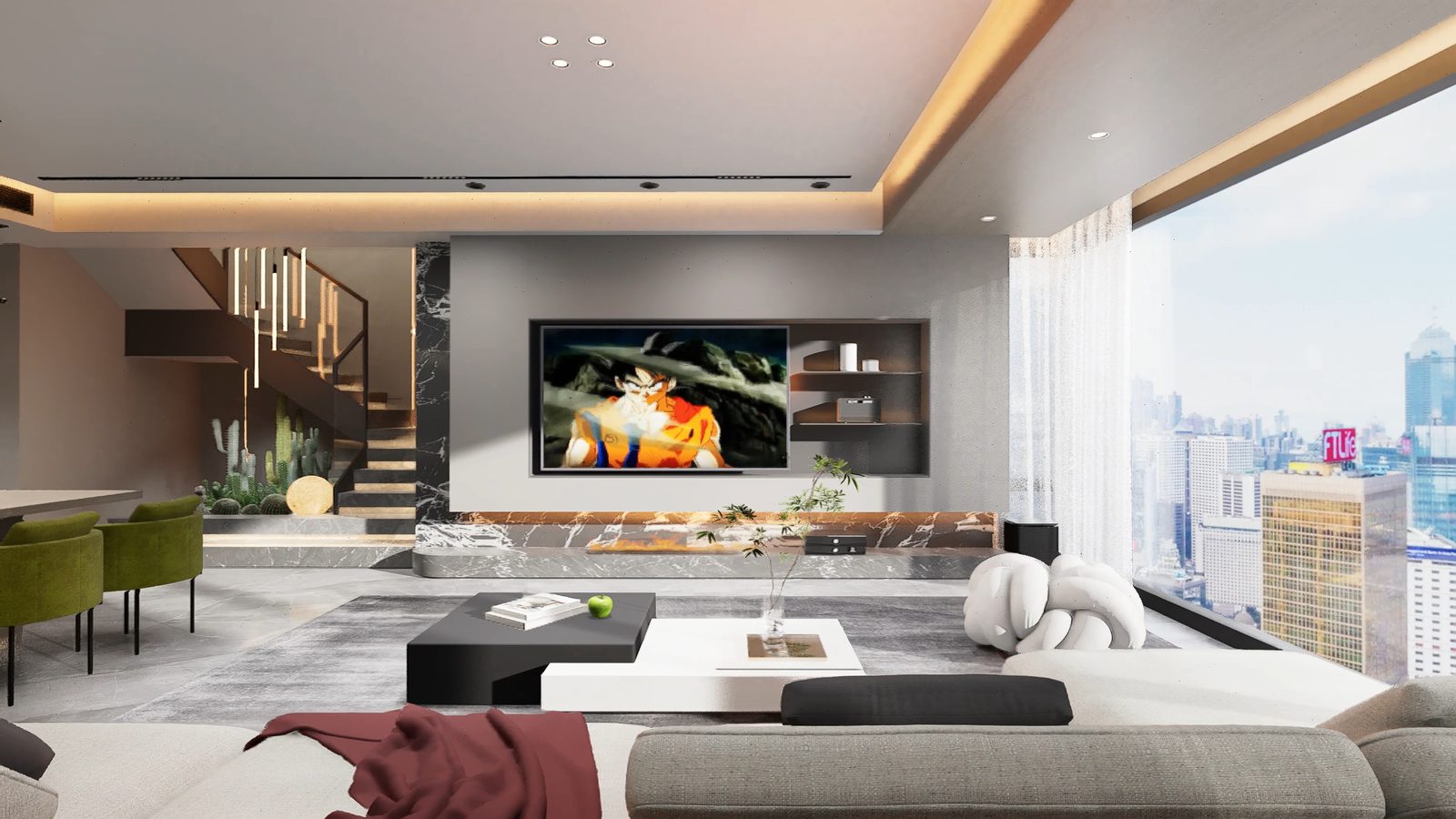
Mini: a Ø91 mm bezel, with both cut-out and depth at 8 cm
And the essence of invisibility is not making the box smaller — it is moving the box out of the "room" layer. With a floor-standing 5.1 you add five pieces of furniture, five runs of cable and five stands to walk around; move them into the ceiling and the floor and walls are given back to daily life, with only the subwoofer left standing.
This path is not new either: the IW3 of 2018 already made a cinema speaker the size of a downlight, and everything now sold as "downlight cinema" traces back to it.
02 The second number: 30 Hz
Below 50 Hz is another matter entirely, and the main speakers cannot handle it. So the low end must be outsourced.
Architectural speakers are not responsible for low bass — that is an industry-wide consensus. In one third-party review of the DALI M-375, the only entry under "cons" was a single line: better used with a subwoofer.
The B28 covers 30–200 Hz (±3 dB): one 8-inch active driver plus one 8-inch passive radiator, sealed enclosure, 400 W rated and 500 W peak, 6 Ω.
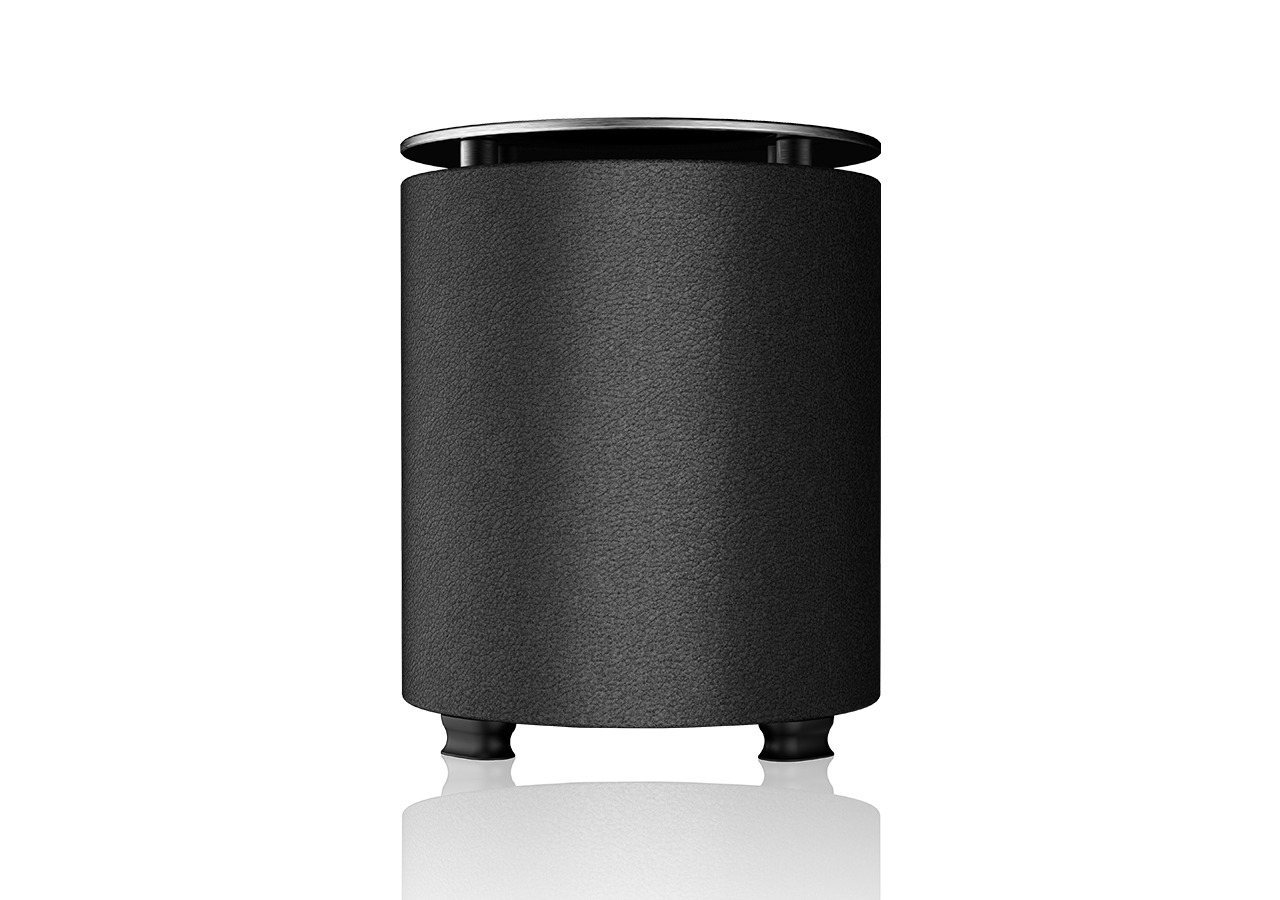
B28: an 8-inch active driver plus an 8-inch passive radiator in a sealed enclosure
"Dual 8-inch" does not mean two active drivers — one produces sound, the other radiates. A sealed box needs no port, which avoids airflow noise and preserves the 30 Hz extension.
Why not go to 20 Hz? To push a sealed box down to 20 Hz you must either build it too large for a living room or drop the sensitivity until the amplifier cannot drive it. 30 Hz is a trade-off: extension, size and efficiency — you may pick two. A dedicated cinema room chasing 20–25 Hz would use a 13.5-inch subwoofer rather than wringing an 8-inch to death.
While we are on it, the crossover: set it around 100 Hz and hand everything below 100 Hz to the subwoofer. The main speakers no longer struggle with bass and only handle the range above 50 Hz — that is why the sound feels "relaxed", not some mystery.
When this system is the wrong purchase: the sofa must sit flat against the centre of the wall and the room is under 15 m², so there is no side or rear position — a soundbar is the better fit; you rent and will not open walls or ceilings this time, so cable cannot be run; the seating is not fixed and the household is large, in which case the single sweet spot of 5.1 makes a soundbar's virtual field the more forgiving choice. If two or more of these apply, do not consider 5.1.
03 The third number: 5 × 100 W
The Mini's foundation: a 2.5-inch two-way coaxial driver, 50 Hz–20 kHz, 86 dB sensitivity, 111 dB SPL, 20–160 W handling.
111 dB is unremarkable on an 8-inch box; it is remarkable on a Ø91 mm bezel. The approach is not to enlarge the driver but to make the sound "turn a corner" — to deliver energy to the sofa instead of scattering it in all directions.
It is driven by the AV-700 III: 5+2 channels, 5 × 100 W + 2 × 80 W, 20 Hz–20 kHz (0 to −2 dB), SNR ≥ 93 dB.
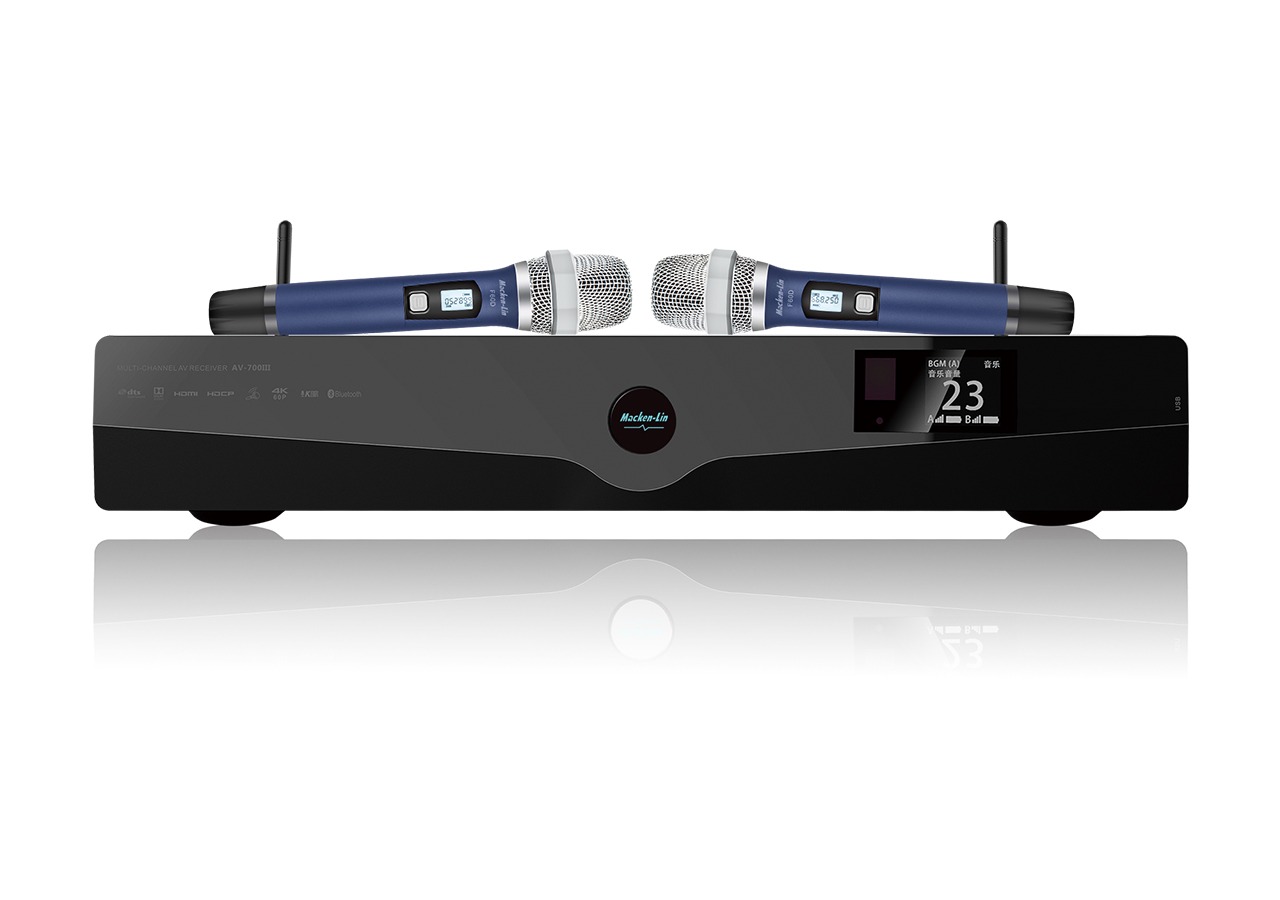
AV-700 III: 5+2 channels, 5 × 100 W + 2 × 80 W, 68 mm chassis height
100 W sits in the middle of the Mini's 20–160 W window: enough to drive it, not enough to blow it. Power is not about playing louder; it is about not sagging on large dynamics — when explosions, drums and full strings arrive together, insufficient headroom makes the sound collapse first.
The licensing deserves a separate note: it is not the four words "decoder supported". Dolby and DTS each issued written approval, and the originals can be opened on the website.

Dolby and DTS certification: approval letters are published on the Honors & Certifications page (AV-700III / AV-900II)
There is one more layer on the low end: an 8-inch driver rated at 400 W and peaking at 500 W while still holding 30 Hz relies on peak management, not on stacking more amplifier power. A subwoofer that cannot control its power falls apart the moment it gets loud; one that can lets a small driver compete with a large system.
04 Four layers: no ceiling rattle, no floor transmission
This section answers the question most people ask last but which actually decides whether they install at all: will the neighbours upstairs hear it?
This system does the same thing on four levels — it keeps the sound inside the listening area:
| Layer | Technology | What it does |
|---|---|---|
| 1 Aiming | Waveguide (patented) | Sends energy into the listening area instead of everywhere |
| 2 Mid-bass | Full-range + passive radiator | Lower internal pressure, so the ceiling does not vibrate |
| 3 Sub-bass | Passive radiator | No port in a sealed box; bass stays concentrated |
| 4 Footing | Absorbing feet / decoupling | The box does not move; bass does not travel through the floor |
The waveguide aims energy at the sofa rather than spreading it; a sealed enclosure with a passive radiator replaces the port, so the box does not "breathe" and the ceiling does not shake with it; the base decouples the cabinet so low-frequency force does not go into the floor.
The goal: full sound where you sit, empty upstairs.
But to be honest: if the neighbours downstream are very sensitive, a decoupling mat or a floating floor will do more than changing speakers — that is the building's job; the speaker can only do its half.
05 Four siblings: Mini is actually deeper than IW3max
Four models share this generation. The difference is not audio grade but whether it can be installed at all:
| Model | Bezel / cut-out / depth | Positioning |
|---|---|---|
| Mini | Ø91 / 8 cm / 8 cm | Smallest bezel, 0.4 kg each; the most uniform look with many holes |
| IW3max | Ø100 / 8.5 cm / 7 cm | Shallower; the choice when the ceiling is thinner |
| U3 | 270×112×78 mm (on-wall) | No ceiling work; wall only |
| CW90 | Ø105 / Ø90 / 100 mm high (wireless) | Ceiling already closed; no more cabling |
The counter-intuitive part: the Mini is 8 cm deep while the IW3max needs only 7 cm. So the thinner the ceiling, the less you should choose the Mini — with 7–7.5 cm of clear space, only the IW3max fits.
The Mini's real advantage is the bezel: Ø91 mm against Ø100 mm, and an 8 cm cut-out against 8.5 cm. Five holes in the same ceiling look measurably different from below.
The order should be: ceiling clearance first, room area second, budget last. Choose in reverse order and you will most likely redo the work.
There is one more easily missed point on budget: two systems both called "5.1" can differ by half the price. What differs is not the number of speakers but the subwoofer size and amplifier power — those two set the floor of the system. Normalise the configuration before comparing prices, or you are comparing two different things.
06 Cinema, karaoke and ecosystem: one set covers three jobs
Watching films and singing normally need two systems: a cinema and a KTV set. An integrated cinema/karaoke system merges them.
The package includes two F60D wireless microphones and the amplifier handles karaoke processing itself; the player ships with a high-definition song library and one year of Quanmin K Song authorisation, so there is no separate song machine to buy.
Content is covered too: the preinstalled Yingniuniu app plays an online cinema directly, and also handles third-party Dolby sources and 4K Blu-ray; with a NAS at home you can build your own library. Music comes from QQ Music, and phone casting works as well.
In one sentence: one set of equipment catches "what to watch, what to sing and what to listen to" — the living room no longer needs a song machine, two microphones and a cable running to the television.
The next layer is the smart home. This system is integrated with Mijia: paired with Snail's 8K player, no third-party control hub is needed — search for "SNAIL POWER 8K Audio-Video Playback Amplifier" in the Mijia app and add it.
Say "Xiao Ai, I want to watch a film" and the screen, lighting, amplifier and source enter the scene together; you sit down and pick a title. The interfaces are sufficient as well — RJ45 for TCP/IP and RS232/485 for serial, so connecting a control system or a dedicated room processor needs no adapter box.
07 How to check after installation
F1: The Movie — a car sweeps past from the left. Listen for whether the image of the main speakers slides continuously rather than jumping from the left box to the right.
Alien: Romulus — the scraping in the ventilation duct should creep up from behind you. Listen to the surround localisation, and whether it only comes from the television.
Wicked — vocals and orchestra arrive together; listen to the centre channel and whether the dialogue stays intelligible.
Three checks: whether the bezel sits flush with the ceiling; whether pressing the bezel shows any movement; whether the wall hums at high volume. If something is wrong, the cabinet is most likely not fixed properly.
Frequently asked questions
Q The ceiling is only 8 cm — can it really be installed?
Yes, but 8 cm is only the threshold. The Mini needs an 8 cm cut-out and 8 cm of depth; in practice leave another 1 cm and avoid the steel studs. Below 7.5 cm do not force it — switch to the IW3max.
Q How do I choose between the Mini and the IW3max?
Measure the ceiling first. Around 7 cm, choose the IW3max (7 cm deep); above 8 cm both fit, and pick the Mini if you want the smaller, lighter bezel. Above 30 m² the IW3max is preferable as well.
Q Will the bass reach the floor below?
Some of it will, but it can be reduced. The sealed box, the passive radiator and the base structure keep most of the energy in the room; what is left travels through the floor slab, and no speaker escapes that. If the neighbours are very sensitive, use a decoupling mat or a floating floor first.
Q Can a soundbar plus a subwoofer replace 5.1?
It can add low frequency, but it cannot add position. After adding a subwoofer the extension and impact improve noticeably, but the rear surround localisation is still virtual.
Q Can it be added after the renovation is finished?
Yes, but it depends on the cabling. An 8 cm cut-out means little wall repair; the difficult part is the speaker cable, and adding cable in a closed ceiling costs far more than cutting the hole. If you do not want to open the ceiling, look at wireless options such as the CW90.
Closing
Say the three numbers once more: an 8 cm hole, 30 Hz extension, 5 × 100 W of drive.
Behind those three numbers is a series of concessions — the driver drops from 8 inches to 2.5 inches, the low end is outsourced to an 8-inch subwoofer, and the mid-bass is supported by a passive radiator and delivered to the sofa by a waveguide. None of it comes for free.
What it buys is one thing: the ceiling is still a ceiling, the floor is still a floor, and only one 274 mm cube remains on the ground.
8 cm, 30 Hz, 5 × 100 W — the three numbers of this 5.1 system are all hidden in the ceiling.
If your home is still at the wiring or ceiling stage, measure the room dimensions, the ceiling clearance and the sofa position first, then draw a layout plan. Much of the rework can actually be avoided before the boards go up.
END
#HomeTheatre #5.1Surround #ArchitecturalSpeakers #DolbyAtmos #SnailPower
Written by Digital Xiaoniu, first published in the Featured Projects section of New Zeyu Audio Group.