Home / News / Experience Reports / A 7 cm Ceiling: How Can It Carry Dolby 7.1?
A 7 cm Ceiling: How Can It Carry Dolby 7.1?
2026-11-01 · Experience Reports
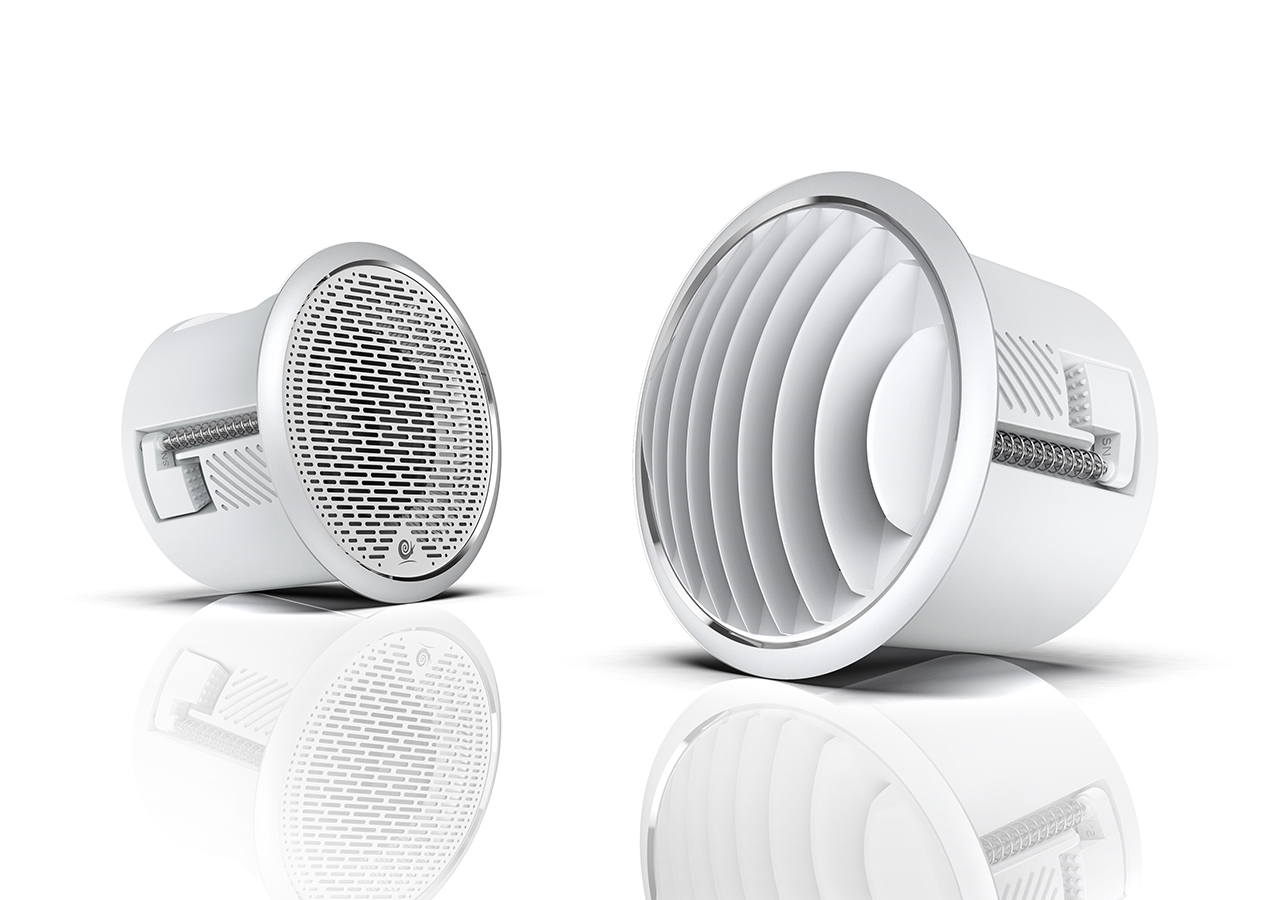
01 How the 7 cm figure is worked out
Let us do the arithmetic first.
7 cm is 70 mm. IW3max requires more than 70 mm; the enclosure is 66.5 mm, which leaves only about 3.5 mm for decoupling, wiring and building tolerance. A ceiling joist, a plasterboard layer or a skim of filler can easily eat a few millimetres, and the enclosure can end up pressed against something.
So 7 cm is the threshold at which it can be installed, not a comfortable dimension. In practice we recommend at least 80 mm; if only 7 cm is available, work out the joist positions, the fixing method and the wiring space before the ceiling is closed up.
02 Does a 66.5 mm enclosure compromise the sound?
Thin does not mean compromised.
The foundations of IW3max: a single 2.5-inch two-way coaxial driver, frequency response 50 Hz–20 kHz, sensitivity 88 dB, SPL 110 dB, power handling 20–180 W, impedance 8 Ω, fully sealed all-aluminium enclosure.
20–180 W of power handling is high for a 2.5-inch driver, and 110 dB leaves headroom in a living room.
Getting high SPL from a small diameter is not about making the driver bigger. It comes down to three things:
1. Passive radiator: a passive radiator reinforces the low end and avoids the bass collapse typical of small enclosures.
2. Short-circuit ring: it suppresses the rise of voice-coil inductance with frequency, lowering distortion at high current.
3. Variable waveguide: energy is directed at the listening area instead of being dissipated in all directions.
The coaxial layout makes the tweeter and the mid-bass radiate from a single point, so imaging is more precise; SNAIL's variable waveguide lets the sound "turn a corner", so even with the speaker hidden in the ceiling it still covers the sofa.
Physical limits have to be acknowledged: a 2.5-inch driver is not asked to produce deep bass below 40 Hz — that is the subwoofer's job. A thin main speaker and a separate subwoofer is the division of labour in this system.
03 What to watch out for when building into a 7 cm ceiling
Three things: joists, fixing and cabling.
Joists: the light-gauge steel framing and metal parts in the ceiling must be kept clear of the enclosure. If the enclosure touches a joist, vibration travels into the structure — at best resonance, at worst damage to the amplifier or the speaker. The manufacturer's installation instructions are explicit: the cut-out must avoid light-gauge steel framing or metal objects.
Fixing: in a 7 cm void the enclosure must be fixed to the joists or to independent hangers — it must not rely on the plasterboard for support. Plasterboard cannot carry the weight and vibration of the enclosure; over time the baffle loosens and the sound smears.
Cabling: 7.1 needs seven speaker cables running from each position back to the equipment location, one subwoofer signal cable, two HDMI cables plus one data cable from the TV wall, and a wired network point plus at least two power sockets at the equipment location. Keep speaker cable and mains cable in separate conduits.
Once these cables are sealed into the ceiling, adding one more later is very hard. So "invisible" is half product and half preparation.
04 What drives a Dolby 7.1 system from 7 cm enclosures
The speaker sets the ceiling of the sound; the amplifier determines whether that ceiling can be reached.
This 7.1 system uses the AV-900 II: a high-power cinema/karaoke integrated amplifier with 7+2 channels — 100 W on each of the seven main channels, plus two optional 80 W wireless channels. It carries licensed Dolby/DTS decoding and handles both Dolby Atmos and DTS:X.
The point of 100 W × 7 is not to play louder; it is to keep seven IW3max units from sagging during big dynamic passages. When explosions, drum hits and full string tuttis arrive together, an amplifier without enough reserve collapses first.
For larger rooms or more headroom, the AV-1800 offers 7 channels at 150 W into 8 Ω and 250 W into 4 Ω, and is certified for Dolby Atmos and DTS:X.
Dolby and DTS are two different immersive formats: whether a soundtrack is flagged Atmos or DTS:X, the amplifier has to decode the corresponding one. The AV-900 II handles both, so the choice of source material is not a constraint.
05 5.1 and 7.1: how the positions divide up
Start with the channel count: 5.1 is six units, 7.1 is eight. The two extra are a side surround on each side of the sofa and a rear surround behind it. The difference between Dolby 7.1 and 5.1 is not "louder" — it is the continuity of sideways movement: when a car drives past or a figure crosses the screen, the sound slides continuously instead of jumping.
With IW3max, a 7.1 system would be: three IW3max LCR for the main channels, four IW3max surrounds for side and rear, plus one S10D subwoofer. The S10D measures 295×295 mm and stands 405 mm high; it can go beside the TV wall or next to the sofa.
For 5.1, five IW3max with a B28 or C110 subwoofer. Fewer channels means easier positioning, and suits a living room that is not large but still wants surround.
06 Three film scenes to sign the system off
Do not just play one song after installation. Pick three films you know well and listen for the side, the rear and the centre separately.
F1: The Movie — find a shot where a car sweeps from left to right. Listen to the side surrounds: does the sound slide continuously, or jump straight from front-left to rear-left?
Alien: Romulus — the metal scraping in the ventilation ducts should creep up from behind you. Listen to the rear surrounds for localisation and detail: is it all coming from the TV?
Wicked — when the vocal and the orchestra arrive together, listen to the centre: are the lines still clear, or does the music swamp the dialogue?
Once all three are done, check the baffles: are they flush with the surface, are they loose when pressed, do they resonate at high volume? Any problem is usually an enclosure that was not fixed properly, or a cavity that was not treated.
Frequently asked questions
Q: Can a 7 cm ceiling really take these speakers?
Yes, but 7 cm is only the limit. The IW3max enclosure is 66.5 mm and requires more than 70 mm of depth; in practice we recommend at least 80 mm to leave room for decoupling, wiring and tolerance. Site survey and the installation drawing take precedence.
Q: Is a 2.5-inch driver enough for the low end?
It does not chase deep bass below 40 Hz. Its job is to render the 50 Hz–20 kHz main channels accurately; the low end is handed to the S10D or C110. A clear division of labour beats forcing a small enclosure to carry deep bass.
Q: Do Dolby and DTS need special source material?
Yes. The amplifier decodes, but the source decides whether there is a Dolby/DTS signal at all: the Atmos badge on a streaming service, the DTS:X track on a Blu-ray. Plain stereo carries no Atmos object information; the amplifier can upmix it but it will not become true immersive sound.
Q: Can this be added after the room is finished?
Yes, but the cabling conditions decide. IW3max needs only a Ø85 mm cut-out, so the patching is small; the real difficulty is the speaker cable — in a sealed ceiling, adding cable usually costs more than cutting the hole.
After the film, the living room is still a living room
The visible change after a 7.1 installation is not "louder sound" — it is that the living room is still the living room: no floorstanding speakers, no stands, no wall taken over.
Seven IW3max hide in the ceiling; only one S10D stands beside the TV wall. Watching a film, the sound comes from all around; with the lights off, the living room is a cinema.
SNAIL POWER was founded in 1995 by audio designer Steven in Milan, Italy. Steven previously worked at dB Technologies and Sonus Faber — one the benchmark for professional sound reinforcement, the other for domestic high fidelity.
SNAIL's product logic has always been "small body, big energy": IW3max takes the 66.5 mm main enclosure to 7.1, AV-900 II delivers the dynamics with 100 W × 7, and S10D supplies the low end. Each part does its own job, and that is how a living room becomes "the sound without the sight".
A 7 cm ceiling, seven IW3max, 100 W × 7 — SNAIL fitted a Dolby 7.1 system into a living room.
If your room is at the water-and-electric or ceiling stage, send us the room dimensions, ceiling height and sofa position and let the technical team prepare a layout drawing first. Many reworks can be avoided before the ceiling is closed up.
Website: nzy-audio.com
Enquiries: 400-8766-598