Home / News / Product News / Subwoofer Placement: Floor, Stand or Corner — What It Costs
Subwoofer Placement: Floor, Stand or Corner — What It Costs
2026-11-10 · Product News
Subwoofer placement means that moving the same sub to a different spot gives you a different answer from the room at low frequencies: across 40–80Hz, floor, stand, and corner can vary by more than 10dB. Below, using the six subs currently on sale, we lay out the gains and the costs of each position.
Key points
- A sub on the floor picks up roughly 6dB of low frequency from half-space coupling; lifting it 40cm has almost no effect at 40Hz, because the wavelength is simply what it is.
- A corner stacks three boundaries, so the gain is high; the cost is that peaks at 40–60Hz get pushed even harder.
- One meter from the wall, the cancellation null drops to 86Hz, digging a hole right in the sub's working band.
- A phone only understands relative level; below 60Hz, don't trust absolute readings.
- Six subs, each suited to different positions: a placement mistake is harder to rescue than the wrong model.
Floor or Stand: Do the Coupling Math First, Then Talk About Looks
The floor is a rigid boundary. Set the sub on the floor and its radiation is squeezed into half-space, theoretically 6dB more than in free field, and that gain covers the whole low-frequency band. Put the same sub on the floor and then on a stand, and what changes first is output, not extension.
Floor reflection is a separate matter. With the driver center h above the floor, the path difference between the reflected and the direct sound is about 2h, and the first cancellation null lands at 343 ÷ (4h). On the floor, h is about 0.15m, giving a null around 570Hz; on a stand at 0.4m, it drops to 214Hz. Both numbers sit above the 80–120Hz crossover point, in the band the sub doesn't handle.
The conclusion is counterintuitive: at 40Hz the wavelength is 8.6m, so a stand that lifts the sub 0.4m is, for that band, no lift at all. Expecting a stand to fix the boom is a mistake — the boom is a room mode.
Where a stand actually helps is elsewhere. First, 150–600Hz loses the comb filtering from floor reflection, so the sound is cleaner; second, the cabinet no longer sits directly on the floor, adding a layer of isolation on the path vibration takes into the slab. When the downstairs neighbor knocks after a living-room theater install, this is usually the reason.
The cost: the output you lose by lifting has to be made up with level, and overdoing it eats headroom; the stand has to be rigid, or hardware resonance becomes new coloration. On the floor is simpler, but cabinet vibration goes straight into the slab.
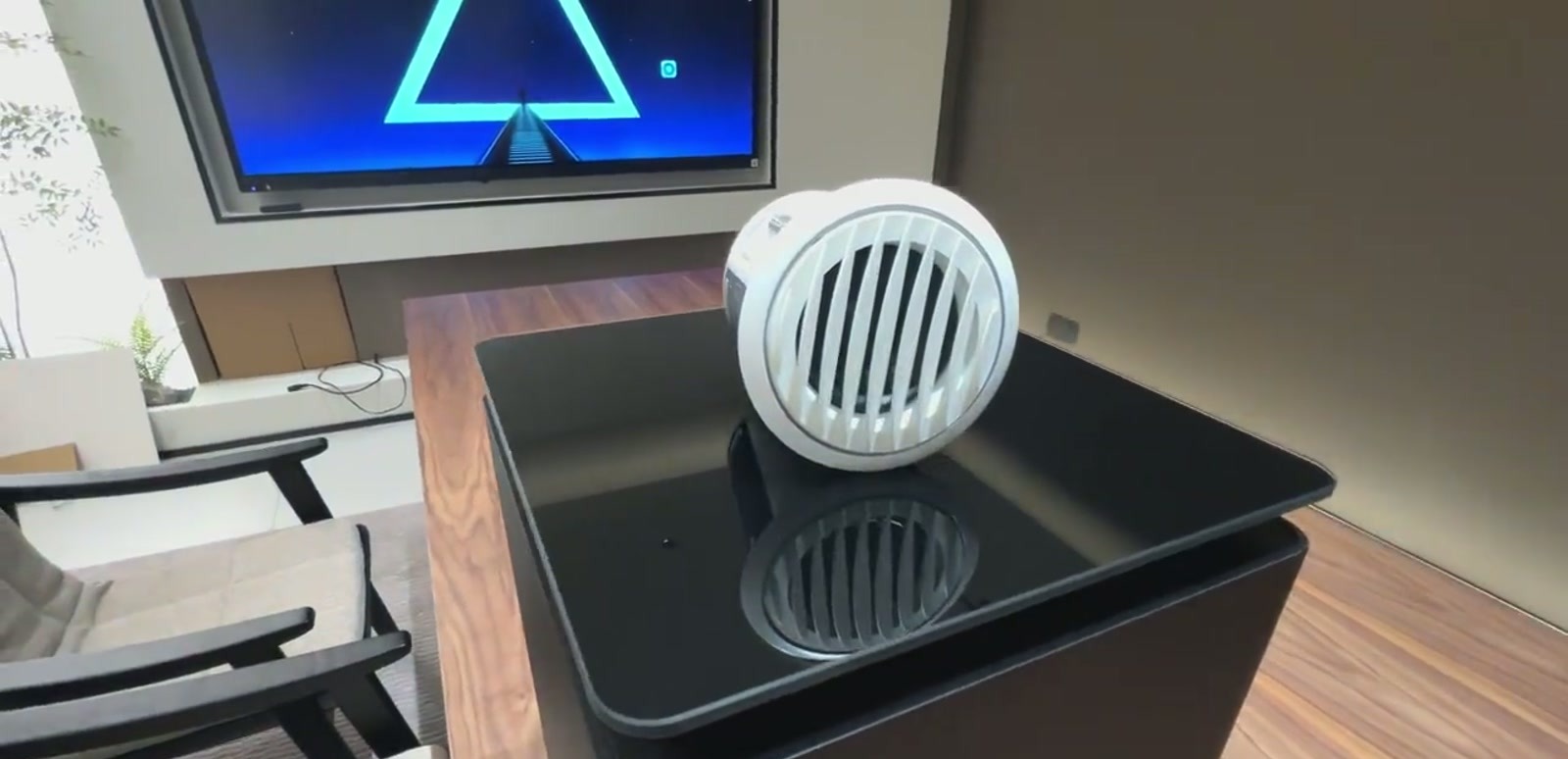
Corner, Mid-Wall, and Distance From the Wall
Boundary gain is counted by the number of surfaces: one wall plus the floor is quarter-space, theoretically +12dB; a corner is eighth-space, +18dB; the middle of the front wall only gets the floor, +6dB. That is the geometry's accounting; room modes rewrite the actual figures, but not the direction.
The problem with a corner isn't too little output, it's that the corner stacks on top of the axial mode peaks. In a living room 5.4m long, 4.2m wide, and 2.7m high, the axial modes fall at 31.8Hz, 40.8Hz, and 63.5Hz. Stuff the sub into the corner and those points between 40 and 60Hz get pushed even higher: it sounds full, then goes hollow at another seat.
Distance from the wall is calculated on its own, and the null is still 343 ÷ (4d).
| Distance from wall | First cancellation null | Effect on the sub |
|---|---|---|
| 0.3m | 286Hz | Above the crossover point, limited effect |
| 0.5m | 172Hz | Just past the crossover, on the edge |
| 1.0m | 86Hz | Right in the working band, digs a hole |
| 1.5m | 57Hz | A chunk collapses in the lower bass |
Cabinet type enters the picture too. The C110 is ported, and the port needs to breathe, so leave 30–40cm from the wall; stuff it into a cabinet or hard against a corner and the output remains but the layering is gone. The B28 and S10D are sealed, less fussy about wall distance, but just as sensitive to corner gain.
The cost: move the sub from a corner to mid-wall and you lose 6dB or more of output. At first it sounds "worse", but it is actually flatter, and that drop has to be made up with the receiver's level control.
Beside the Sofa or Straight Ahead
Straight ahead means the middle of the front wall, the area under the screen. The sub shares a vertical plane with the three main speakers, so low-frequency phase is easy to align; the downside is that this spot is usually the TV cabinet, and putting the sub in there is like locking the port.
Beside the sofa is a near-field approach. Output and physical impact are immediate because the distance is short; the cost is that it only serves one side. On a 3m-wide sofa, the two ears can sit more than 1m apart in distance to the sub — at 80Hz that is most of a cycle, and one side gets noticeably more than the other.
The back-wall area gains from wall loading and a close seat, but it booms locally, so it is worse than the first two.
In home theater design, the sub position is often left to the end: sofa, TV, and cabinets are fixed first, then the sub goes into whatever corner is still empty. The order should be reversed — plot the sub position and the seating position together.
The cost: placed beside the sofa, cabinet vibration goes straight into the sofa frame, mixing structural noise into the physical impact; it sounds "punchy", but it's the sofa making the noise. Cable routing, cleaning, kids kicking it — those troubles only exist on this side.
Phone Plus Test Tones: Judge It Yourself in Three Steps
The tools are simple: a 20–200Hz sweep, or third-octave pink noise, plus a spectrum analyzer app on your phone, to first see the peaks and dips of your own room.
Step one, look at the current state. Leave the sub where it is, sit in the main seat, run a sweep, and note which points in 40–80Hz are high and which collapse. Phone microphones are generally inaccurate below 60Hz, so read relative level only, never absolute values.
Step two, change position. Move the sub 30–50cm left or right, or forward or back, sweep the same band again, and compare whether the peaks and dips moved. The room hasn't changed; the excitation point has.
Step three, match phase. Once the position is set, switch the phase on the home theater receiver between 0 and 180 once, measure both times, and pick the setting that is flatter from 60–100Hz; try the crossover point at 80, 100, and 120Hz to see which blends best with the main speakers.
The cost: a phone measuring bass can only show trends, not a ±1dB difference. The three-step method rules out "clearly wrong", not "off by 3dB"; for accurate numbers you need a measurement microphone.
Which Position Suits Each of the Six Subs
Put the six subs on sale into one table, and the placement column is worth more of your attention than the power column.
| Model | Driver | Power | Rated low limit | Cabinet and dimensions | Placement notes |
|---|---|---|---|---|---|
| B28 | Dual 8-inch (1 active + 1 passive radiator) | 400W (500W short-term) | 30Hz | Sealed, Φ274×335mm | Not fussy about wall distance, stays controlled even against the wall |
| C110 | 10-inch | 500W | 25Hz | Ported, 350×420×345mm | 30–40cm from the wall, don't box it in |
| S10D | Dual 10-inch | 1000W | — | Sealed, 295×295×405mm | Narrow cabinet, easy to place on the floor or a stand |
| 13.5-inch driver; cabinet dimensions on the official spec page | Dedicated theater room, leave clearance on all sides | ||||
| W10 | 10-inch | 500W Class D | 25Hz (±3dB) | 5.8G wireless, 114dB | Beside the sofa, saves a signal cable |
| P10 | Dual 10-inch | 1000W Class D | 25Hz | 5.8G wireless, four DSP modes | Larger living room, likewise cable-free |
Figures the official pages don't give are left blank in the table — we don't make them up.
Read the table by position: if you can leave a gap from the wall, the C110's ported advantage can show; if the sub can only go against the wall or beside a cabinet, the B28 and S10D are steadier. Large spaces call for the S10D and X135, while around 20㎡ the B28 is enough.
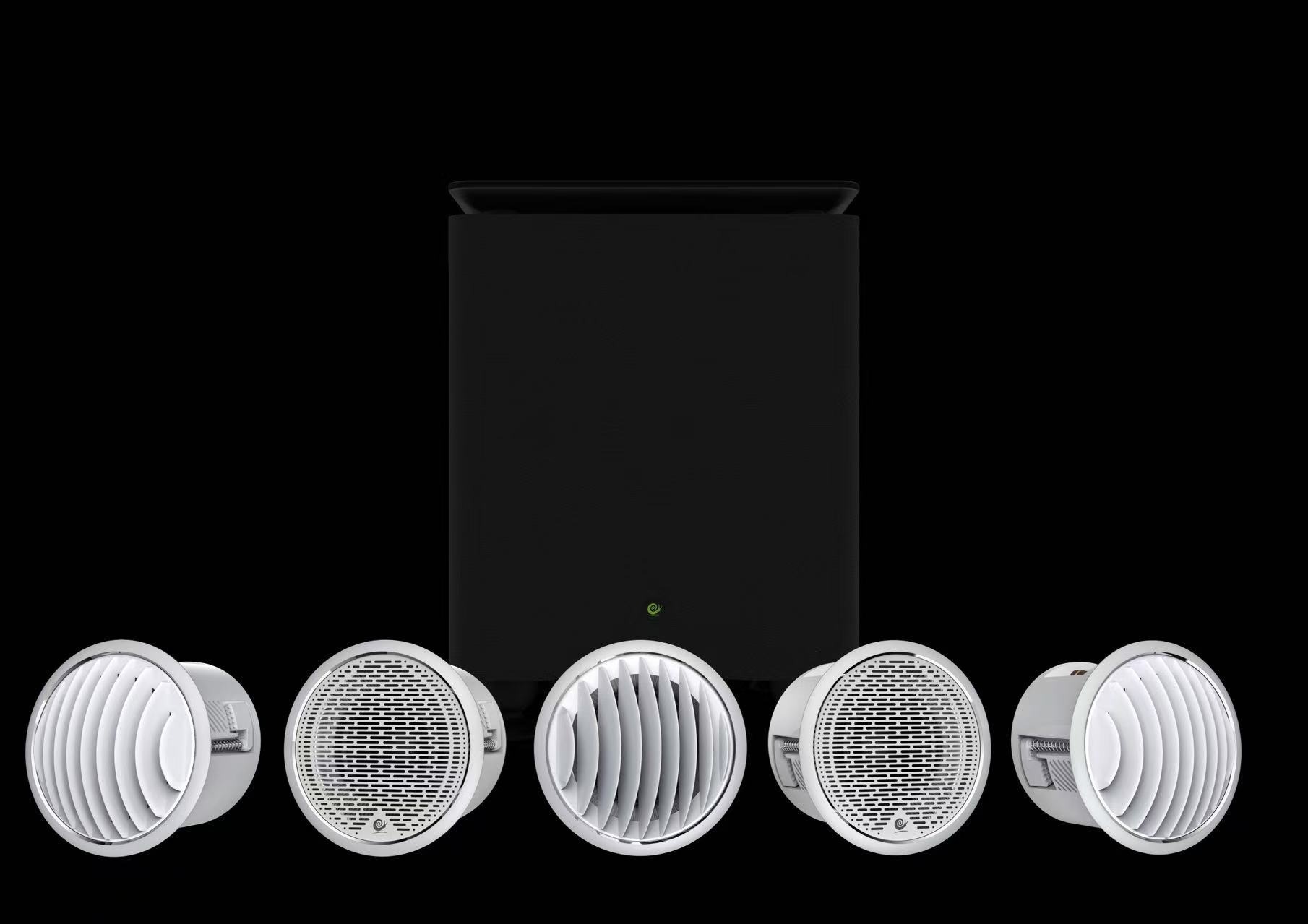
The W10 and P10 are another line. The CW90 5.1 wireless karaoke-theater set is ¥17,200 all in, from ¥17,200 for the entry level: the CW90 takes a Ø90mm cutout, Ø105×100mm faceplate, 90W per unit, 111dB, five units in the ceiling; the sub is the W10 on its own 5.8G channel, so no sub cable has to be run from the receiver, and the P10 is the dual 10-inch 1000W step up. This is what wireless means for placement: the positions that sound good — beside the sofa, midway along the side wall — often have no signal cable. Dolby Atmos and DTS:X certification in progress; until the paperwork comes through, we say in progress only.
Who shouldn't buy: if the room is under 20㎡ and you aren't treating the bass, the S10D and X135 are overkill; a B28 plus one careful placement is the better deal.
The cost: wireless saves the signal cable, not the power cable. The sub still has to be plugged in, and the transmitter needs a spot too; when there is no outlet beside the sofa, it still can't go there.
The Cost of a Good Position, and Who Shouldn't Bother
The positions that sound good often don't look good. A quarter of the room length, the middle of the side wall — these flatten the bass, but they are exactly where the walkway, the floor lamp, and the plants go.
A good position doesn't necessarily have power either. Mid-room and beside the sofa, outlets are rarely left during renovation; running surface cable isn't realistic, and a wireless sub only solves the signal.
The room matters more than the sub position. Placement changes how the fixed modes are excited; it cannot change the modes themselves. In a 5.4m living room, that 31.8Hz peak won't disappear because the sub moved half a meter — it only moves from one seat to another.
Invisible theater speakers tuck all five units into the ceiling, leaving only the sub on the floor, so the sub position ends up more conspicuous than the speakers. Some people go the other way and choose a smaller sub just to keep the floor clean — that is an aesthetic trade-off, not an acoustic judgment.
Who shouldn't bother with placement: rooms that are nearly square, with length, width, and height falling into the degenerate range; rooms under 2.4m high with a full glass curtain wall; open kitchens connected straight to the living room, where the bass leaks away. In these rooms, moving the sub ten times is just changing position within the same hole. Treat the acoustics first — bass traps, a thick rug, enclosing the balcony, a floating floor — then come back to the sub position.
The cost: acoustic treatment means construction work, far more expensive than moving a sub, and not every living room allows it. The compromise: pick a position that isn't ugly, has power, and has enough output, then use the receiver's EQ to pull 40–60Hz down a notch.
If you remember only one line: sweep three times with your phone first and confirm where the room's peaks are; then see which of those positions avoids the peak and still leaves a way for the power cable. Placement doesn't solve the room, but it decides which version of the bass you hear.
END
#SubwooferPlacement #HomeTheaterBass #StandingWaves #CornerPlacement #PhoneBassMeasurement #InvisibleTheater #TheaterAndKaraokeInOne
Written by Digital Xiaoniu, first published on the SNAIL POWER official site, Product News.