1. Connecting the TV:
For the TV you should run an HDMI cable and at least two sets of audio/video cables (for connecting a DVD player, a set-top box and similar equipment), and you may also run a VGA cable in reserve for conveniently connecting an ordinary computer.
The simplest approach is to embed a PVC conduit 5 cm in diameter between the area below the TV and the TV cabinet; all the cables can pass through it, and since the distance is short it is very easy to pull cables out and add more.
2. Connecting the projector:
Projector prices fall year after year, and 1080P is already under ten thousand yuan; even a product costing around 5,000 yuan, as long as its contrast ratio reaches 3,000 or above, can give an impressive performance when used to build a home cinema. For watching movies, only a 16:9 big screen really satisfies. So readers who are interested would do well to run the projector cabling in advance; large-screen high-definition home cinema is the trend. Because HDMI cable is fairly thick and stiff, you must use a thicker PVC conduit to run it, and it is best to run more than two HDMI cables to the projector, because the connector of an HDMI cable can be damaged by repeated plugging and unplugging, and having to break open the wall then would cost more than it is worth; you can also run one component video cable and one VGA cable at the same time as spares, since equipment keeps being added and upgraded, and being prepared for every eventuality is best.
As for the wiring route, the cables can run from the TV cabinet out to the floor and then to the rear wall. Dedicated HDMI wall plates are sold on the market: run the cables through the conduit and connect both ends to the wall plate, then plug the player and the projector into the plate with short HDMI cables. However, connecting this way affects HDMI transmission quality to a greater or lesser degree, so it is not recommended.
3. Wiring the home cinema speaker cables.
Home cinema audio involves a good many cables, further divided into audio signal cables and speaker cables, so take care when wiring.
1. Audio cable: an audio cable carries the sound signal, and it still needs amplification by a circuit before sound comes out. In home wiring, the main thing to consider is the subwoofer's audio input: if the subwoofer has its own amplifier, then one low-frequency audio signal needs to be output from the 5-channel amplifier to the subwoofer. Most subwoofers are placed against the wall to the left or to the right of the TV cabinet, so embed one audio cable (coaxial) from the TV cabinet position to the left or to the right, with RCA terminal sockets fixed on the wall at both ends, so that it can be plugged and unplugged freely in use. Although a good subwoofer has no sense of direction, it is still slightly better to place it on the left if you can. Other audio and video cables either run to the TV through a PVC conduit, or connect directly to the amplifier and playback equipment, and since those cables are short there is no need to wire them in.
2. Speaker cable, commonly called speaker wire.
A home theater is generally divided into 7.1-channel and 5.1-channel setups. For an ordinary living room, or for a dedicated home cinema room smaller than 10 square meters, 5.1 is recommended; if a 7.1 layout is not positioned sensibly the sound becomes messier, the sound and picture drift apart, and the experience of watching a movie actually gets worse.
The .1 in 5.1 or 7.1 refers to the subwoofer. Its wiring method has already been explained above, so you only need to run 7 or 5 speaker cables. The front left and right speakers are placed 2 to 3.5 meters apart; if they are paired with a large-screen projection, the left-right spacing can also be extended to the two sides of the screen, again using connection sockets mounted on the wall with a conduit in between. The center channel speaker needs no wiring; simply connect it directly to the amplifier. Surround speakers go about 1.5 meters above the wall behind the sofa. As for their height and whether they are placed on the side walls or the rear wall, you can position them according to the actual situation without being too fussy, but they must be behind and above the ears. The now-emerging rear center surround speakers just need to be at the same height as the rear surrounds, positioned directly behind the listening position.
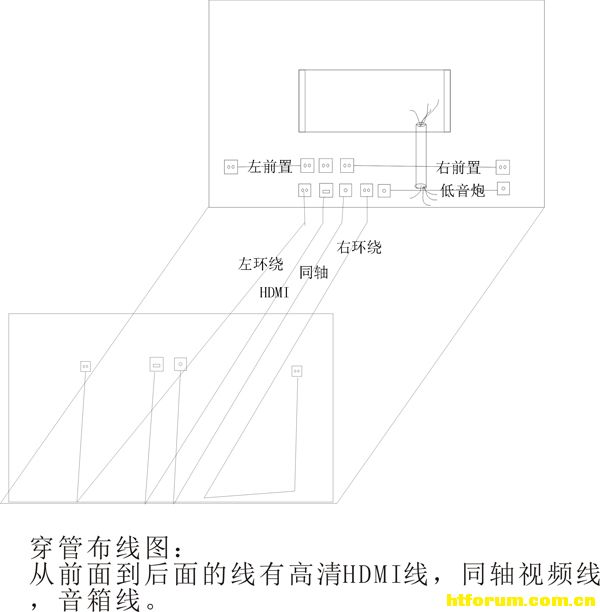
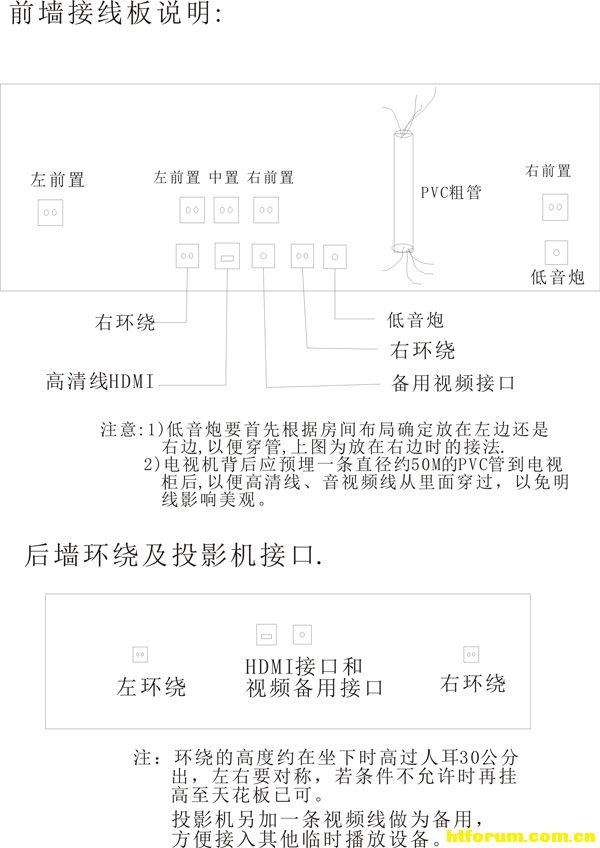
Reprinted from a home theater forum